

I did not get the result I wanted from my first serious mechanistic interpretability attempt. Probably the best thing that could have happened.
I started with an attractive idea: take sparse autoencoder features, connect them to a specific semantic target, intervene on the model through the decoded feature direction, and see whether the model’s behavior moves in the predicted way. The target was negation scope. The model was small. The tools were concrete: TransformerLens for model execution and hooks, SAELens for the pretrained SAE path, and a local artifact ledger so I could not quietly turn a smoke test into a mechanism claim. The source repo for this line of work lives under ml_research/self-ground in nshkrdotcom/learning.
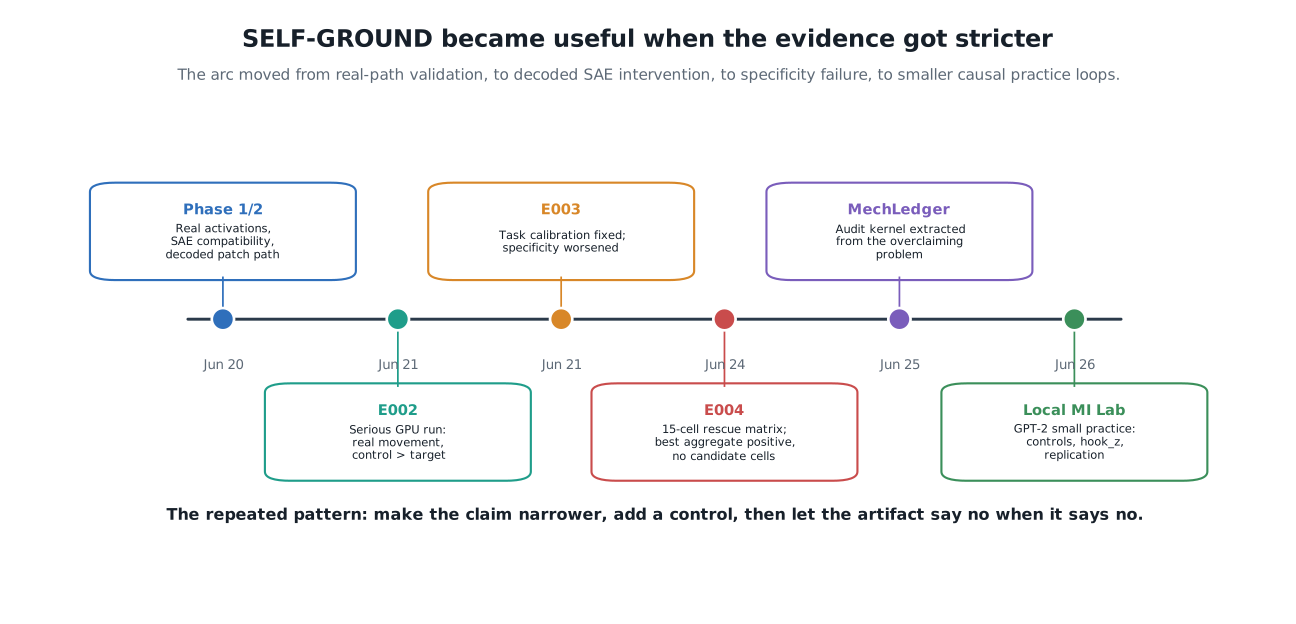
Getting the intervention to run only proved the path. Mechanism claims needed stricter evidence. A negative result can be cleaner, more useful, and more educational than a fragile positive one. The work got more useful as I made the evidence gates stricter: path validation first, specificity testing next, and then smaller causal practice loops when the original claim failed.
Why I Started With Negation
Negation is a tempting first target because it feels simple enough to test and meaningful enough to matter. “The movie is good” and “The movie isn’t good” create a clean intuitive contrast. If a model handles that distinction, maybe a feature set should respond differently to the negated and non-negated forms. Negation seemed like somewhere to test whether an SAE feature description has causal content rather than just an attractive label.
The temptation is the danger. Top activating examples make it easy to see a theme and start writing as if the model has handed you a concept. The rule I needed: avoid writing “this feature represents negation.” Write something more constrained, like “this feature set has evidence consistent with influencing negation-sensitive token contrasts under this model, hook, and SAE configuration.”
Pedantic, until the results arrive. Then it becomes the difference between doing research and writing a story around a number.
The core question became: can I build a small, inspectable pipeline where every upgrade in claim strength has to pass through an artifact? The pipeline had to load an actual model, capture activation tensors, verify that the SAE actually matches the model and hook point, encode activations into SAE feature space, modify selected features, decode back into residual space, patch the model, rerun logits, and compare the result against controls. If any of those steps failed, the run needed to say so directly.
The point was simple: make it harder for me to fool myself.
Running It Wasn’t the Same as Finding Something
The early SELF-GROUND phases were mostly path validation. Phase 1 proved that the repo could touch a transformer’s activations and logits end to end. It loaded a small TransformerLens model, generated deterministic negation pairs, ranked residual-stream dimensions by a contrast score, patched residual activations through hooks, and measured logit changes.
Path validation helped, but feature-level interpretability required sparse units. Raw residual dimensions are basis-dependent. They lack the sparsity and feature identity needed for that role. They can be diagnostic, but they should not be treated as interpretable units.
Phase 2 moved to the decoded SAE path, and the project got more serious there. The repo verified semantic compatibility alongside tensor shape. It treated EleutherAI/pythia-70m and EleutherAI/pythia-70m-deduped as different checkpoints, even when a same-width SAE might appear shape-compatible. The matched path used EleutherAI/pythia-70m-deduped, blocks.2.hook_resid_post, and the pythia-70m-deduped-res-sm SAE release.
A wrong-checkpoint SAE can still have tensors that line up. If the code accepts that as “compatible,” the rest of the experiment is built on sand. SELF-GROUND failed closed on the intentional mismatch and passed on the declared matching model and hook. Only after that did it run a decoded ablation: encode, modify SAE features, decode, patch, and measure. Ablation here meant zeroing selected SAE feature activations; amplification later meant scaling them up.
The first decoded intervention produced a real nonzero effect. The phrase that mattered was “real nonzero effect”; “negation feature” would have oversold it. Smoke-scale only: four pairs, two selected features, no full control feature set, ablation only. The honest claim was that the path worked. Nothing stronger.
I started appreciating the value of a claim ledger here. The ledger has no glamour. It just gives every claim a status and every status an artifact. Coming from systems and infrastructure work, that instinct felt familiar: if a deployment has to pass health checks before I trust it, a mechanism claim should have to pass its own checks too. In this kind of work, boring bookkeeping is an epistemic safety device. It stops a clean-looking number from becoming a conclusion too early.
E002: The Path Worked. The Claim Didn’t.
E002 was the first serious artifact-backed negation SAE run. It used the TransformerLens plus SAELens decoded intervention path on CUDA, with activation-density-matched controls, random control feature sets, bottom-active controls, and 30 valid tasks across sentiment_negation, property_negation, and state_negation.
A concrete task row looked like this: prompt "The movie was not good. The movie was", target token bad, foil token good, matched control prompt "The movie was good. The movie was", control target good, and control foil bad. That row supplies the unit behind the later specificity numbers: target movement has to beat the matched non-negation control, not merely move the logits.
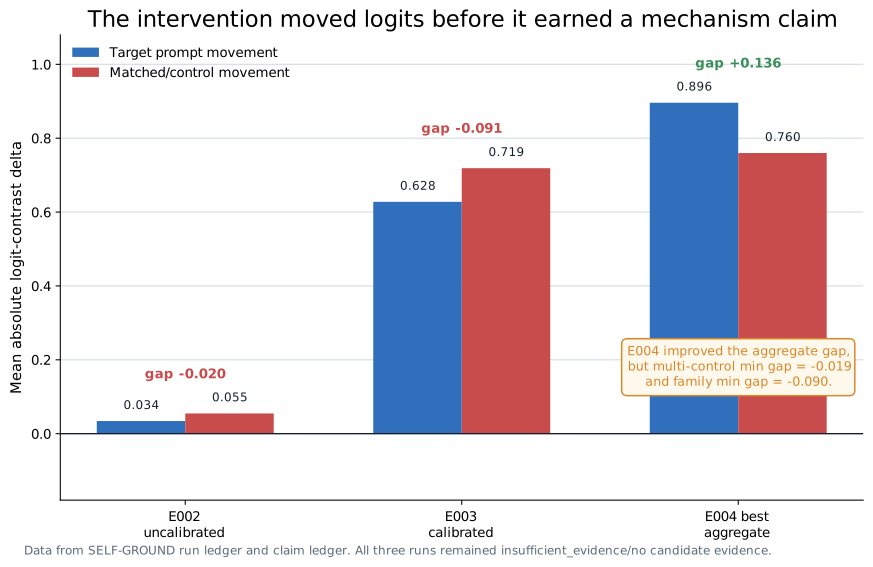
The run completed. It produced 240 behavioral rows and skipped none. The top feature set moved the target prompts by 0.0341995.
The matched controls moved more: 0.0546811.
The specificity gap went negative: -0.0204816. The claim status stayed insufficient_evidence. Before I accepted that, I went back through the feature selection and patch diagnostics, because a negative gap can come from a broken path just as easily as from a bad claim.
The decoded intervention path worked; the failure lived in the science rather than the machinery. Later diagnostics showed that an earlier zero-effect diagnostic run had selected inactive features for the tested prompt, while the E002-selected feature set produced a nonzero decoded patch and a visible max absolute logit delta. The machinery had not globally broken.
The scientific problem was harsher: the movement lacked enough specificity.
There was also a task-calibration problem. The baseline intended-direction pass rate was only 7/30. property_negation was especially bad, with 0/10 tasks passing intended-direction calibration. If the model does not reliably prefer the expected token contrast before intervention, the downstream intervention result is ambiguous. The run was telling me two things at once: the patch path can move logits, and the task suite was too weak a basis for a negation-specific feature claim.
The likely failure mode was syntactic volume rather than semantic negation. In a Pythia-70M-scale model, contrast-ranked SAE features can pick up high-frequency transitions, token position, or common next-token boosts. Ablating them then acts like a generic perturbation. On matched controls such as “The movie was good. The movie was …”, the model may already sit inside a tighter local completion pattern, so a blunt residual edit can create a larger logit-contrast swing there than on the target prompts. I now call that pattern global control dominance: an SAE feature can correlate with a behavior while still moving controls more than targets.
E003: Calibration Fixed One Problem and Exposed Another
E003 was designed to test whether E002 had mostly failed because the task bank was bad. The fix was straightforward in principle: generate a larger candidate bank, baseline-calibrate before intervention, require each family to survive, and rerun the same kind of decoded SAE evaluation on the calibrated task source.
The candidate bank had 240 token-valid tasks, 80 per required family. Baseline-only calibration kept 69 tasks: property_negation=10, sentiment_negation=36, and state_negation=23. Of the 171 rejected tasks, 161 failed because the unpatched model favored the wrong direction, while 10 fell below the margin requirement. A meaningful repair. The evaluated run had a baseline intended-direction pass rate of 1.0.
That gate has to run before any patch score appears. A decoded SAE patch that shifts a margin by +0.5 still fails if the unpatched model started at -2.5 for the intended contrast. Without baseline-only calibration, that same number can look like progress while the model still prefers the wrong token.
Then the intervention result got bigger in the wrong way.
The top target delta was 0.6277370. The matched-control delta was 0.7188387. The specificity gap was -0.0911018, worse than E002. Calibration fixed the task-suite coverage blocker, including the property-negation family, while the selected SAE feature set still failed the matched-control specificity test.
The project stopped chasing a positive here and became an education. The larger effect invited the story I wanted: calibration made the method promising. The artifact said something more constrained and less convenient: calibration made the task suite cleaner, and the cleaner suite made the non-specificity problem more obvious.
Less exciting. Truer.
Activation Manifold Telemetry
One check mattered more than I expected: activation-manifold telemetry. The evaluator tracked relative norm drift for the patched residual stream and the decoded delta norm ratio for the SAE reconstruction. A patch that gets a larger target delta by moving the residual far from its baseline scale has stopped acting like a clean intervention. Once relative drift crosses warning levels such as >0.5, changed logits reflect a hard shove to the model more than the influence of a specific feature.
The stricter rule denied strong_candidate_evidence whenever the norm-drift warning rate exceeded 0. That made a large target delta insufficient by construction. A behavior change accompanied by drift warnings counted as a broken perturbation rather than candidate support.
E004: The Rescue Matrix Still Said No
E004 was the specificity rescue attempt. It asked whether the E003 failure could be rescued by nearby layers, stricter pre-intervention feature selection, ablation plus amplification, and a multi-control suite. The matrix tried 15 cells across blocks.1, blocks.2, and blocks.3, using five feature-selection modes.
All 15 cells completed. None reached candidate evidence.
The best aggregate run was block1_ensemble_specificity_ablate_amplify_multi. It had target movement of 0.8960492, control movement of 0.7598730, an aggregate specificity gap of 0.1361762, and a top-vs-control ratio of 1.179. For a minute, that was the tempting stopping point. The aggregate looked like progress. If I only cared about one number, this would be the place to start overselling.
But the stricter gates were there for that reason. The multi-control suite included lexical-identity, semantic-unrelated, shuffled-target, and hard-negative controls. The best aggregate run still had a multi-control minimum gap of -0.0194242 and a family minimum gap of -0.0900231. At least one configured control suite and at least one required family still failed. The matrix-level adjudication was clear: no candidate cells, no candidate evidence, and no broad negation mechanism claim.
E004 changed how I think about mechanistic interpretability practice. A causal-looking effect alone cannot carry the claim. A larger causal-looking effect cannot either. A favorable aggregate still fails if the family breakdown and control suite reveal the weakness. One flattering mean could have hidden the failed slices; requiring every family and every control suite to stay positive turned the matrix into a falsification screen. The evidence unit has to be the whole artifact contract that decides whether the number survives its controls.
The MechLedger Detour
Midway through, I took a tooling detour: framework extraction, then a separate MechLedger project. I won’t pretend that was unrelated. It came from the same pressure that produced the claim ledger in the first place. Once overclaiming starts to feel easy, you start wanting infrastructure that forces claims to stay attached to evidence.
That instinct is good, but it has a failure mode. Building a research-integrity tool can become a way to avoid running the next hard experiment. SELF-GROUND itself records that boundary: framework extraction should resume only after multiple distinct tasks have run end to end and a shared abstraction would remove real complexity.
The useful part of MechLedger was the audit kernel: claim statuses, run records, debt reports, draft-claim checks, and a conservative mapping from SELF-GROUND outcomes into evidence statuses. In the MechLedger backfill, E002, E003, and E004 all stay negative or weakened under controls. A good audit tool should preserve that.
The less useful part would have been believing that better provenance makes the science stronger by itself. Provenance makes the weakness easier to see. The experiment still has to carry the claim.
The benchmark boundary got the same treatment. RAVEL-style evaluation asks whether an intervention isolates one causal attribute while leaving matched controls undisturbed. For the RAVEL/SAEBench bridge, I wrote a D008 API feasibility probe instead of claiming integration. The probe wrote a structured probe_result.json; in this environment, the status came back not_installed because the external sae_bench packages were absent. That fail-closed result kept the local work honest: a RAVEL-shaped custom token-contrast evaluation, with upstream benchmark compatibility left unclaimed until the API path supports custom datasets, custom SAE models, or precomputed activations.
Starting Over With Smaller Questions
After the negation SAE run, I shifted into local-mi-lab, a smaller practice lab for mechanistic interpretability basics. I needed reps more than I needed another rescue matrix. SELF-GROUND had become heavy: SAEs, model/SAE compatibility, task calibration, control suites, claim ledgers. The systems-engineering instinct to validate the path before trusting the system helped, but it also meant I had built a lot of harness around one hard task before I had enough smaller experimental reps.
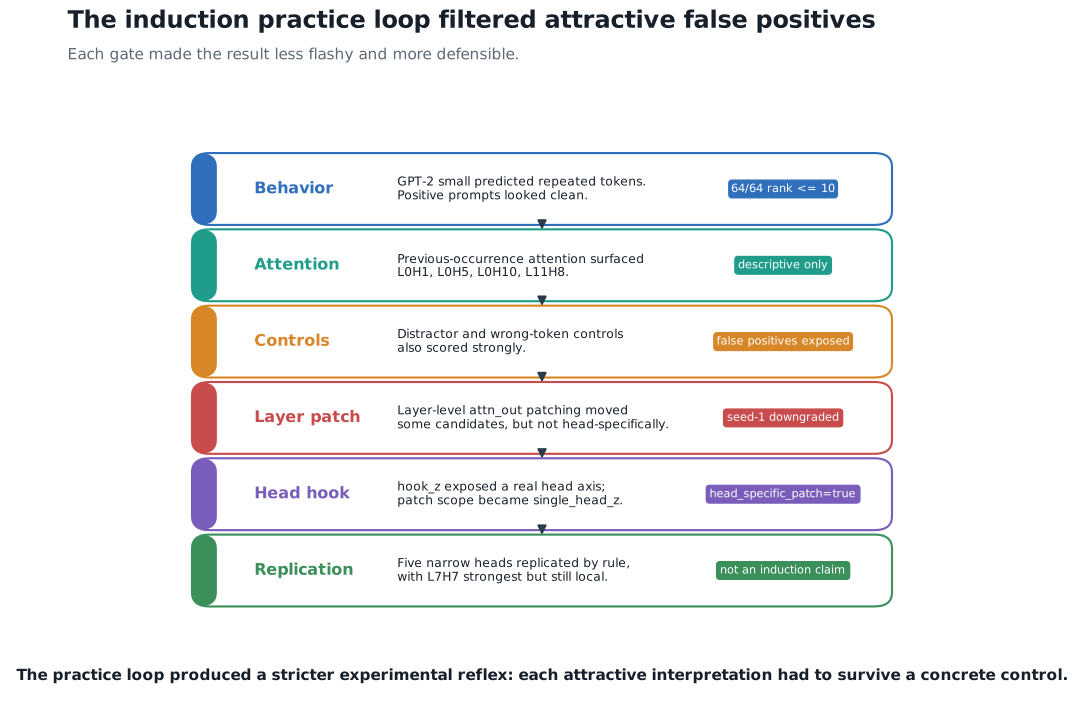
The Local MI Lab work used GPT-2 small because the tooling is mature and the runs are fast. The first loop looked at repeated-token induction behavior. On positive repeated-token prompts, GPT-2 small behaved cleanly: 64 out of 64 examples had the expected token ranked in the top 10, with a mean expected-token probability around 0.2849. Descriptive attention inspection surfaced familiar-looking candidates: L0H1, L0H5, L0H10, L11H8, and L0H4.
The seductive part came before controls. If you stop there, you can easily say “these are induction heads.” The controls stopped that.
The six-family control workflow showed that raw previous-occurrence attention lacked target specificity. Distractor controls and random-expected-token controls also scored strongly. In the controlled run, L0H1 and L0H5 attended strongly on positives, but they also attended strongly where that attention did not justify an induction claim.
Then came a tiny controlled patching follow-up. It patched selected candidates on positives and high-scoring controls. The first seed had a positive mean effect size of 0.0522, while the hardest control family reached 0.1755. The largest positive-minus-control causal gap came from a random comparison candidate instead of the raw attention candidates. A seed-1 replication downgraded the result further: positive mean effect dropped to 0.0127, max control mean was 0.1397, and the only positive-specific candidate was again a random comparison head.
The beginner lesson was clean: raw attention is descriptive, layer-level attn_out patching cannot isolate individual heads, and a candidate that moves controls has not earned specificity just because it looked good on the positive examples.
Head-Specific Patching Changed the Question, Not the Claim
The next practice step was to verify whether TransformerLens exposed a truly head-specific hook for GPT-2 small. blocks.<layer>.attn.hook_z provided a head axis, while hook_attn_out was only layer-level. That distinction changed the intervention from “patch a whole layer’s attention output” to “patch one head’s output at a selected position.” hook_z matters because it captures a head’s mixed value vectors before the attention out-projection (W_O) maps and sums the head outputs back into the residual stream. Patching hook_attn_out moves the whole layer after head contributions have been summed, so a positive delta there cannot say which head carried the effect.
The head-specific experiment also used a stricter metric: true_vs_control_logit_diff. The looser target-logit metric could reward nonspecific movement. The new metric asked whether the head moved the true token relative to a control token, and whether it did so more on positives than on controls. That blocked a patch from getting credit for generic logit inflation, punctuation drift, or common-token bias.
Across seeds 0, 1, and 2, the sweep tested 72 heads across selected layers. I noticed L7H7 because it kept coming back across seeds, the kind of thing that makes you want to start naming a mechanism. Three seeds can flag a candidate, not settle one, especially when the same head also appeared as a prior random-comparison candidate. Other local candidates included L9H11, L7H11, L7H0, and L0H8 under the current rule. Most original raw-attention candidates still failed or became nonspecific. L11H8 had positive seeds but was classified as nonspecific because controls also moved.
More interesting than the earlier false positives, still short of an induction-head discovery. The prompt set is synthetic. The intervention is final-position clean-to-corrupt hook_z patching. The sweep used selected layers. The controls are simple practice controls. L7H7 was also flagged as a prior random-comparison candidate, which means it deserves manual inspection before it deserves a story.
Progress looked healthier here: the intervention became more targeted, the metric got stricter, replication was required, and the claim stayed small.
What I Would Do Differently
If I were starting again, I would start smaller sooner. I learned a lot from the SELF-GROUND negation setup, but I also spent too much time building the harness around a task before I had enough basic mechanistic interpretability reps. A small GPT-2 induction loop with controls taught me some lessons faster than a heavier SAE pipeline could.
I would also make baseline calibration part of the task design from the beginning. E002 showed that token contrasts that sound natural to me can fail calibration for a specific model and tokenizer. The model has to be able to do the task in the intended direction before an intervention can be interpreted cleanly.
Coming into this from systems engineering gave me useful habits and some blind spots. I trusted path validation, audit trails, and failure modes quickly. I underestimated how much of the scientific work sits in task construction, calibration, and choosing controls that are adversarial enough to make a good-looking result uncomfortable.
Most importantly, I would put controls into the causal phase immediately, from the first moment a candidate looks promising. The Local MI Lab work made this concrete. A head can look good descriptively and fail under controls. A layer patch can move a metric without isolating a head. A random comparison head can produce the biggest apparent gap in a seed. None of that is embarrassing if the experiment is built to catch it. The embarrassment comes only if the write-up hides it.
For the negation SAE line, the honest next choice is either to retire the current Pythia-70M-deduped SAE/hook setup as unsupported for this claim, or redesign the ranking objective and control mapping before spending more GPU time. For the induction line, the next step is manual inspection of L7H7, L9H11, and L7H11 on held-out prompt constructions, with the explicit goal of trying to break the interpretation before strengthening it.
The Result I Actually Got
The negation mechanism didn’t show up. Neither did the induction circuit. Nothing I’d stake a claim on came out of this.
What did come out: I know how to sit with a number I like and wait for the controls before writing anything down. The path moved logits. The calibration repair was real. E004’s aggregate improved. L7H7 replicated across seeds. All of that was true; none carried the claim.
That gap between a result that runs and a claim that survives is the thing I didn’t understand going in. I understand it now, not as a principle but as something I watched happen to my own numbers.
The first serious result: I can now tell the difference between a path that runs, an effect that moves, and a claim that survives controls.