

I built Local MI Lab because SELF-GROUND had become too heavy for the amount of mechanistic interpretability practice I actually had. The negation SAE work taught me a lot, but it also wrapped every question in model/SAE compatibility, task calibration, control suites, and claim ledgers. I needed something small enough that I could see every part of the loop and still have energy left to ask whether the evidence meant anything. The source repo for this practice loop lives under ml_research/local-mi-lab in nshkrdotcom/learning.
GPT-2 small was the right size for that. TransformerLens support was mature, the runs were fast, and repeated-token induction gave me a behavior I could test without pretending I had discovered a new task. I wanted practice: build prompts, check behavior, inspect attention, patch activations, add controls, replicate, then try to break the result on held-out constructions.
Coming from systems engineering shaped the lab more than I expected. I wanted scripts before notebooks, artifact files before impressions, and explicit run summaries before I let myself write a story. It also meant the lab kept forcing a question I had avoided in heavier work: when a result looks good, which control would make me give it up?
The First Run Looked Clean
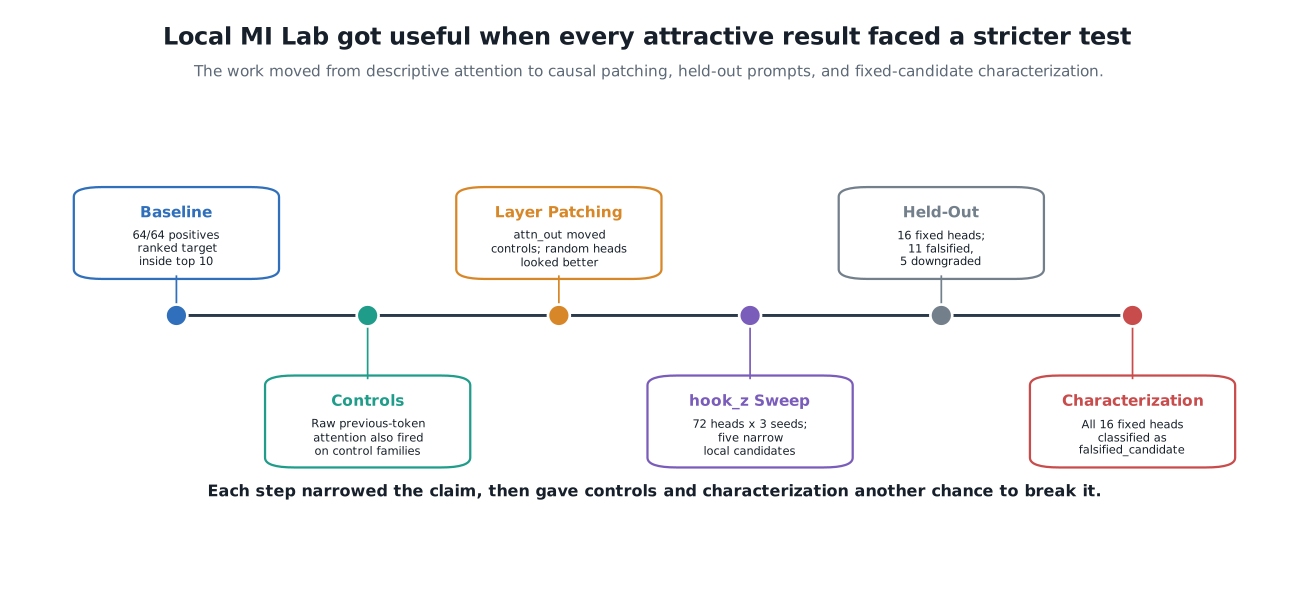
The first GPT-2 small induction run looked almost too friendly. On 64 repeated-token prompts, all 64 examples had the expected token ranked in the top 10. The mean expected-token probability was around 0.2849, with median rank 1.0. Logit-lens summaries and attention-pattern inspection gave me concrete artifacts to look at instead of impressions.
The descriptive attention result also looked familiar. Top previous-occurrence attention heads included L0H1 at 0.537, L0H5 at 0.531, L0H10 at 0.244, L11H8 at 0.211, and L0H4 at 0.182. If I had stopped there, I would have had a neat beginner story: GPT-2 small predicts repeated tokens, and these heads attend to the previous occurrence. It would have been too easy.
Attention to a previous token can track structure without proving target specificity. The next controlled run used 192 examples across six families: positive repeated sequences, no-repeat controls, shuffled repeats, distractor repeats, same-token-frequency controls, and random-expected-token controls.
The positive prompts still behaved well. In the controlled run, positives had mean expected-token probability 0.2785, median rank 1.0, and 32/32 examples inside rank 10. The problem came from the controls. The distractor_repeat_control family had mean expected-token probability 0.2323, median rank 1.0, and 32/32 examples inside rank 10. Same-token-frequency and shuffled-repeat controls also scored strongly.
The raw attention heads carried the same problem. L0H1 and L0H5 attended strongly on positive prompts, but they also attended strongly where that attention lacked induction-claim support. The best positive-minus-control gaps were reported as 0.000 because the random-expected-token control kept the same repeated prompt while scoring the wrong target. The prompt could look induction-like while the metric failed to separate the thing I cared about.
Layer Patching Was Still Too Broad
The next step was a tiny controlled patching follow-up. I selected 11 candidates from the attention artifacts: top raw-positive heads, top control-firing heads, and deterministic comparison heads. The patching scope was intentionally small: four families, eight examples per family, final position, and the layer-level attn_out component.
The seed-0 run produced a positive mean effect size of 0.0522. The hardest control family reached 0.1755. Six candidates passed a simple positive-specific rule, but the largest positive-minus-control causal gap, 0.5102, came from a random comparison candidate, L9H6, rather than a raw previous-occurrence attention candidate.
That result made me pause because it had the shape of a trap. There was a number I could have liked, and a candidate that beat controls under a simple rule. The artifact also said the candidate came from the comparison bucket and that the intervention patched an entire layer’s attention output. The result could teach patching mechanics, far short of a head-level story.
The seed-1 replication took away most of the temptation. Positive mean effect dropped to 0.0127, max control mean was 0.1397, and the best positive-minus-control gap was 0.0466 on another random comparison candidate, L9H3. Raw positive-attention heads L0H1, L0H5, L0H10, and L0H4 became nonspecific or no-effect under this tiny causal check.
The run taught the opposite lesson from the one I wanted. Raw attention was descriptive. Layer-level patching could move a metric without isolating a head. A candidate that only looks good after comparison-head selection deserves extra suspicion.
hook_z Made The Intervention Honest
Before the next sweep, I checked the hook itself. TransformerLens exposed blocks.0.attn.hook_z for GPT-2 small with shape [1, 8, 12, 64], including a head axis. hook_attn_out showed up as [1, 8, 768], a layer-level output. That distinction changed the experiment from patching a whole attention layer to patching one selected head output at a selected position.
The metric changed too. The earlier target-logit-style metric could reward nonspecific movement. The stricter metric, true_vs_control_logit_diff, asked whether the intervention moved the true expected token relative to a wrong or control token, and whether positives moved more than controls.
The head-specific sweep tested 72 heads across layers [0, 2, 4, 7, 9, 11] for seeds 0, 1, and 2. The artifacts recorded head_specific_patch=true and actual_patch_scope=single_head_z. Those fields sound bureaucratic until you have already seen how much interpretation can ride on the difference between a layer patch and a head patch.
Seed 0 put L7H7 at the top with a positive-minus-control gap of 0.0884. Seed 1 put L7H7 at the top again with 0.0893. Seed 2 did it again with 0.0641. A candidate repeating across seeds has a different feel from a one-off number. The held-out pass existed for that temptation.
The Candidate That Kept Coming Back
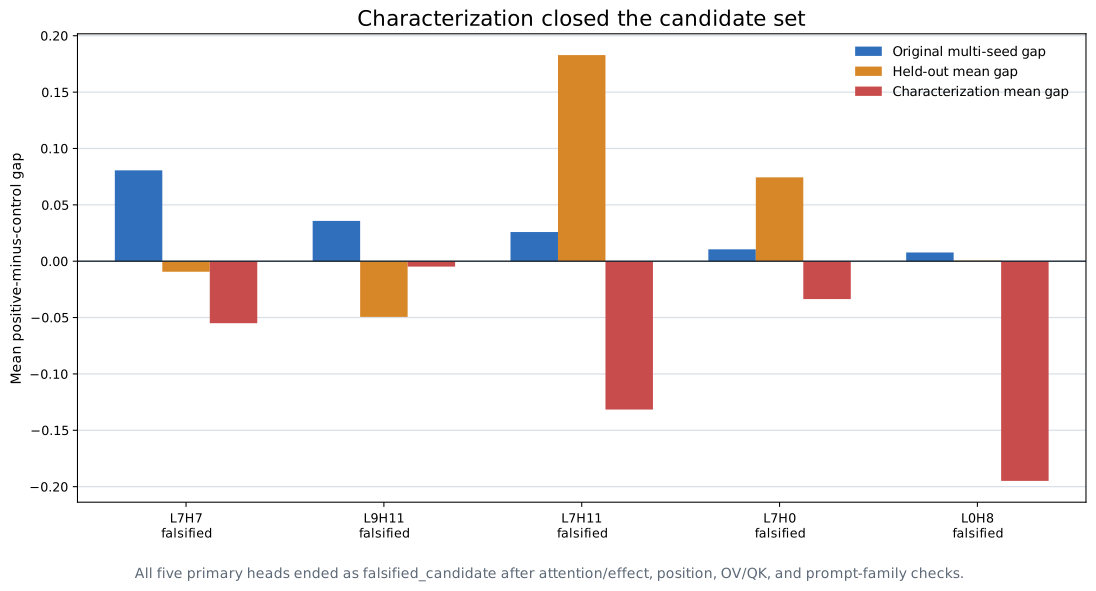
The consolidated head-specific report found five scoped replicated candidates under the current rule: L7H7, L9H11, L7H11, L7H0, and L0H8. L7H7 had the strongest mean positive-minus-control gap at 0.0806, with all three seeds positive-specific. L9H11 followed at 0.0357, then L7H11 at 0.0259, L7H0 at 0.0105, and L0H8 at 0.0077.
The raw-attention heads mostly failed the stricter causal check. L0H1, L0H4, and L0H5 had no positive effect. L0H10 was nonspecific. L11H8 had positive seeds but controls also moved, so the consolidated report classified it as nonspecific.
L7H7 needed the most caution. The strongest repeated candidate also carried a prior random-comparison label. Manual inspection showed positive examples with visible effects, including repeated symbolic, metal, and weekday prompts. It also showed controls that moved, especially same-token-frequency controls. The combination was why I built the lab this way. A promising head should become easier to attack before it becomes easier to narrate.
At that stage, the supported claim stayed constrained: true head-specific hook_z patching worked locally, raw attention had failed as a filter, and five heads were worth held-out testing. The evidence reached a smaller candidate set with better support than the first attention story, short of a circuit or broad induction-head discovery.
Held-Out Prompts Broke The Candidate Story
The held-out robustness pass was the test I needed before the story became too comfortable. It fixed 16 candidates before scoring: the five prior replicated candidates, prior raw-attention comparison heads, and deterministic negative controls. It changed the prompt families, changed the seeds to 10, 11, and 12, and tested clean-to-corrupt patching, zero ablation, and mean ablation at final and previous-occurrence positions.
The held-out prompt families were designed to break artifacts rather than repeat the original generator. They included longer symbolic sequences, word sequences, number sequences, double-repeat structures, wrong-target same-prompt controls, and no-structure same-token controls. The decision rule required more than seed-level survival. A candidate had to survive across seeds, families, controls, intervention variants, and effect direction.
I was watching for stability rather than the biggest surviving row: the same head needed to keep moving the right contrast when the prompt family, control construction, intervention, and seed changed.
The consolidated result was blunt: 11 candidates were falsified, 5 were downgraded, and no fixed head cleanly survived. Prior replicated candidates failed to carry through as robust induction-head candidates beyond the original synthetic setup.
L7H7 survived seed-level rows under final-position clean-to-corrupt patching and zero ablation, but its held-out mean positive-minus-control gap was -0.0094, and the consolidated status was heldout_falsified. L9H11 also survived seed-level rows across interventions, yet its mean gap was -0.0494 and its status was heldout_falsified. L7H11 retained a large positive mean gap of 0.1829, but survived only one seed and became heldout_downgraded. L0H8 was downgraded with a mean gap near zero. L7H0 was falsified.
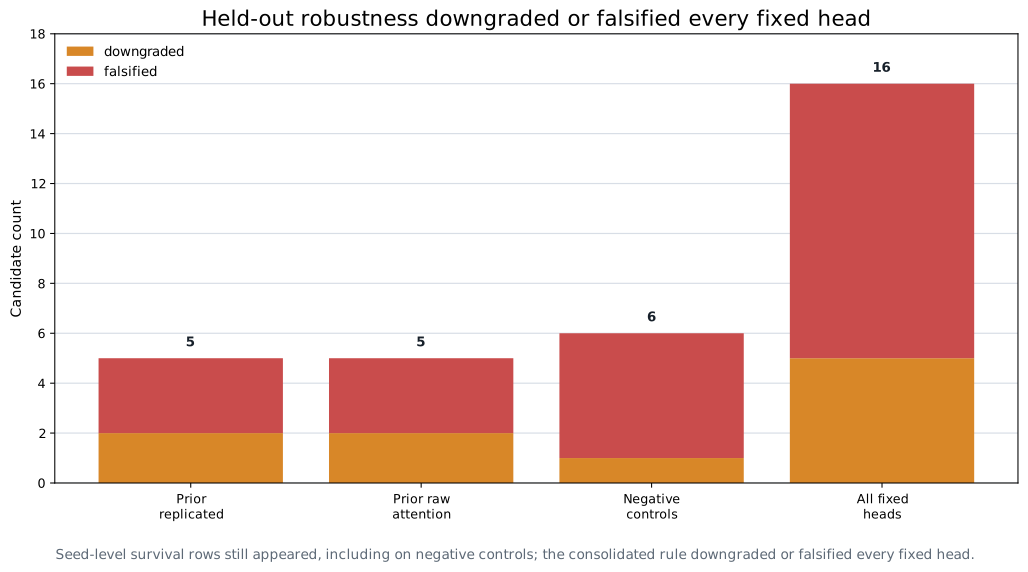
The negative controls made the held-out result hard to dodge. L11H0, selected as a negative-control no-effect head from the prior report, survived three seed-level rows and had a mean gap of 0.1124, yet the consolidated report still falsified it because the detailed failures broke the survival story. If a negative control can look that good under permissive slices, then permissive slices are dangerous.
Characterization Closed The Candidate Set
Held-out robustness was useful, but it still left an uncomfortable shape: some heads were falsified, some were downgraded, and a few seed-level rows still looked tempting. I did not want to leave the article there because the repo no longer stops there. The next pass fixed the candidate set and asked whether any of those heads could be strengthened by local signatures that looked more induction-like.
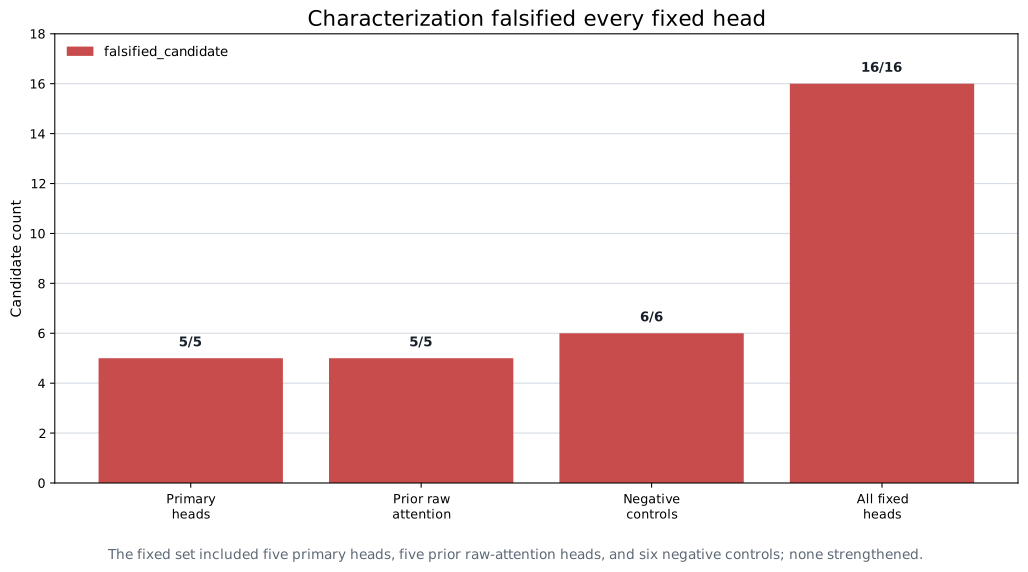
The characterization pass kept the same 16 heads: five primary candidates, five prior raw-attention comparison heads, and six negative controls. It ran seeds 20, 21, and 22. The prompt families broadened the surface area again: symbolic short and long, word short and long, number short and long, multi-distractor, reversed-control, and target-swap-control prompts. The diagnostics also widened. Instead of only asking whether a patch moved a logit contrast, the pass checked attention/effect alignment, source and destination position sensitivity, token-domain and sequence-length sensitivity, and local OV/QK margins.
The result was cleaner than the held-out pass. No candidate strengthened. All 16 fixed heads were classified as falsified_candidate. The five primary heads all failed: L7H7 ended at a mean positive-minus-control gap of -0.0550, L9H11 at -0.0048, L7H11 at -0.1316, L7H0 at -0.0336, and L0H8 at -0.1949.
The comparison groups mattered as much as the primary heads. All five prior raw-attention heads ended falsified. L0H4 had one seed-level support row but did not replicate. All six negative controls also ended falsified, while some still produced seed-level support. The uncomfortable confirmation was the point of the lab: even a stricter rule could still produce tempting local rows, so the final interpretation had to come from the consolidated matrix rather than any single good-looking example.
Counterexamples Did The Work
The characterization counterexample reports made the failure legible. L7H7 still had strong successes: a char_multi_distractor row under zero ablation moved by 0.6624, and mean ablation on the same family reached 0.6610. The same candidate also had word-short failures at -0.3868, multi-distractor failures around -0.2946, and a target-swap control that moved by 1.0170. That mix explains why the consolidated status matters.
L9H11 told a similar story. It had multi-distractor successes up to 0.3927, but also a multi-distractor zero-ablation failure at -0.6542 and reversed-control movement at 0.4538. L7H11 was even more dramatic: successes around 0.4337, a clean-to-corrupt multi-distractor failure at -1.3689, and a target-swap control that moved by 2.8701.
I trust that part of the lab most. The counterexample reports went beyond a failed label. They showed where the appealing result broke: which family, which intervention, which position, which prompt. From a systems background, that felt like the difference between a red dashboard and a usable incident report. The failure had coordinates.
Failure Taxonomy Made The Breakage Boring
After characterization, I did the unglamorous thing I should have wanted from the beginning: I turned the counterexamples into a deterministic failure taxonomy. I did not need another way to talk about L7H7. I needed the failures to become comparable enough that the next step could be constrained.
The taxonomy used the five primary counterexample files and the consolidated characterization summary as inputs. It produced 296 row-level failure labels across the fixed set. The largest category was control_moved, with 80 rows. target_swap_leak followed with 54. domain_flip, length_flip, and intervention_disagreement each appeared in 40 rows. reversed_control_leak appeared in 26, and position_mismatch in 16.
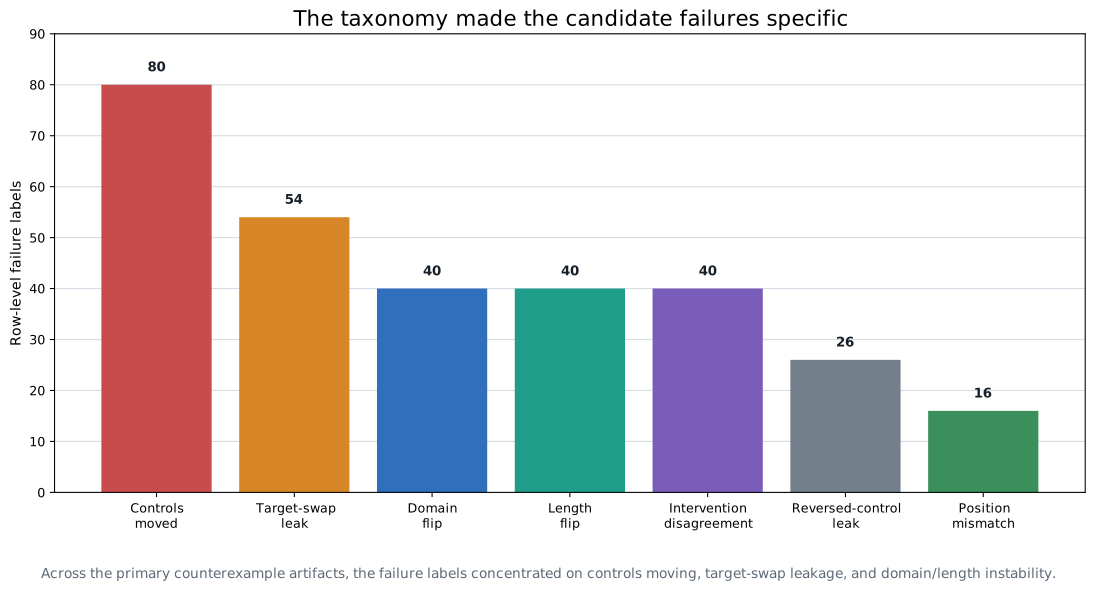
The primary heads all had the same dominant pattern: control_moved, target_swap_leak, reversed_control_leak, domain_flip, and length_flip. L7H7 and L9H11 also had local OV/QK-looking hints earlier, but those hints never combined with causal specificity. I care about that because it blocks a common escape hatch. Extra diagnostics had joined the evidence for stopping.
Once the failures were in a table, the next move became obvious. A new head search would just be a way to feed a false-positive-prone pipeline more chances. The next experiment had to test the metric and prompt setup itself.
Metric Calibration Stopped The Search
The calibration pass asked a narrower question than the earlier head work: can true_vs_control_logit_diff separate repeated-token positives from controls before I use it to search for mechanisms? It used GPT-2 small, 72 examples, and a pre-registered family set: clean symbolic, word, number, and format-variant repeats on the positive side; wrong-target, target-swap, same-token-frequency, reversed-order, no-repeat, and frequency-trap families on the control side. Tokenization passed for all 72/72 rows.
Some of the calibration looked good at first. The positive mean true_vs_control_logit_diff was 4.5026. The max control mean was 3.2170, so the aggregate positive-minus-hardest-control gap was 1.2856. If I only cared about that one number, I could have called the metric usable and moved on.
The pre-registered thresholds did not allow that. The weakest positive family, calib_clean_repeat_word, had mean 1.7428. The hardest control, calib_frequency_trap_control, had mean 3.2170 and fraction_diff_positive = 1.0. A control family beat the weakest positive family and produced positive-looking rows every time. The final status was metric_needs_revision, with search_allowed: false.
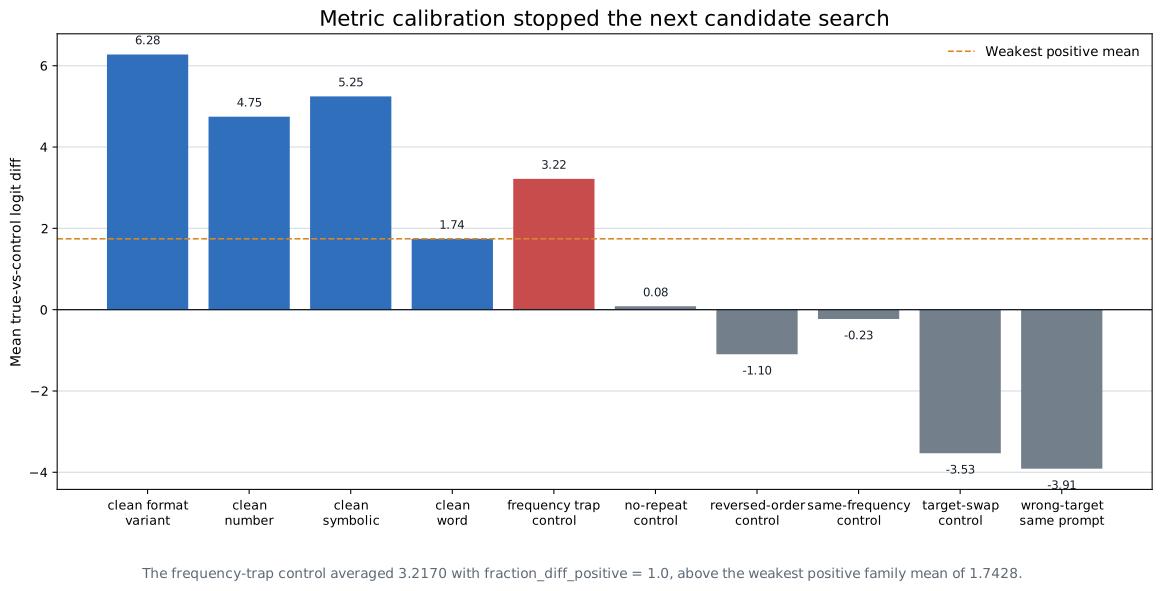
The right place to stop was there. The metric had enough signal to be interesting and enough leakage to be dangerous. For a first mechanistic interpretability practice loop, that distinction matters more than squeezing one more head out of the sweep.
What I Learned From This Lab
I learned to distrust raw attention faster. Attention patterns are useful for choosing where to look, but they are cheap evidence. If the same head attends strongly on a random-expected-token control or a distractor prompt, the attention pattern has already lost the specificity I need for a mechanism claim.
I also learned to treat patch scope as part of the claim. Layer-level attn_out patching can teach activation-patching mechanics, but it cannot support a head-level interpretation. The hook metadata matters because the claim depends on the intervention target. If the artifact cannot tell me whether the patch was single_head_z or a full layer output, the write-up should stay quiet.
L7H7 changed how I read replication. A candidate can repeat across seeds, beat the original controls, and still fail when the prompt construction changes. Replication under one generator raises the bar for the next test; it extends the test.
I also got a better feel for what “held-out” and “characterization” have to mean in practice. Changing only the random seed would have been too weak. The useful passes changed token domains, sequence length, control construction, interventions, positions, and local diagnostics. They gave the candidate more ways to survive and more ways to contradict itself.
The last lesson was about stopping. I wanted the pipeline to earn another search. The taxonomy and calibration work refused that. A metric can separate positives on average and still fail because one control family finds the shortcut. That failure is what the lab was built to surface.
The Result I Got
Local MI Lab gave me a completed practice loop through the calibration stop point.
The runs now form a progression: GPT-2 small handled the repeated-token prompts; controls showed that raw attention could follow structure without target specificity; layer-level patching moved metrics at the wrong scope; head-specific patching made replicated candidates worth chasing; held-out prompts broke or downgraded those candidates; fixed-candidate characterization falsified all 16 heads; failure taxonomy explained the breakage; metric calibration stopped the next search.
No induction head, circuit, broad GPT-2 claim, or new head search came out of this lab. What came out was more useful for where I was: I can now look at an attractive mechanistic interpretability artifact and ask which control, hook, metric, prompt family, intervention variant, diagnostic axis, or calibration threshold would make me stop believing the story.