
Chapter
GCTS Theory
The formal object model for Grounded Chiral Tensor Synthesis: evidence, access states, claims, worlds, chirality, and confidence.
The current CNS research line: access-aware likely-truth ranking over structured possible worlds.
This is the current research hub for CNS 7.1 / GCTS: Grounded Chiral Tensor Synthesis.
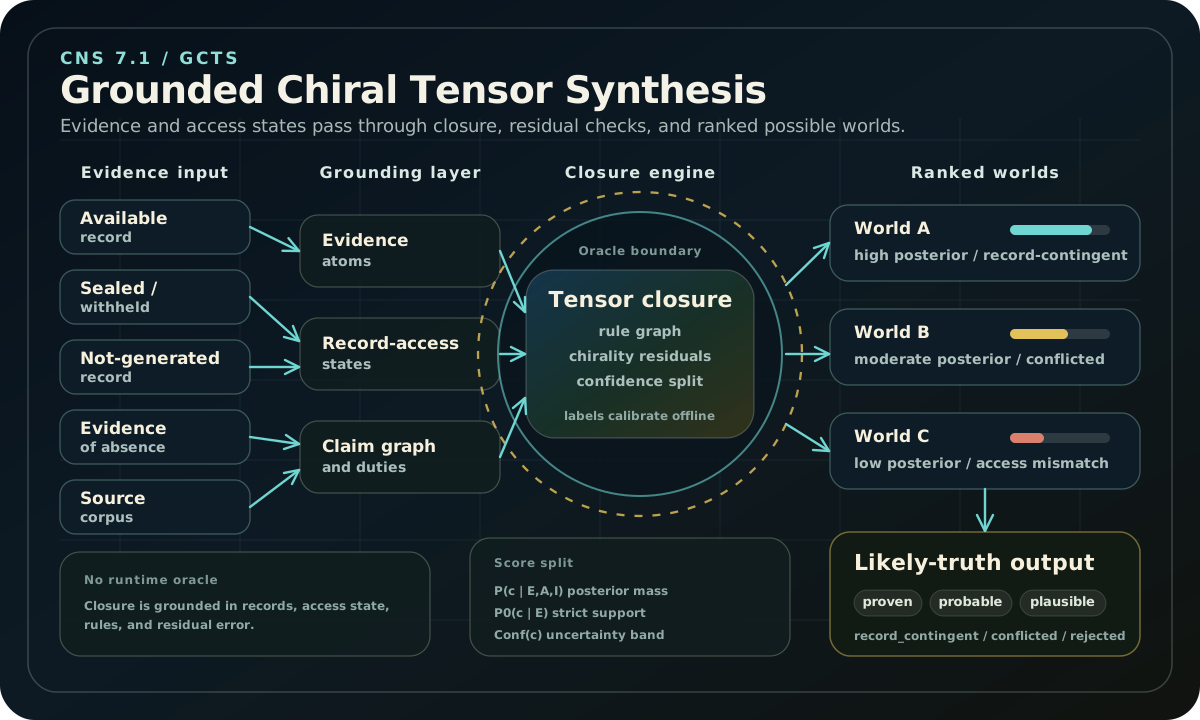
GCTS changes the center of gravity from narrative synthesis to likely-truth ranking under limited, contradictory, and access-controlled evidence. It ranks claims through structured possible worlds, evidence atoms, record-access states, proof traces, contradiction residuals, and calibrated uncertainty.
The core move:
CNS should build a distribution over structured possible worlds, quantify the mismatch between language, logic, evidence, and access states, and emit ranked, confidence-calibrated likely-truth hypotheses with explicit evidence, record dependencies, proof support, and uncertainty.
The ingredients are crowded. Fact verification, source-trust scoring, provenance, probabilistic logic, possible-world semantics, legal evidence models, and missing-data theory all have substantial prior art.
The GCTS research boundary is the integration: typed record-access states, generation-duty-aware missingness, contradiction-preserving claim graphs, strict-proof separation, likely-truth posterior ranking, and runtime oracle-boundary controls in one evidence-first architecture.
The most important distinction is the record layer. A missing record is not collapsed into generic uncertainty. GCTS asks who would control the record, whether ordinary procedure would generate it, whether the event should have been observable, how the record was requested, what production response occurred, and how strongly that access state should affect claim ranking.
The earlier CNS 2.0 work introduced Structured Narrative Objects, chirality, evidential entanglement, critic pipelines, and generative synthesis. GCTS keeps the useful intuition that productive disagreement has structure, but replaces several loose parts with stricter machinery:
| CNS 2.0 emphasis | GCTS upgrade |
|---|---|
| Structured Narrative Objects | Evidence atoms, claims, access states, and possible worlds |
| Critic score | Separate strict proof, posterior probability, and confidence |
| Chiral pair synthesis | Chirality plus contradiction residuals across graph, proof, evidence, and access layers |
| LLM-centered synthesis | LLMs extract and render; structured evidence ranks truth |
| Evidence overlap | Access-aware missingness, source control, and record-generation duty |
| Truth-like trust score | Likely-truth ranking with oracle-boundary controls |
proven,
probable, plausible, record_contingent, conflicted, unsupported,
rejected, and insufficient_evidence.Source note: adapted from the CNS 7.1 / GCTS research docset generated and revised in May 2026. It presents a buildable research proposal before a completed implementation. Current public framing should remain conservative: GCTS proposes an architecture-level integration. Automated fact verification, provenance, probabilistic logic, and missing-data theory all have substantial prior art.
Chapter
The formal object model for Grounded Chiral Tensor Synthesis: evidence, access states, claims, worlds, chirality, and confidence.
Chapter
The runtime pipeline for evidence ingestion, access modeling, tensor closure, world ranking, and audit reports.
Chapter
The rule that prevents labels, expert judgments, or LLM truth decisions from bypassing evidence closure and world ranking.
Chapter
Closest neighboring systems and the conservative novelty posture for Grounded Chiral Tensor Synthesis.
Chapter
Typed record-access states for missing, controlled, sealed, destroyed, unavailable, and not-generated evidence.
Chapter
How GCTS handles missing records, controlled evidence, source incentives, and strategic non-production.
Chapter
The falsifiable experiment plan for latent-context recovery, oracle-less grounding, calibration, access-state modeling, chirality, and adversarial record suppression.
Chapter
A practical implementation path for building the first access-aware likely-truth engine without full custom model training.
Chapter
A synthetic example showing how record-access states affect likely-truth ranking and claim status.
Chapter
Primary papers, standards, and adjacent systems relevant to Grounded Chiral Tensor Synthesis.
Chapter
Canonical terms for CNS 7.1 / Grounded Chiral Tensor Synthesis.