

Big idea. No tweaking one sentencing guideline. No stapling on another useless pilot program. Redraw the whole country as five rings.
At the center: the Platinum Standard city, dense with services, surveillance, rapid response, and full legal protection. Around it: an inner ring of humane, committee-governed detention. Then an exurban ring of managed friction. Then a rural belt of diffuse autonomy. At the edge: containment estates, robotically managed, isolated, and legally exceptional.
The value is the system. It takes pieces of American practice that already exist in scattered form and turns them into a single explicit map.
I. The Inversion
The source logic is straightforward. Take the “broken windows” instinct and reverse its geography. Instead of treating the city center as a place where disorder must be tolerated because density makes control expensive, treat it as the place where the law is strongest, fastest, and least forgiving. Then move outward into looser and more differentiated forms of order.
In that sense this is a centripetal justice gradient. The closer to the core, the more law, the more service density, the more surveillance, the more intervention capacity. The farther out, the more the system tolerates variation in local norms and local governance.
There is a practical argument underneath that architecture. The current prison system does a poor job of producing non-recurrence. In the Bureau of Justice Statistics’ five-year follow-up of prisoners released from state custody, 76.6% were arrested again within five years.1 The current arrangement is bad at returning people to ordinary civil life.
That is where Zone 2 enters. The inner suburban ring takes the Scandinavian wager seriously: if the state wants lower future crime, it should build institutions that look more like re-entry than degradation. Norway’s correctional service says its system is meant to let offenders change their pattern of criminal behavior; its staff are unarmed; its strategic planning emphasizes meaningful daily content, active routines that prevent isolation, and a life during sentence “as close as possible to life outside prison.”2
Zone 3 and Zone 4 move in a different direction. They borrow less from modern penal reform than from older local orders. Switzerland’s political system still distributes meaningful power among the Confederation, the cantons, and the communes, with autonomy allocated according to subsidiarity and direct-democratic participation available at multiple levels.3 Iceland’s Althing, founded in 930, was a public site where law, dispute, and legitimacy were performed in the open.4 The exurban managed-friction belt and the rural hinterland are reaching for that same family of ideas: lower formalism, thicker local norms, more room for community settlement.
Zone 5 is the cleanest break from current practice and, inside the proposal’s own logic, the most politically coherent part. Remote 5-20 acre containment estates run by automation solve a specific problem: the corruption and abuse risk that come with human guards, human patronage, and ordinary prison hierarchy. The source material is explicit on the point. The pitch is blunt. Survival needs are met. The stated trade is freedom of movement for stable control, anti-corruption design, and the possibility of ecological self-sufficiency inside the perimeter.
II. The Five Rings
Set the rings out plainly.
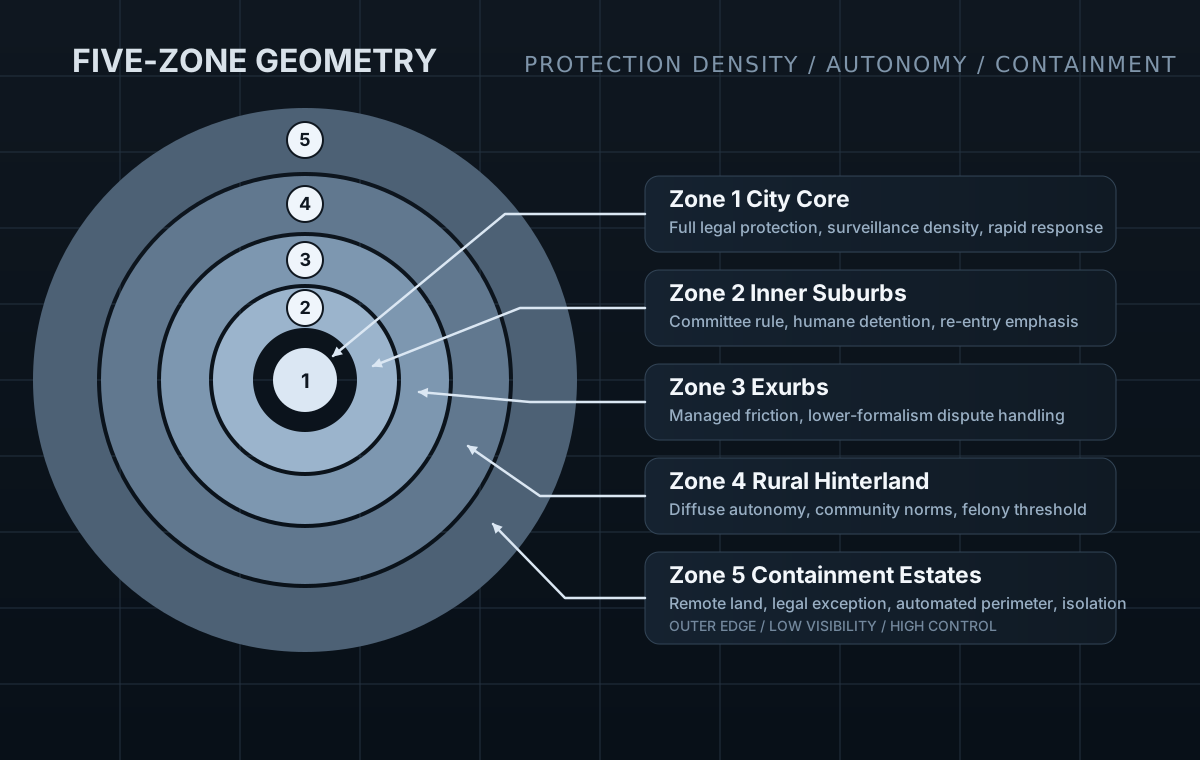
Zone 1: City Core. Full federal plus enhanced local law. Zero tolerance. Highest density of civil services, surveillance, and rapid response. Offenders get pushed outward. Local incarceration drops out of the picture.
The core is the sales pitch. Safety first. Delay reduced to the minimum.
Zone 2: Inner Suburbs. Democratic committee rule paired with radically humane detention. This is the zone where the proposal is most obviously borrowing from real institutional analogues.23
Zone 3: Outer Suburbs and Exurbs. Managed friction. Committees sanction limited, consensual misdemeanor-level physical dispute resolution in designated areas. Grievances can be settled inside the zone’s own social compact. Conduct outside the sanctioned scope escalates inward.
This is where the map starts gambling on local culture.
Zone 4: Rural Hinterland. Diffuse autonomy. Low formal governance. Common law and community norms dominate. Federal law mainly appears at the felony level.
Zone 5: Containment Estates. Robotically managed, legally exceptional, physically stable, and designed for people who have exhausted the inner rings.
And at the edge, the hard answer. No romance. No ambiguity.
Each zone answers a different policy problem. Zone 1 promises order at the core. Zone 2 promises rehabilitation without chaos. Zone 3 promises lower formal transaction costs for low-level disputes. Zone 4 promises local autonomy. Zone 5 promises a hard containment answer without the usual corruption vector.
That is also why the map is politically interesting. It offers something recognizable to several constituencies at once without forcing them to agree on a single theory of punishment.
III. The Geography
Lay this over the United States and the regional logic comes into focus quickly.
The Northeast is the cleanest fit.
The core cities are obvious: Manhattan, Boston proper, Center City Philadelphia, Washington inside the Beltway. The inner committee belt fits the high-capacity, civically assertive municipalities just outside them: Jersey City and Hoboken, Cambridge and Somerville, Bethesda and Silver Spring. The exurban negotiation belt reaches into the Hudson Valley, central Pennsylvania, western Massachusetts, and the Virginia piedmont. The hinterland pushes out into the Adirondacks, western Maine, and Appalachian terrain. The proposed containment edge begins where population thins and the terrain itself becomes part of the perimeter.
The Southeast works the same way. Downtown Atlanta, Charlotte, Nashville, and Miami become core. Their immediate wealth belts become the humane-governance zone. Beyond that: Piedmont towns, Tennessee river valleys, deep rural interior, swamp margin, hollow country.
The Midwest is more spread out. Chicago, Minneapolis, Detroit’s revived central districts, and Kansas City’s core stand as islands of intense legal order in a much wider field of settlement. The collar suburbs fit the committee zone. Corn-belt and exurban towns become managed-friction country. Then come the rural belts and the possible containment sites in flat, low-density territory with rail or drone logistics.
The Mountain West may be the easiest place to imagine because the distances are already so large. Denver, Salt Lake City, Albuquerque, and Oklahoma City function as islands. The Front Range and its satellites become the second and third zones almost automatically. Eastern Colorado, Wyoming, Nevada, and the Great Basin already have the isolation the outer zones would require.
On the Pacific Coast, the same pattern is visible in a different landscape. San Francisco, Seattle, Portland, and parts of Los Angeles or San Diego fit the center. Oakland, Bellevue, Pasadena, San Jose, and their analogues fit the second zone. The Central Valley, inland Washington, eastern Oregon, the Klamath and Mojave margins do the rest.
None of this mapping is arbitrary. The five rings fit the way American metro regions already sort density, wealth, distance, and state capacity.
IV. The Mobility Trap
The central problem is mobility.
Metropolitan Americans move. Constantly. One jurisdiction for home, another for work, then several more in between. The Census Bureau’s county-to-county commuting analysis found that more than a quarter of U.S. workers traveled outside their county of residence for work during a typical week, with commuting patterns showing a large and dispersed commuter shed.5
Sealed habitats? Forget it.
A five-zone justice regime would need neutral corridors between zones that function as legally neutral passageways, close to the role of international waters or diplomatic transit routes in the original source framing. It would need neutral vehicles, neutral stations, neutral labor rules, neutral emergency response, neutral insurance, and neutral commercial guarantees.
If that infrastructure fails, the arrangement stops being a coherent national system. The source material’s warning is the correct one: the map collapses into economic apartheid.
The operational point is plain enough. Any serious version of this system would be a transit project as much as a justice project.
V. The Currency Question
This is where the system becomes more than a punishment map.
Build this thing in full and dollars stop being enough. Time matters too. Access matters. The quality of ordinary daily life in each ring matters. That is what makes the In Time comparison useful. The 2011 film treated lifespan itself as currency. The more plausible version here would be quality-adjusted civic time.
Call it a crypto layer if you want. The serious version would be a publicly auditable metropolitan token indexed to quality-of-life standards: housing stability, safety, access to care, commuting burden, education, civic participation, environmental quality, and social trust. The OECD’s well-being framework already treats well-being as multidimensional, spanning living conditions and quality of life across multiple measurable domains.6
Under that arrangement, Zone 1 becomes the place where money is concentrated and time is worth more because daily life is measurably better. Zone 2 would be rewarded for successful re-entry and social repair. Zone 3 would be penalized if managed friction degraded safety or health. Zone 4 would keep its autonomy only if it maintained baseline well-being above the floor. Zone 5, if it existed at all, would force the state to quantify what kind of life remained inside a containment perimeter.
The value of the idea is analytical. A quality-of-life-indexed civic token would make explicit the exchange rate between order and livability across space.
Whatever one thinks of the crypto wrapper, it clarifies the proposal. These zones mark law. They also mark how governance prices daily life.
VI. What The Model Reveals
Treat it as diagnosis. The transit problem is severe. The committee-governance rings would need constitutional backstopping against local overreach. The containment estates would need technical systems and legal doctrines still missing in usable form.
It makes several things explicit. American debates about crime are often debates about geography. Rehabilitation is easier to support when it is spatially separated from the most protected districts. Local democracy becomes much more contested once it is asked to govern force. Automated custody looks cleaner on paper because it promises to remove ordinary corruption from the chain of control.
Most of all, this map converts an existing national habit into a readable diagram. American order is already allocated unevenly through zoning, school districts, police saturation, emergency response times, detention siting, and land use. The proposal gathers those scattered facts into one formal map.
That is why the thought experiment is useful. It is systematic. It is geographically concrete. And it makes official a pattern the country already recognizes in fragments.
VII. The Miller Test
If you want the quickest way to stress-test these five rings, run them through Stephen Miller.
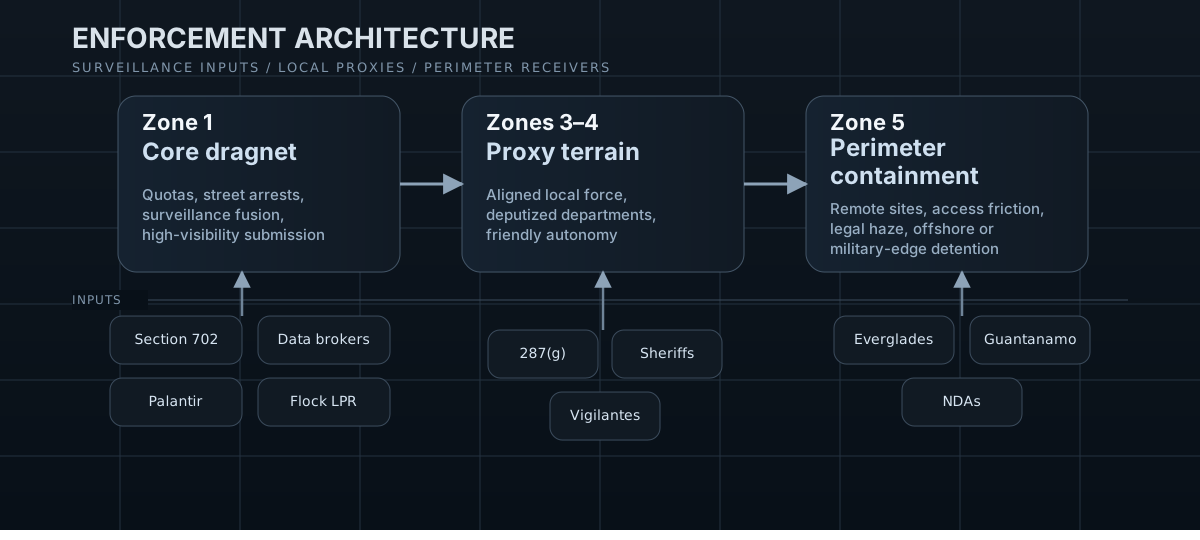
He wants dragnet enforcement in the core, punishment at the edge, and a field of proxies in between.
Start with Zone 1. That part holds. AP reported in June 2025 that Miller pushed ICE toward at least 3,000 arrests a day, up from an average of 656 a day from January 20 to May 19.7 Another AP report found that after the quota took hold, 65% of the more than 204,000 people processed into the system in fiscal 2025 had no criminal convictions.8 That is the city as sorting floor. Volume. Speed. Saturation. Visible submission.
The digital side matches the physical side. Miller’s coalition pushed for a clean Section 702 extension, kept the data-broker loophole in play, and paired the arrest machine with Palantir’s ImmigrationOS and the expanding reach of Flock license-plate readers.9 Zone 1 under this record looks exactly like the hard version of the thought experiment: a premium enforcement district where surveillance feeds custody and custody feeds spectacle.
The humane ring gets chewed up on contact with this administration. The Bureau of Prisons staffing crisis pulled teachers, nurses, and counselors into guard duty through augmentation. Pre-release halfway house placements got squeezed down. Non-citizens lost re-entry pathways and moved straight toward ICE custody at sentence end.10 The Scandinavian wager has no constituency inside this machinery. Recovery burns time. Miller wants throughput.
The correction lands in Zones 3 and 4.
The middle bands carry the harder point. He crushes local autonomy when it blocks him and arms it when it helps him. Sanctuary jurisdictions drew threat letters, funding pressure, and legal intimidation. A local Virginia prosecutor handling a case tied to threats against Miller drew a congressional subpoena campaign the minute she refused to move on command.11
Friendly local power gets the opposite treatment. Migration Policy Institute reported that by early 2026 a record 1,313 state and local law-enforcement agencies had signed 287(g) agreements, turning local departments into federal subcontractors for the deportation push.12 Constitutional sheriffs, county-level nullification fantasies, and vigilante border patrol culture all become useful once they deliver bodies into custody.13
That changes the map. Zone 3 stays alive as managed friction in service of the state. Zone 4 stays alive as allied local force. Blue autonomy draws federal override. Red autonomy gets a badge, a contract, or a wink.
Then the system reaches Zone 5 and the original argument comes roaring back.
Florida’s Everglades detention site, branded in public as “Alligator Alcatraz,” brought the outer ring into working form: remote land, ecological isolation, access friction, legal haze, miserable conditions, and a political culture that treats distance as virtue.14 Guantanamo adds the offshore version. Trump publicly called for capacity up to 30,000 immigrants there. Miller floated habeas corpus suspension. Rights shrink as geography hardens. The perimeter does the talking.15
The border land fight pushes the same logic back onto the mainland. WOLA and the ACLU documented the spread of National Defense Areas and other military-civilian hybrids along the southern border, where ordinary public land starts carrying military trespass logic and enforcement picks up a martial sheen.16
That is the Miller test after the record catches up.
Zone 1 becomes the dragnet. Zone 2 gets gutted. Zone 3 and Zone 4 turn into franchise territory for aligned local power. Zone 5 receives the people pushed off the map.
The deeper point stays the same. America already moves disorder around. Miller reads that geography clearly. Then he adds quotas, software, deputized locals, swamp detention, military land, and offshore fog.
VIII. Conclusion
Here is the part that should stay with you.
The five-ring thought experiment still lands. The Miller record changes the middle. The core turns into dragnet space. The humane ring gets stripped for parts. The outer bands fracture by loyalty. Friendly sheriffs and deputized departments become force multipliers. Hostile jurisdictions get federal override. The edge keeps its cages, swamps, and military perimeter.
Under the Census Bureau’s residence rules for the 2020 count, people in federal and state prisons are counted at the facility.17 Then the same agency offers states a geocoder tool to help them move some group-quarters populations around when they redraw legislative boundaries.17
Look at that for a minute.
Count people where they are confined. Build the map from there. Shift the count for representation when state law says to do it. Administrative language. Clean. Flat. Routine. The whole argument sits right there. Geography decides who belongs to which place. Geography decides who strengthens a district, who disappears into a perimeter, who becomes part of a number instead of part of a neighborhood.
That is why the five rings hit so hard. They feel familiar because the country already runs on this logic. Safer blocks in one direction. Custody sites in another. Faster response here. Proxy force over there. Federal override in one jurisdiction. Delegated force in the next. Hard edge at the perimeter.
Try drawing it yourself.
Start with the protected core. Work outward. Mark the suburbs that get process and recovery. Mark the outer bands where the state loosens its grip. Then mark the places built for confinement, detention, and permanent removal. After that, ask one question: where does the country say a person counts?
That question gets you to the real story faster than any campaign speech ever will.
The five-zone map may stay on paper. Fine. Large parts of the underlying order are already built. The roads are real. The districts are real. The detention sites are real. The count is real.
America keeps organizing protection, punishment, and political value by location. The map is already on the books.
Notes
U.S. Department of Justice, Bureau of Justice Statistics, Recidivism of Prisoners Released in 30 States in 2005: Patterns from 2005 to 2010 (April 2014). https://bjs.ojp.gov/content/pub/pdf/rprts05p0510.pdf ↩︎
Norwegian Correctional Service, “About the Norwegian Correctional Service.” https://www.kriminalomsorgen.no/informasjon-paa-engelsk.536003.se.html ; Norwegian Correctional Service, Operational Strategy for the Norwegian Correctional Service, noting meaningful content, prevention of isolation, and a life as close as possible to life outside prison. https://www.kriminalomsorgen.no/getfile.php/4888894.823.ijuubwissujnwu/KDI_strategibrosjyre_TRYKK_FINAL2_Engelsk.pdf ↩︎ ↩︎
Presence Switzerland / Federal Department of Foreign Affairs, “Federalism” and “Direct Democracy.” https://www.aboutswitzerland.eda.admin.ch/en/federalism ; https://www.aboutswitzerland.eda.admin.ch/en/direct-democracy ↩︎ ↩︎
Alþingi, Althingi information booklet, history section. https://www.althingi.is/pdf/Althingi2008_english.pdf ↩︎
U.S. Census Bureau, Brian McKenzie, County-to-County Commuting Flows: 2006-10 (2013). https://www.census.gov/library/working-papers/2013/acs/2013-McKenzie.html ↩︎
OECD, “OECD Well-being Data Monitor.” https://www.oecd.org/en/data/tools/well-being-data-monitor.html ↩︎
Associated Press, “Los Angeles protests follow weeks of intensifying immigration enforcement” (June 10, 2025), reporting that Stephen Miller, the White House deputy chief of staff and chief architect of Trump’s immigration policies, said ICE should make at least 3,000 arrests a day and that the target brought new strains on detention capacity. https://apnews.com/article/immigration-california-ice-arrests-eae3354dec46c19310c5c622c29c3e65 ↩︎
Associated Press, “Trump says he wants to deport ’the worst of the worst.’ Government data tells another story” (2025), reporting that total ICE arrests rose after Miller gave the agency a quota of 3,000 arrests a day and that 65% of the more than 204,000 people processed into the system in fiscal 2025 had no criminal convictions. https://apnews.com/article/fact-check-trump-immigration-crime-ice-criminal-dangerous-violent-99557d9d68642004193a9f4b7668162e ↩︎
Demand Progress, “Civil Rights, Progressive Leaders to Dems: Don’t Follow Stephen Miller on Surveillance,” March 2026. https://demandprogress.org/civil-rights-progressive-leaders-to-dems-dont-follow-stephen-miller-on-surveillance/ ; Politico Pro, “White House wants a reprieve in spy-powers fight that is splitting the GOP,” February 2026. https://subscriber.politicopro.com/article/2026/02/trump-section-702-clean-extension-00787007 ; American Immigration Council, “ICE to Use ImmigrationOS by Palantir, a New AI System, to Track Immigrants’ Movements.” https://www.americanimmigrationcouncil.org/blog/ice-immigrationos-palantir-ai-track-immigrants/ ; ACLU, “Flock’s Aggressive Expansions Go Far Beyond Simple Driver Surveillance.” https://www.aclu.org/news/privacy-technology/flock-roundup ↩︎
Prisonology, “A Front-Line View From The Bureau Of Prisons.” https://www.prisonology.com/blog/a-front-line-view-from-from-the-bureau-of-prisons ; United States Sentencing Commission, public comment record discussing 2025-2026 priorities and non-citizen treatment in prerelease custody. https://www.ussc.gov/sites/default/files/pdf/amendment-process/public-comment/202507/90FR24170_public-comment_R.pdf ; Prison Policy Initiative, “Tracking how the Trump administration is making the criminal legal system worse.” https://www.prisonpolicy.org/federaltracker.html ↩︎
CalMatters, “Trump allies warn California leaders they could go to prison over sanctuary city laws,” December 2024. https://calmatters.org/justice/2024/12/sanctuary-cities-san-diego-letter/ ; WUSA9, “House Judiciary chair subpoenas Arlington prosecutor in Stephen Miller threats probe,” March 2026. https://www.wusa9.com/article/news/politics/house-judiciary-chair-subpoenas-arlington-prosecutor-stephen-miller-threats-probe-jim-jordan/65-50e681fd-b245-4ebf-a019-ab2132bc0458 ; Washington Post, “House Republicans subpoena prosecutor for records tied to Stephen Miller protester,” March 20, 2026. https://www.washingtonpost.com/politics/2026/03/20/jim-jordan-stephen-miller-prosecutor/ ↩︎
Migration Policy Institute, “Unleashing Power in New Ways: Immigration in the First Year of Trump 2.0,” reporting a record 1,313 state and local agencies with 287(g) agreements by early 2026. https://www.migrationpolicy.org/article/trump-2-immigration-1st-year ; ACLU, “ICE is Rapidly Expanding Dangerous 287(g) Agreements with Local Police.” https://www.aclu.org/news/immigrants-rights/ice-expanding-287g-agreements-police ↩︎
Boston Review, “The Making of the Deportation Machine.” https://www.bostonreview.net/articles/the-making-of-the-deportation-machine/ ; Barn Raiser, “The Myth of the Constitutional Sheriff.” https://barnraisingmedia.com/the-myth-of-the-constitutional-sheriff/ ; WHQR, “Deep dive: A look at the 287(g) program and its implications for local NC law enforcement,” July 16, 2025. https://www.whqr.org/local/2025-07-16/deep-dive-a-look-at-the-287g-program-and-its-implications-for-local-nc-law-enforcement ; Inkstick, “Trump’s Return to Power Puts Militias and Border Patrol in Spotlight.” https://inkstickmedia.com/trumps-return-to-power-puts-militias-and-border-patrol-in-spotlight/ ↩︎
Associated Press, “Environmental groups sue to block migrant detention center rising in Florida Everglades” (June 27, 2025). https://apnews.com/article/florida-alligator-alcatraz-history-immigration-detention-activism-796d5fae66d28de45c647241aa02d7bd ; ACLU, “Florida’s Secretive Immigration Detention Center, Explained.” https://www.aclu.org/news/immigrants-rights/floridas-secretive-immigration-detention-center-explained ; Global Detention Project, “Everglades Detention Facility (‘Alligator Alcatraz’).” https://www.globaldetentionproject.org/countries/americas/united-states/detention-centres/2831/everglades-detention-facility-alligator-alcatraz ; Amnesty International USA, “New Findings Reveal Human Rights Violations at Florida’s ‘Alligator Alcatraz’ and Krome Detention Centers.” https://www.amnestyusa.org/press-releases/new-findings-reveal-human-rights-violations-at-floridas-alligator-alcatraz-and-krome-detention-centers/ ↩︎
Associated Press, “While signing Laken Riley Act, Trump says he’ll send ‘worst criminal aliens’ to Guantanamo” (January 29, 2025). https://apnews.com/article/trump-signs-laken-riley-act-immigration-crackdown-30a34248fa984d8d46b809c3e6d8731a ; PBS News, “WATCH: Stephen Miller says Trump administration is ‘actively looking at’ suspending habeas corpus.” https://www.pbs.org/newshour/politics/watch-stephen-miller-says-trump-administration-is-actively-looking-at-suspending-habeas-corpus ; Associated Press, “Trump team mulls suspending habeas corpus to speed deportations. Can it?” https://apnews.com/article/habeas-corpus-trump-migrants-deportations-constitution-28a598363d03bfc9448b5132c72f2b3d ; ACLU, “Groups Sue Trump Administration for Access to Immigrants Sent from U.S. to Guantanamo Bay.” https://www.aclu.org/press-releases/groups-sue-trump-administration-for-access-to-immigrants-sent-from-u-s-to-guantanamo-bay ↩︎
Washington Office on Latin America, “Weekly U.S.-Mexico Border Update: Massive funding bill, Alien Enemies Act, military missions, Venezuela TPS,” May 2025. https://www.wola.org/2025/05/weekly-u-s-mexico-border-update-massive-funding-bill-alien-enemies-act-military-missions-venezuela-tps/ ; ACLU, “Border Communities Face New Risks Under Trump’s National Defense Areas.” https://www.aclu.org/news/immigrants-rights/border-communities-face-new-risks-under-trumps-national-defense-areas ; Just Security, “The Shield of the Americas Is the Trump Corollary’s Military Edge.” https://www.justsecurity.org/133705/shield-americas-trump-corollary-military-edge/ ↩︎
U.S. Census Bureau, “2020 Census Residence Criteria and Residence Situations,” stating that people in federal and state prisons on Census Day are counted at the facility. https://www.census.gov/programs-surveys/decennial-census/decade/2020/about/residence-rule.html ; James Whitehorne, U.S. Census Bureau, “The Census Geocoder - Group Quarters Assistance” (August 10, 2021), explaining that some states use Census geocoding tools to reallocate certain group quarters populations for state redistricting. https://www.census.gov/newsroom/blogs/random-samplings/2021/08/census-geocoder-group-quarters-assistance.html ↩︎ ↩︎