
This is guest post by David Lord, Taylor Lord, Shiva Prasad, Anup Banasavalli Hiriyanagowda, Nikhil Chandra from Guidesly.
Guidesly is reshaping how outdoor recreation is booked, run, and experienced. Founded in 2019, it began as a way to connect anglers, hunters, divers, and outdoor recreation enthusiasts with trusted guides, dive shops, and charters. It has since grown into a vertical AI software as a service (SaaS) system serving the entire industry. With Guidesly Pro, outdoor professionals gain a business solution that powers every part of their operation—bookings, payments, websites, client management, and marketing—all from a single system.
For many guides, the toughest challenge is getting discovered and cutting through the noise online. Even those who know what must be done can spend up to eight hours a day updating websites, posting on social media, and running email campaigns. Without consistent execution across these channels, visibility drops, and smaller operators risk falling behind competitors with full marketing team-missed opportunities that directly impact growth and bookings.
It was addressing this problem that Jack AI was born. From the start, Guidesly saw AI not only as a tool, but as a way to connect the silos that guides face every day—uniting bookings, data, content, client engagement, and marketing into one intelligent flow. The vision went beyond automation. It was about creating a true partner that works alongside guides, quietly handling the heavy lifting they don’t have time for.
Unlike general-purpose AI tools that require constant prompting and oversight, Jack AI works in the background on its own. It activates automatically after each trip, transforming raw data, photos, and videos into polished, ready-to-publish content across websites, social media, and email. Running serverless on AWS, it scales automatically to deliver consistent content at speed, allowing guides to focus on their trips rather than administrative work.
In this post, we walk through how Jack AI is built on AWS to power this end-to-end automation. We explore how services such as AWS Lambda, AWS Step Functions, Amazon Simple Storage Service (Amazon S3), Amazon Relational Database Service (Amazon RDS), Amazon SageMaker AI, and Amazon Bedrock come together to ingest trip media, enrich it with context, apply computer vision and generative AI, and publish marketing-ready content across multiple channels—securely, reliably, and at scale.
The challenge: Freeing guides from marketing operations
For outdoor guides, the real goal is delivering truly memorable experiences, but creating engaging content remains a critical and time-consuming task. Each trip produces dozens of photos and stories, yet turning them into compelling marketing is a challenge:
- Identifying species and trip details – Guides capture countless photos, but manually tagging species, sizes, techniques, and locations is painstaking. Missing details can make posts less informative and less engaging for potential clients.
- Capturing the right voice – Every guide has a unique style shaped by local jargon, personal storytelling, and years on the water or in the field. Writing content that feels authentic—without sounding generic or mismatched—is nearly impossible to scale.
- Keeping up with SEO – Consistently producing keyword-rich, locally improved content is challenging even for professional marketers. For busy guides, missed SEO opportunities mean lower discoverability and fewer bookings.
- Managing multiple channels – Trip report pages, blogs, Instagram captions, Facebook posts, and email newsletters all demanded attention. Updating these resources manually meant hours of writing, editing, and formatting every week.
- Sacrificing time on the water – Every hour spent at a laptop is an hour taken away from guiding clients. For small businesses, this tradeoff impacts both revenue and customer experience.
Even with guides doing their best, manual processes weren’t accurate or fast enough to keep pace with client demand, modern marketing needs, and the critical need to stay connected with customers via email. That’s where Guidesly’s Jack AI steps in—automating content creation, SEO optimization, email marketing, and multi-channel distribution, so guides can focus on what they love: delivering unforgettable outdoor experiences.
Overview of the solution: Jack AI
To bring Jack AI to life, Guidesly implemented a fully automated, serverless, AI-driven marketing workflow on AWS, designed to transform raw trip data into ready-to-publish content. This system allows guides to focus on delivering exceptional outdoor experiences while maintaining a consistent, authentic digital presence across websites, social media, and email campaigns.
The following diagram illustrates our pipeline:
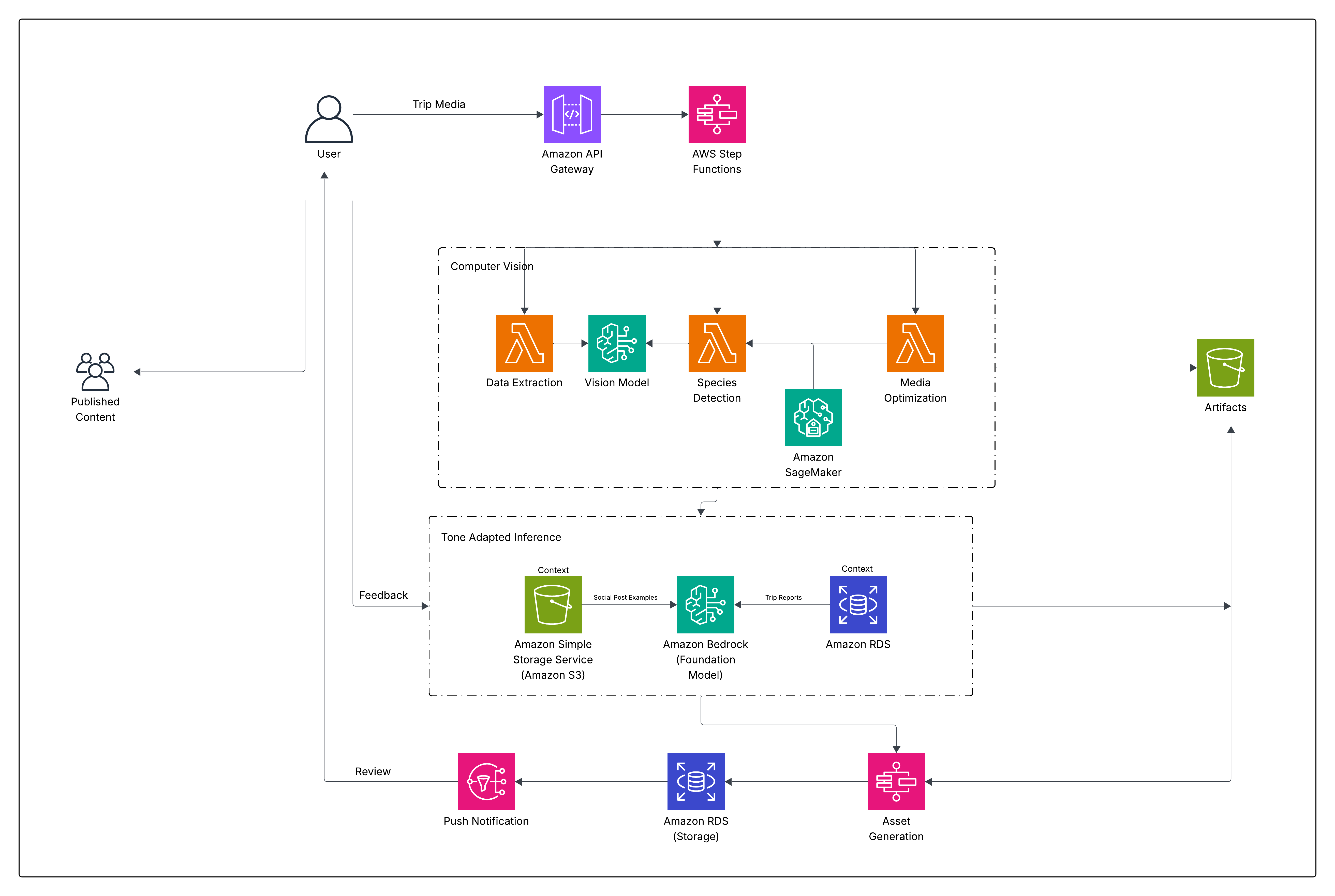
Trip media ingestion – Amazon API Gateway:
- Automatic trigger: Trip photos and videos uploaded by guides to enter the system through Amazon API Gateway , which immediately triggers the orchestration pipeline.
- Fresh content delivery: Media is processed as soon as it’s uploaded, enabling social posts and email campaigns to reach audiences while trips are still top of mind.
Pipeline orchestration
AWS Step Functions manage the workflow, invoking AWS Lambda functions for each stage—from data extraction and fish detection to media improvement, content generation, and publishing.
- Data extraction from media
- Automatic metadata capture: As soon as guides upload photos and videos, the system extracts embedded EXIF Metadata, including GPS coordinates, timestamps, and device settings.
- Contextual enrichment: The extracted geospatial information is then combined with relevant weather and water condition data for the same time and location. This captures details such as tide levels, water temperature, wind speed, and cloud cover—context that would otherwise be lost.
- Richer storytelling: By grounding each trip in the actual environmental conditions alongside what was caught, the system produces content that is more personalized, authentic, and engaging, without requiring additional effort from the guide.
- Scalable consistency: Whether processing a single image or hundreds, automation makes sure that every media artifact is enriched with high-quality contextual data, providing reliable inputs for downstream processes.
- Fish species detection using computer vision
Fish species identification is one of the core capabilities of the Jack AI system. The challenge is not only detecting fish in real-world images but also accurately classifying hundreds of species across highly variable environments such as boats, docks, lakes, and offshore locations.
To address this, we designed a multilayer computer vision pipeline that combines custom-trained computer vision models with foundation vision models available through AWS services.
Experimentation and model development
Our model development workflow runs primarily inside Amazon SageMaker AI using JupyterLab as the experimentation environment.
With this setup, we can:
- Rapidly prototype new computer vision architectures
- Run large-scale training jobs on GPU-backed instances
- Evaluate models across multiple fish classification benchmarks
- Iterate quickly between model improvements and production deployment
The SageMaker AI environment acts as the central hub where datasets, training scripts, and model experiments are managed.
Dataset and training challenges
Fish identification presents a unique machine learning (ML) challenge due to the large number of species and uneven data distribution. Our system currently supports over 400 fish species classes, collected from a combination of:
- Proprietary fishing report imagery from the Guidesly system
- User-submitted catch photos
- Curated datasets gathered from partner sources
While some popular species have thousands of training examples, many species have limited labeled images, which makes traditional supervised learning approaches difficult.
To address this imbalance, we use a hybrid training strategy:
- Standard supervised learning for species with large datasets
- One-shot and few-shot learning techniques for rare species where training data is limited
This allows the system to expand classification coverage without requiring large datasets for every species.
Multi-layer vision pipeline
Rather than relying on a single model, we implemented a two-stage vision architecture that separates object detection from species classification.
Detection Layer
The first stage uses YOLO-based object detection models trained to identify relevant objects within fishing images, including:
- Fish
- Fishing gear
- People
- Boats and environmental context
The detection models identify bounding boxes for each object. Instead of passing the entire image to the next stage, we crop only the detected fish regions.This approach significantly improves classification accuracy because it removes unrelated background elements that can confuse classification models.
Classification Layer
Each cropped fish image is then passed into a specialized classification model.Over the course of development, we experimented with several architectures including:
- Convolutional neural networks (CNNs)
- ResNet-based models for strong baseline classification
- One-shot and few-shot models for long-tail species recognition
The combination of architectures allows us to balance accuracy, inference speed, and training efficiency across hundreds of species classes.
Hybrid vision + foundation model approach
In addition to our custom-trained models, we integrate multimodal foundation models (FMs) available through Amazon Bedrock to provide additional reasoning and contextual understanding.
However, raw vision models can sometimes hallucinate or misinterpret visual scenes. To reduce this risk, we apply several preprocessing steps before sending images to foundation models:
- Image preprocessing
- Cropping detected fish regions
- Normalizing image dimensions
- Removing unnecessary background
- Context enrichment
- Media metadata (location, water body, time)
- Known species distribution
- Detection model outputs
- Structured system prompts
- Provide the model with contextual information about the image
- Constrain possible species predictions
With this hybrid approach, we can combine the precision of domain-specific classifiers with the reasoning capabilities of large vision models.
From research to production
After the models are validated, we deploy them using managed endpoints on Amazon SageMaker AI. This enables:
- Real-time inference on uploaded images
- Automatic scaling for large volumes of media
- Continuous monitoring and model updates
The result is a scalable vision system capable of processing thousands of fishing images across Guidesly’s system, delivering reliable fish species detection even in complex real-world conditions.
- Media improvement for faster, web-ready publishing
After fish detection and contextual enrichment are complete, Jack AI focuses on preparing media for real-world publishing. High-resolution photos and videos uploaded by guides are automatically processed into optimized, web-ready assets designed for use across websites, social networks, and email campaigns. This improvement pipeline handles compression, resizing, and format conversion behind the scenes. This makes sure that media files remain lightweight without sacrificing visual quality. By standardizing assets early in the workflow, Jack AI removes the need for manual image editing and maintains consistent presentation across devices and systems.
Improved media is stored as versioned artifacts in an Amazon S3 bucket and tagged for straightforward retrieval and reuse. These assets can be surfaced repeatedly across SEO pages, trip reports, newsletters, and social posts without reprocessing, keeping the publishing pipeline fast and efficient. Beyond performance, this step also supports SEO goals—fast-loading images to improve search rankings, enhance user experience, and reduce bounce rates on guide websites.
- Tone improvement
To make sure that generated trip reports feel authentic and aligned with the natural voice of fishing guides, a Tone Improvement layer was introduced within the content generation pipeline. Rather than modifying the underlying language model through fine-tuning, the system improves tone through contextual inputs and structured prompting. This preserves the distinctive storytelling style guides use while maintaining scalability and operational simplicity.
The foundation of this approach is context injection. Structured trip metadata is embedded directly into the model prompt, giving the model the grounded context it needs to generate accurate and relevant narratives. Alongside this, historical trip reports and guide-specific phrasing patterns are retrieved and included as reference examples. This helps the model mirror the vocabulary, pacing, and descriptive style that guides naturally bring to documenting their trips. Rather than training a custom model, carefully designed prompts guide the foundation model toward outputs that reflect the expected tone. This allows for dynamic adjustments to writing style without the operational overhead of maintaining fine-tuned models. To avoid fabricated details, the generation process is constrained strictly to the provided metadata and contextual inputs. The model is instructed not to infer missing information like additional species, techniques, weather, or locations absent from the source data, so every report remains consistent with the actual trip record.
Generation itself is executed using Amazon Bedrock FMs, which process the contextual inputs and structured prompts to produce coherent, domain-appropriate reports at scale. By relying on contextual prompting rather than model re-training, the system avoids training infrastructure, reduces operational overhead, and enables rapid iteration as new guide reports and domain patterns emerge. This approach struck the balance that the system needed: authentic, guide-style trip reports delivered with reliability, cost efficiency, and the scalability to grow as the system expands.
Publishing pipeline
After the content is generated, improved, and refined for tone, the publishing pipeline brings everything together to deliver marketing-ready assets across channels. This stage is designed to run end-to-end with minimal manual effort, making sure that guides stay informed while automation handles execution behind the scenes.
Asset generation is handled through an Assets Generation Step Function that orchestrates multiple AWS Lambda runs. These functions generate marketing deliverables from the artifacts stored in the S3 bucket for each trip. This includes SEO-friendly trip reports, fresh website content, social media posts, and personalized email campaigns. The outputs are automatically stored in the system and integrated into downstream publishing workflows, reducing the need for manual drafting, copywriting, or formatting. After the assets are ready, guides receive push notifications for review, so they can stay informed without unnecessary operational overhead.
Processed artifacts—including improved media, extracted trip details, and generated marketing assets—are stored centrally using Amazon RDS and Amazon S3. Amazon S3 provides durable, cost-effective storage for media and generated content, while Amazon RDS makes structured trips and guide data available for downstream workflows and reporting. Together, these services make sure that assets are immediately reusable across websites, social channels, and email campaigns without requiring additional processing.
Publishing controls remain flexible through AI-driven automation. Guides can review and approve generated content, request refinements, or rely on a built-in auto-publish toggle for full automation. With this flexibility, each guide can balance quality control with efficiency—remaining hands-on when needed or opting for a set-and-forget approach. Behind the scenes, AWS Step Functions orchestrate multiple AWS Lambda function runs, scaling automatically to accommodate hundreds of guides with minimal infrastructure management.
Cost considerations
While the architecture is designed to scale automatically, the cost per generated trip report remains relatively small. In typical scenarios, generating a full report—including media processing, computer vision inference, and content generation—costs approximately $0.10 to $0.50 per report. The final cost varies depending on factors such as the number of images processed, the presence of video media, and the volume of AI inference requests. Because the workflow is serverless and event-driven, guides only incur costs when reports are generated, keeping the unit economics predictable as usage grows.
Impact on outdoor recreation marketing
With Jack AI operating end-to-end on AWS, the impact extends beyond automation and into how outdoor recreation marketing is executed day-to-day. By combining AI-driven automation with AWS services, the process of generating, refining, and publishing marketing content has been reduced to a single, repeatable workflow. Outdoor recreation guides no longer need to spend hours drafting trip reports, formatting images, or scheduling social posts. Instead, these tasks are handled automatically, relieving guides to focus on what matters most: their clients and the outdoor experience itself.
The outcome is a consistent, high-quality digital presence across websites, social media, and email campaigns. Guides improve visibility, strengthen search rankings, and engage customers more effectively without the need for dedicated marketing staff.
Results
Since launching Jack AI on AWS, Guidesly has seen rapid adoption and measurable impact across its community of outdoor guides. By automating one of the most time-consuming parts of their work, marketing, Jack AI has reduced the operational effort required after each trip while helping guides stay visible and competitive online.
Previously, guides often spent more than six hours every week behind a laptop writing trip reports, formatting blog posts, creating social media captions, and attempting to improve content search. With Jack AI running on AWS, much of this work is now handled automatically. Trip photos and short notes uploaded by guides are converted into a complete set of marketing ready assets. This includes trip reports, SEO rich website content, social captions, and email updates, produced in minutes rather than hours.
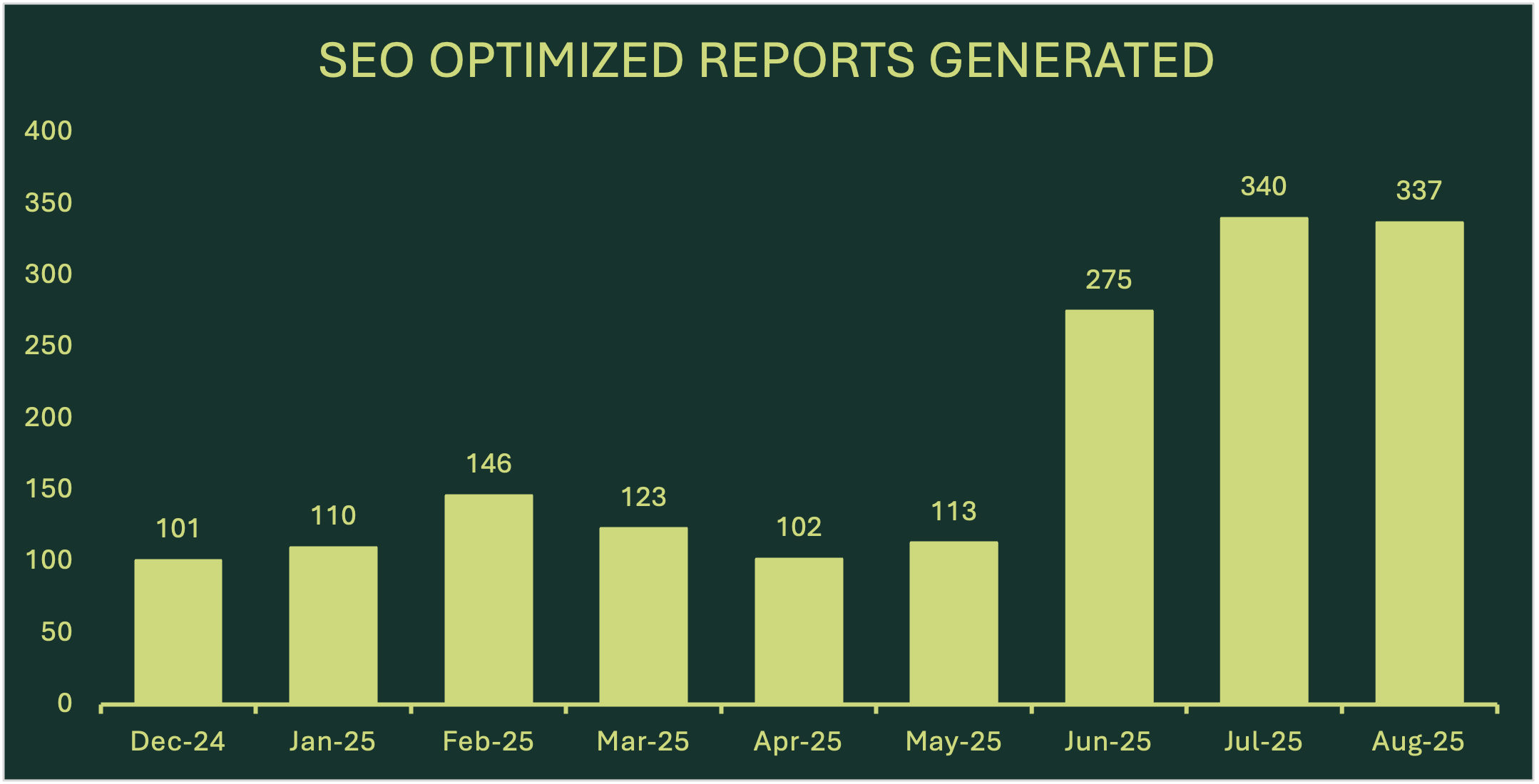
Jack AI adoption has steadily climbed, growing from just over 100 reports in early 2025 to nearly 340 reports by July 2025. This rise reflects a broader shift in our guides and the outdoor industry, where guides who once hesitated to embrace technology and digital marketing are now relying on Jack AI to build and grow their online presence.
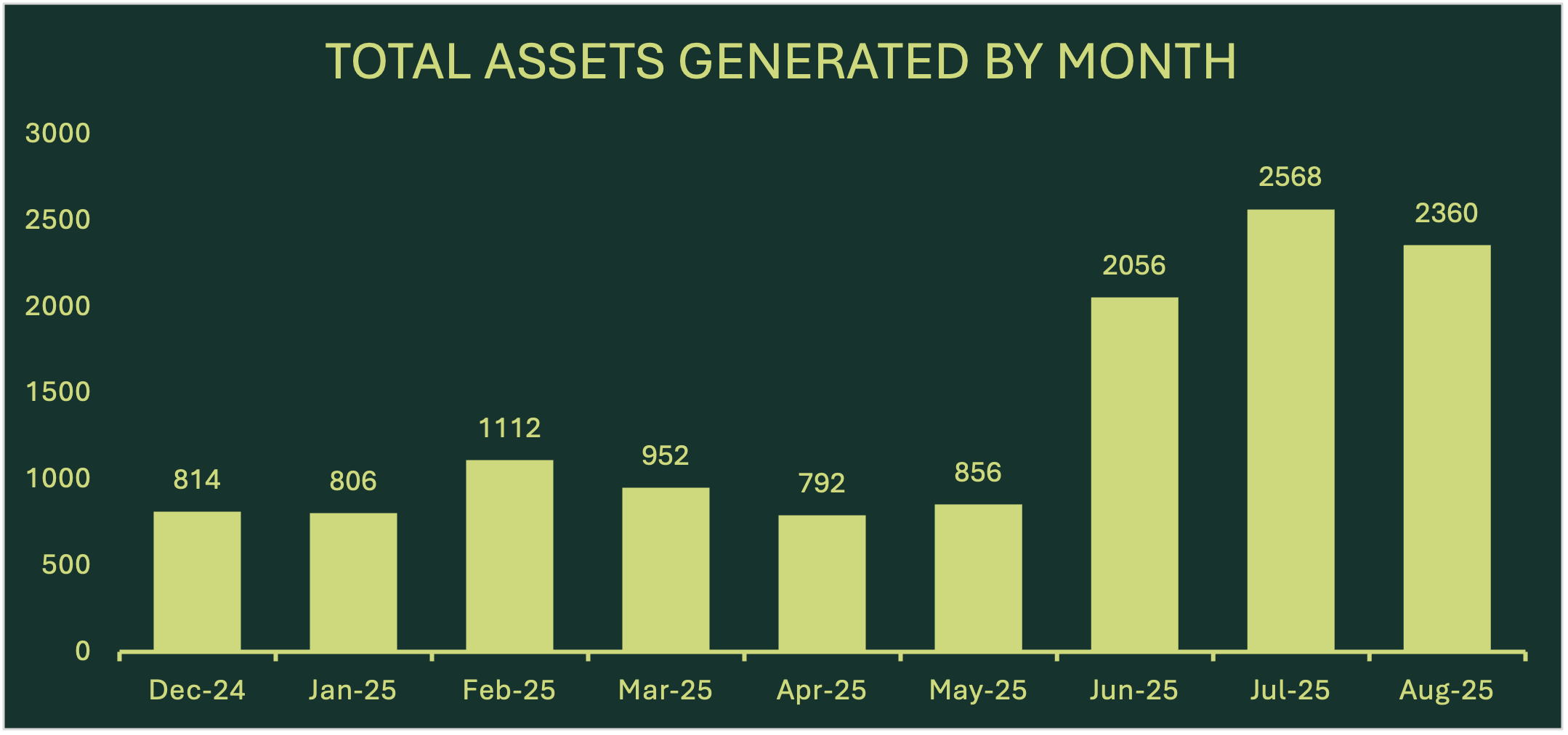
Content output has scaled dramatically, from under 800 assets in early 2025 to more than 2,500 by midsummer. Each trip report produces multiple deliverables—including SEO artifacts for guide websites, captions for Instagram and Facebook, and narrative descriptions tailored to email marketing—allowing guides to maintain an authentic, consistent presence across channels.
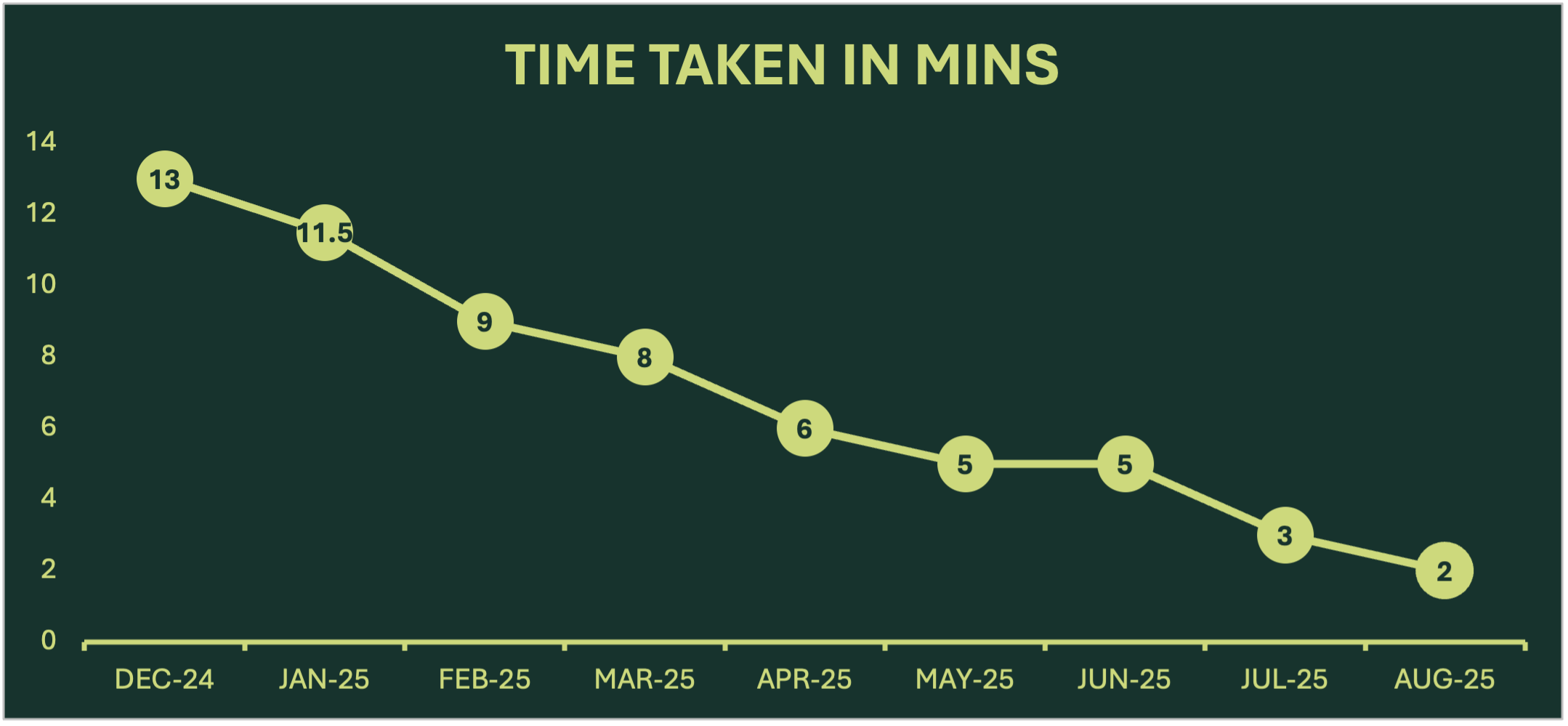
Content is delivered at peak relevance. With asset generation time dropping from 13 minutes in December 2024 to just two minutes by August 2025, Jack AI ensures that trip reports, social media posts, and email campaigns are ready almost immediately after a trip concludes. This speed allows guides to reach clients and their networks while the experience is still fresh, driving higher engagement across social channels and faster responses to post-trip emails. Automated emails showcasing recent trips reach past and current customers within hours, helping convert positive client energy into repeat bookings and word-of-mouth marketing.
Scaling revenue
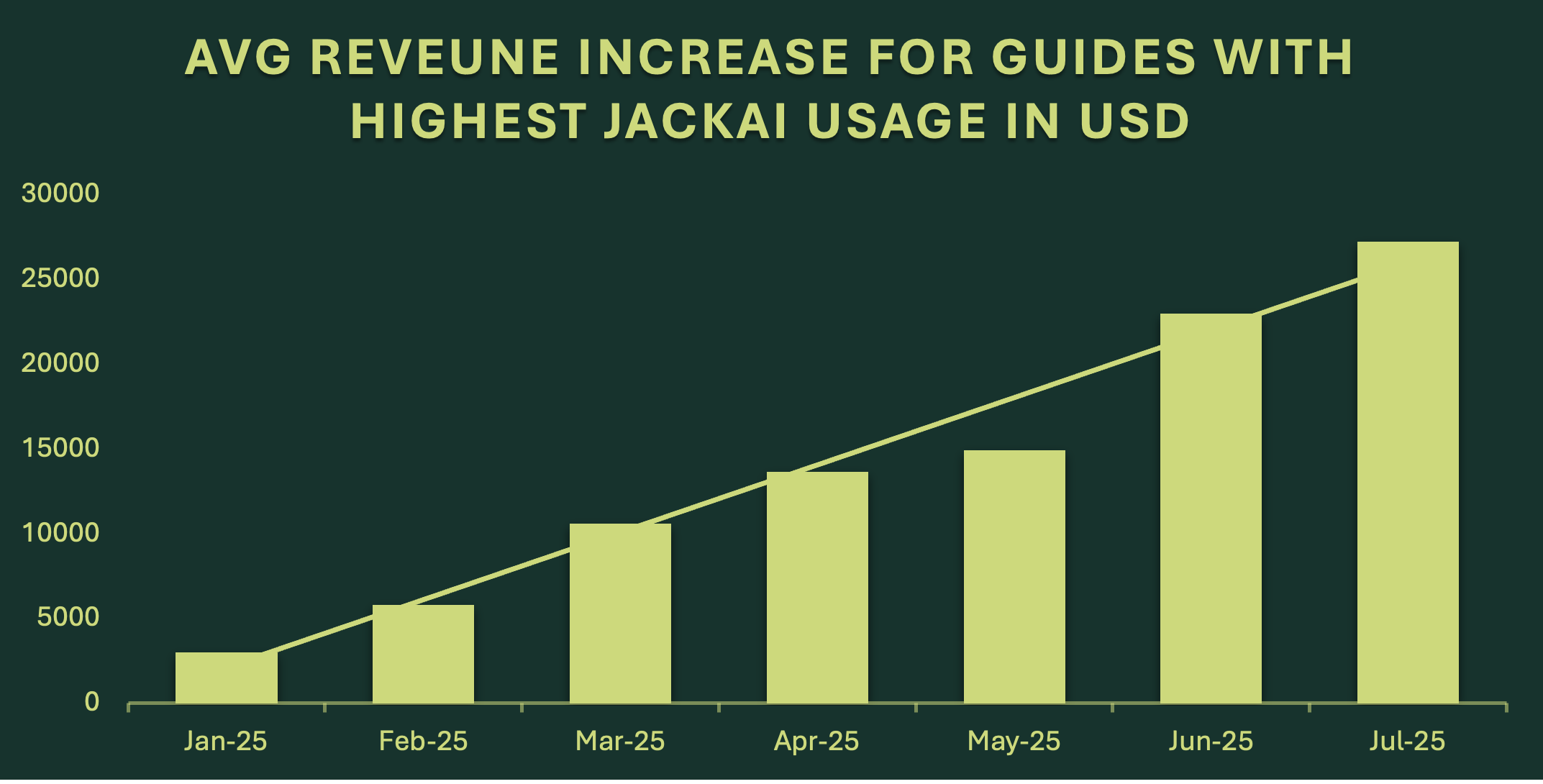
The financial impact of these improvements has been clear. Among the five most active guides using Jack AI:
- Average monthly revenue grew from approximately $3,000 in January 2025 to more than $27,000 by July 2025—a nearly 9× increase in just six months.
- Guides credited the growth to their ability to maintain a steady flow of content that boosted visibility in search engines, drove engagement on social networks, and ultimately converted into new bookings.
Conclusion
Perhaps most importantly, guides have embraced Jack AI not only as a reporting tool, but as a core part of running and growing their businesses. By automating trip report creation, SEO improvements, social media content, and email campaigns, Jack AI has become an integral part of daily operations, reducing the burden of marketing while maintaining the authenticity of each guide’s voice. Its ability to identify species, estimate size, and incorporate real-world trip conditions into content adds a level of detail and engagement that guides and their clients value. Jack AI delivers this functionality reliably and consistently, handling growing volumes of media and trip data without interruption. The system’s serverless architecture makes sure that as adoption continues to increase, performance remains high, and guides can focus on what they do best: delivering exceptional outdoor experiences. These results show how Jack AI helps outdoor guides recover hours spent on manual content creation, maintain a consistent online presence, and drive bookings. Built on scalable AWS infrastructure, the system turns a time-intensive task into an automated, repeatable workflow.
Know more about Amazon SageMaker AI to get started.
About the authors
“David Lord – CEO”
“David” is a 3x Entrepreneur and Ernst & Young Entrepreneur of the Year. David is a lifelong fly fisherman with 25+ years’ experience fishing with guides. Guidesly is a passion project that combines David’s passion for fly fishing, guide experiences and being an entrepreneur.
“Taylor Lord – Head of Product”
“Taylor” is an experienced product and marketing leader. Taylor was an InsureTech / AI startup Hi Marley (Series B) executive before joining Guidesly. Taylor has worked at two startups and is an excellent product and marketing executive.
“Shiva Prasad – Head of Technology”
“Shiva” leads the technology team in India. Shiva is a SaaS expert who has led development teams for 15 years. Shiva and David have worked together twice previously. This is his 3rd startup, formerly working for JumpStart Games & RazorGator.
“Anup Banasavalli Hiriyanagowda – AI Associate/Data Scientist”
“Anup” is an AI Engineer at Guidesly, who enjoys building real-world AI systems. He specializes in machine learning frameworks, large language models, computer vision, and scalable software pipelines, using AWS services to design and deploy production-ready solutions.
“Nikhil Chandra – AI Associate”
“Nikhil” Naveen Chandra is an AI Associate Engineer at Guidesly, specializing in serverless AWS architecture and AI-powered systems for large-scale communication and automation.