
A poll of Los Angeles voters released last week found Mayor Karen Bass leading Councilmember Nithya Raman by a wide and growing margin. Days earlier, a poll of Wisconsin’s Democratic gubernatorial primary showed democratic socialist Francesca Hong walloping Milwaukee County Executive David Crowley by more than 20 percentage points.
There were problems with both.
Crowley went on to comfortably defeat Hong in Wisconsin’s primary. And other polling of the Los Angeles race has shown a much tighter contest between Bass and Raman.
This wasn’t just another case of polling getting it wrong. These polls were fake. So was the polling company.
In response to inquiries from the Los Angeles Times, Median Strategies said it was all a test.
“Median Strategies was created as a short term social experiment to examine how purported polling information could enter and spread through the political information ecosystem without independent verification,” the company said in an email to the Times. “We are not seeking publicity or attribution for the individuals involved and are declining interviews.”
The experiment worked, at least to some extent. The California Post reported on the Los Angeles poll, declaring in a now-deleted headline that voters who had supported reality TV star Spencer Pratt in the primary could decide the election for Bass. Her campaign celebrated the results on social media before later deleting the post.
Real or not, polling has always presented journalists with a tricky proposition. There’s something irresistible about them. Hard numbers that appear to measure an election before it’s actually been decided? Who doesn’t want that?
But polls are estimates, not predictions. Their usefulness depends heavily on who conducted them, who they surveyed and how. Even the most legitimate polls can produce misleading snapshots of a race when stripped of that context.
That makes journalists important gatekeepers. An unknown poll can acquire credibility just because a news organization reports on it. And, as Median Strategies demonstrated, the appearance of a methodology, a sample size and a margin of error can make invented numbers look a lot like real ones.
I reached out to Kelly McBride, Poynter’s senior vice president for ethics and NPR’s public editor, who has written extensively about responsible polling coverage, to ask what this dustup means for journalism.
Ren LaForme: What obligation do journalists have to verify a pollster’s legitimacy before reporting its results?
Kelly McBride: Journalists have an absolute duty to ensure that, when they are reporting the results of a poll, they have verified that the polling firm is legitimate, that it is independent and that its polling methods are sound. We have struggled with this problem for a decade now.
There are many reasons that political polling can be less reliable now than it was in the past. It’s much harder to get a sample that mirrors the population. But using poll results from a firm that no one has ever heard of, that doesn’t have a track record and doesn’t make their methods available, is inexcusable, especially because there’s so much slop out there. Reliable journalism is where the public turns because everything else is so unreliable.
LaForme: Median Strategies said this was a “social experiment.” Does exposing weaknesses in the polling ecosystem justify deliberately injecting false information into it?
McBride: No. That’s the same argument that people use when they publish fake scientific studies. It exposes weaknesses in journalism. Also, it weakens the entire information ecosystem around politics and voting. In the same way that scammers make it less likely that you’ll believe it’s real when your utility company says they didn’t get your payment this month, fake information about an election makes it harder for the public to trust real information.
LaForme: If a news organization published a bogus poll, as The California Post did in this case, what does it owe its audience? Is a correction enough, or should it explain exactly how its reporting process failed?
McBride: This requires more than a correction. If you reported these fake poll results, the public deserves to know why you think they should trust you in the future. What are you going to do to fix the system that let this bad information through?
And this is even more important for broadcasters. Digital and print articles can be easily corrected. And their audiences have come to see honest corrections as a sign of transparency. But the broadcasters get very legalistic sometimes when deciding to put corrections on the air. They might argue that their reporting was accurate because it cited the poll.
LaForme: Polls are wrong all the time. Why is this so important?
McBride: When journalists report on political polling results, they risk changing the outcome of elections by influencing the behavior of voters. Some people might not vote to support their candidate because they think it’s a lost cause. Others might not bother because they feel like their preferred candidate has it in the bag already. For this reason, every newsroom needs to strongly embrace the best practices when reporting on polls:
- Only use reliable, known quantities.
- Understand the different polling methods and how reliable they are.
- Insist on knowing the sample size and what it was adjusted for. A good poll will attempt to mirror the population it seeks to represent, adjusting for race, income, education and other factors.
- Explain what the stated margin of error means to the poll, especially if the results could change and still be within the margin of error.
- Don’t hype polls that are outliers.
- Most importantly, because polls can be so misleading, don’t treat them as news. Instead, use polls to supplement election stories, rather than making them the sole focus of your story or your headline.
By Ren LaForme, managing editor
False copyright complaints are making news stories disappear
Multiple South Florida newsrooms are sounding the alarm over a new tactic for suppressing undesirable news stories: false copyright claims.
The issue came to light when multiple Florida newsrooms were notified that their stories about local entrepreneur and then-political candidate Michael Carbonara had been eliminated from Google search results over copyright issues. The takedown requests came in the weeks leading up to the Republican primary, which took place Tuesday. (Carbonara, who had been running to represent Florida’s 22nd Congressional District, lost the primary.) In a story earlier this month, WLRN reported that it and Florida Politics had been targeted by multiple complaints falsely claiming that their stories contained material stolen from other outlets. Google consequently removed those stories from its search results.
“WLRN has found that the effort largely paid off, making it nearly impossible for the public to find information about Carbonara’s data center connections or other critical coverage of the candidate through a basic Google search,” the WLRN story reported.
Last week, the South Florida Sun Sentinel reported that its articles about Carbonara had been targeted, too. It identified more than 100 news articles mentioning Carbonara from various outlets that had been removed from Google search results.
WLRN said in its report that it was unable to identify the origin of the false copyright complaints. Several of the complaints — which included “identical” language — came from different companies allegedly based in the United Kingdom that had minimal information online. The Carbonara campaign did not respond when WLRN asked if it had anything to do with the takedown complaints.
Though some of the news stories were restored after the news outlets petitioned Google for their reinstatement, the Sun Sentinel noted that the process can take up to 14 business days — a very long period of time in the run-up to an election.
“Because current federal rules encourage tech platforms to act immediately upon receiving a (copyright) notice, claims are often processed automatically without basic verification. That creates a system that is far too easy for bad actors to manipulate,” Sun Sentinel managing editor David Schutz said in the paper’s report on the issue. “That doesn’t just burden newsrooms that invest in original reporting — it directly undermines the public’s access to the news.”
By Angela Fu, media business reporter
ABC files First Amendment lawsuit against the FCC
ABC sued the Federal Communications Commission Tuesday, alleging that the agency had violated the company’s First Amendment rights by threatening to revoke the broadcast licenses of eight ABC-owned stations.
The lawsuit , filed in federal court in Washington, D.C., states that the FCC — which is supposed to function as an independent regulatory agency — has openly pressured and coerced ABC into changing its programming. As part of a “retaliatory campaign” against ABC’s speech, the FCC has decided to review eight ABC-owned stations’ licenses years before their expiration date, placing immense pressure on the station, the lawsuit states. It further argues that even if the FCC does not decide to revoke the licenses and force the stations off the air, ABC will suffer “years of costly litigation, with the threat of adverse action ever present” as the FCC conducts its review process.
ABC noted that the pressure has already influenced its editorial decisions — namely the decision to stream President Donald Trump’s July 16 prime-time address on its ABC News LIVE channel, which it ordinarily would not have done. In its lawsuit, ABC asked the court to stop the FCC from continuing its review of the eight stations’ licenses.
“If the Administration gets its way, the message to every media company in the country will be unmistakable: tell only the stories the Administration deems favorable, or face the coercive machinery of the federal government,” the complaint reads. “In such a world, the press could in no way be described as free.”
An FCC spokesperson told Deadline that the agency would “continue to follow the facts and law wherever they lead.”
“All broadcasters have a legal obligation to operate in the public interest — even (ABC parent company) Disney,” the spokesperson said. “The FCC has been examining claims that Disney engaged in illegal DEI discrimination for over a year.”
The FCC and its chairman, Trump appointee Brendan Carr, have repeatedly threatened ABC over its programming. In September, in response to ABC late-night host Jimmy Kimmel’s comments about the assassination of far-right influencer Charlie Kirk, Carr called on ABC to “take action” on Kimmel, saying “we can do this the easy way or the hard way.”
In response, ABC pulled Kimmel’s show off the air for several days.
In February, the FCC launched an investigation into ABC’s daytime talk show “The View” after James Talarico, a Democrat running for Senate in Texas, made an appearance. The complaint notes that no other candidates for public office have appeared on “The View” since the FCC started its investigations.
“Although there have been no changes in the program’s editorial standards regarding the newsworthiness of any candidate who might otherwise have been invited during this period the cumulative pressure from the FCC’s multiple actions against ABC has impacted the program’s decisions about which guests to invite,” the complaint reads. “Those escalating pressures have led Plaintiffs to be more circumspect in booking political candidates on The View, and have resulted in passing on further consideration of booking several political candidates.”
The conflict between ABC and the FCC came to a head in April when the agency said it would review several ABC stations’ broadcast licenses early. Among those licenses, the earliest expiration date is Dec. 1, 2028, and the vast majority will not expire for at least another four years. The complaint notes that Trump himself has called on the FCC to revoke ABC’s licenses multiple times and says the early review is unprecedented.
“The Commission’s early license renewal proceedings threaten the potential loss of the Stations’ valuable broadcast licenses, without which the Stations cannot operate,” the complaint states. “And this is on top of the fact that Plaintiffs have been forced to respond to over 600 separate requests, producing more than 13,000 pages of documents responding to the Commission’s sweeping discovery demands in two separate investigations.
“Faced with such a burden, any broadcaster would question whether its speech is worth the cost.”
By Angela Fu, media business reporter
White House rapid response team involves CNN reporter’s children in attack
The White House on Monday launched a personal attack against CNN reporter Kristen Holmes after she asked President Donald Trump a pointed question, with its rapid response account going so far as to invoke Holmes’ children .
At a news conference, Holmes, a senior White House correspondent for CNN, asked: “Jon Ossoff said you’d rather travel with your aide Natalie Harp and build the ballroom than do your job as president. What is your response?”
Trump called Ossoff a “Pee-wee Herman look-alike.”
“No, I would much rather do other things,” Trump continued, adding that they’re “building a great facility here” and “fixing a White House that hasn’t been taken care of.”
Trump later lashed out at Holmes, interrupting her and demanding that she be quiet.
The White House’s rapid response team later took to X, tagging Holmes’ handle and calling her a “disgraceful, humiliating embarrassment to her alleged profession.” The account then sent a follow-up tweet , saying her children would be “sickened and embarrassed to have a parent be so callous and vindictive.”
The administration’s rapid response team was launched last year with a stated objective to “support President Donald J. Trump’s America First agenda and hold the Fake News accountable for their lies.”
CNN stood by Holmes, a mother of two, with its CNN Communications team also using X to reject the attacks. Its statement read: “Kristen Holmes is one of the most respected and accomplished journalists covering the White House. This afternoon, she did her job and asked the President of the United States a tough, relevant, and newsworthy question on behalf of the American people. Public officials are free to challenge reporting they disagree with, but personal attacks on journalists for asking questions are beneath the office and inconsistent with the principles of a free press. We stand firmly behind Kristen and reject those attacks in the strongest possible terms.”
By Amaris Castillo, staff writer
ESPN founder Bill Rasmussen dies at 93
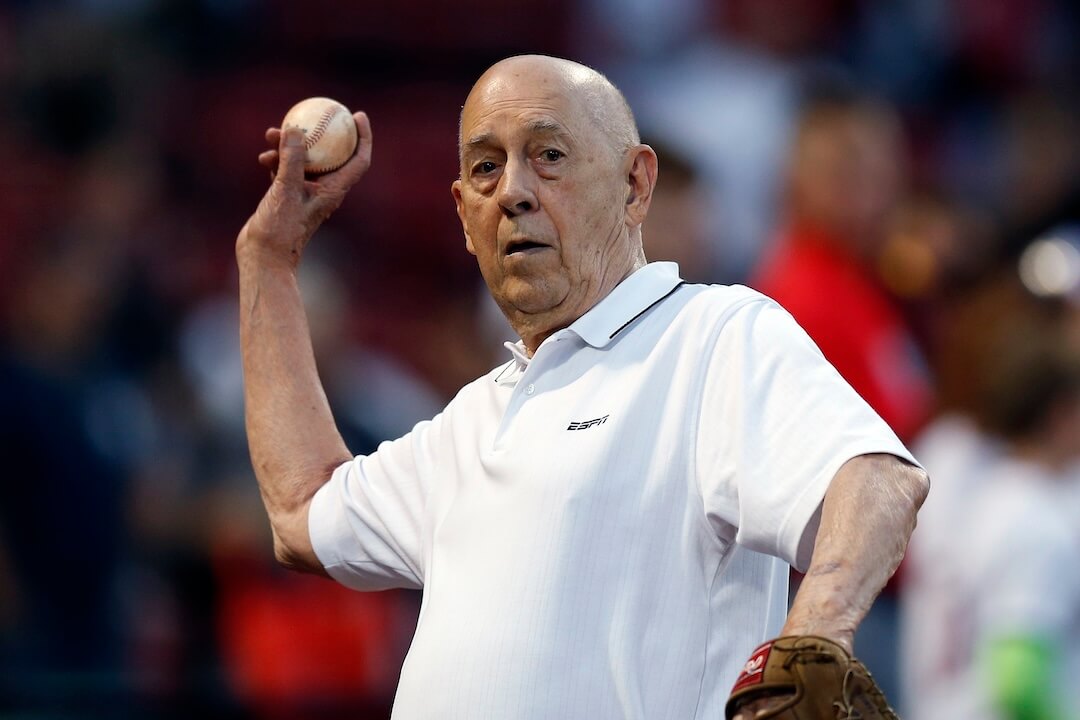
ESPN founder Bill Rasmussen tosses a ball before a Boston Red Sox-New York Yankees game Sept. 8, 2019, in Boston. Rasmussen, whose idea for a 24-hour sports network transformed sports media, died Tuesday at 93. (AP Photo/Michael Dwyer)
Bill Rasmussen, the founder of ESPN, which revolutionized sports media, died Tuesday. He was 93.
“Rasmussen’s vision, along with his son Scott, of a 24-hour sports TV network was a wildly innovative idea in the late 1970s, and initially met with skepticism,” wrote Dan Shanoff and Mark Puleo for The Athletic . “A few years later, ESPN was a media fixture.”
The network said Rasmussen died from the effects of Parkinson’s disease.
In 2024, Rasmussen spoke with ESPN’s Jeremy Schaap as part of a celebration of the network’s 45th anniversary.
“I’ve never really been one to stand up and say, ‘Look what I did,’” Rasmussen said, adding that many people had no idea who he was when he walked into a room. And that’s fine, he said.
ESPN Chairman Jimmy Pitaro described Rasmussen as a remarkable man, a visionary and an innovator. “Quite simply, none of us would be here today if it wasn’t for Bill’s passion and all the hard work and entrepreneurial spirit he put into building ESPN in the late 1970s — key aspects of our company culture that still carry on to this day,” Pitaro said.
Before founding ESPN, Rasmussen was fired as communications director for the NHL’s Hartford Whalers. He had a family to support and began pondering his next move. According to Cronkite News , an idea came to Rasmussen over coffee.
“I thought, why not a channel that’s on all the time?” he recalled. “Sports don’t stop at six o’clock.”
It was a radical idea at the time. Sports at the time were very much rationed to viewers.
Rasmussen secured financial backing from Getty Oil in exchange for an 85% stake in the new company.
“That was tough to take,” Rasmussen recounted. “If I didn’t give up the control, we would have lost the idea.”
Rasmussen and his son Scott founded the Entertainment and Sports Programming Network and broke ground on a headquarters in Bristol, Connecticut. On Sept. 7, 1979, ESPN launched with the first broadcast of its new show, “SportsCenter.”
Rasmussen was later ousted from the company he founded. According to The Athletic, the relationship between Rasmussen and ESPN was strained for nearly two decades afterward, until outreach from ESPN’s then-president George Bodenheimer ahead of the network’s 20th anniversary “brought Rasmussen back into a venerated place.”
In 2019, Rasmussen publicly announced that he had Parkinson’s disease. In an essay published by ESPN, he said he hoped to help others affected by the progressive brain disorder.
“ESPN has proven how powerful strength in numbers can be: From only a few viewers on cable television opening night in 1979 to access to the entire population of the globe in 2019!” Rasmussen said. “Today, a cure for Parkinson’s remains elusive, but by raising awareness, I hope thousands will bring new interest, new talent, new research and new dollars to bear on this insidious disease.”
In his 2024 interview, Schaap asked Rasmussen what it was like to see the network grow in the way that it did as its creator.
“Of course I’m proud of ESPN,” Rasmussen said. “Who wouldn’t be?”
By Amaris Castillo, staff writer
Stephen A. Smith is still talking about his NABJ ‘Thumbs Down’ award
On Saturday, at its annual gala, the National Association of Black Journalists gave Stephen A. Smith the “Thumbs Down” award for what the association called his “pattern of disparaging commentary directed at prominent Black women across politics, sports, and media.”
As we wrote in Monday’s newsletter, Smith wasn’t too happy about it, firing off a tweet that said, among other things, “I’ve shut my mouth for years. Now y’all started something.”
On Monday, he responded again, calling on NABJ president Errin Haines to discuss the award on his show.
In a 44-minute video posted to his YouTube channel titled “I Was Blindsided by the NABJ—Now I’m Responding,” Smith claimed that the NABJ’s decision to give him the award was personal and had nothing to do with journalism.
Smith has been vocal about his political beliefs , including occasional praise for President Donald Trump, and repeatedly hinted at a future presidential run. He has also publicly critiqued figures such as former Vice President Kamala Harris, former first lady Michelle Obama and Democratic Rep. Jasmine Crockett of Texas.
In his video, Smith suggested that partisanship was at play.
“If I had said this about a Black female conservative, any of the things I said about Jasmine Crockett, Kamala Harris, Michele Obama, would we be having this conversation?”
While Smith conceded that he is “far from perfect,” he maintained that he has supported the NABJ and Black journalists for decades. He also pointed to his previous relationship with the NABJ and his ESPN show, “First Take,” which hosted live broadcasts from the NABJ’s 2024 and 2025 conventions.
Haines declined to appear on Smith’s show, instead suggesting that they speak privately, off the air.
By Phoenix Chapital, intern
Media tidbits and links
- Stat, the news site that focuses on health and medicine, announced a hire for an interesting new position: trust in science. Nicholas Florko, who has worked as a staff writer at The Atlantic, “will pioneer a new beat covering declining trust in science and producing explanatory and accountability journalism that helps readers understand where and why trust is breaking down as well as the consequences of that skepticism,” according to a Stat release . Margaret Manto will also join Stat and be based in Washington, D.C., where she will report on the Food and Drug Administration, including its oversight of the biopharmaceutical industry.
- Meanwhile, The Atlantic has hired Gabby Deutch and Ian Bogost as staff writers, and Nick Summers and Talya Zax as senior editors.
- The Hollywood Reporter’s Etan Vlessing writes “Peacock Reveals Another Price Hike After NBCU Streamer’s First Profitable Quarter.” Peacock Premium, which includes ads, will be $12.99 per month, up from $10.99. Peacock Premium Plus, which is ad-free, will go up by $3 to $19.99 per month.
- Penguin Random House suspended promotion and public sales of journalist Ross Barkan’s forthcoming book “The Revolutionary: Zohran Mamdani and the Remaking of American Politics,” which was set for an October publication, following allegations of extensive plagiarism in political columns he wrote as a freelancer for New York Magazine. For more, The Washington Post’s Scott Nover wrote “Publisher suspends sales of journalist’s book after plagiarism review.”
- The New York Times’ Cecilia Kang, Eli Tan and Emmy Martin with “States Seek $200 Billion From Meta Over Child Social Media Addiction Claims.”
- The World Cup and NBA Finals drove a 118% increase in broadcast viewing in June, writes TheWrap’s Lucas Manfredi .
- Front Office Sports’ Ben Axelrod writes “NBA Rips ESPN Reporting on Kawhi Leonard Investigation.”
- Reuters’ Dawn Chmielewski, Rollo Ross, Harshita Mary Varghese and Lisa Richwine with “Microdramas boom in a shrinking Hollywood as studios chase a TikTok audience.”
- NPR’s Rhitu Chatterjee with “She told no one about her agony except ChatGPT. What her death reveals about AI risks.”
- “The power grid relies on thousands of aging, hand-built transformers. If enough fail, the blackout could last years,” writes The New York Times’ Christopher Cox in “What if America Went Completely Dark?”
More resources for journalists
Learn critical skills that new managers need
in this dynamic, in-person, five-day workshop: Nov. 16-20, 2026, in St. Petersburg, Florida. Apply now.
Learn how to write a memoir
with expert guidance in a five-week virtual workshop. Enroll now
.
Strengthen your investigative reporting
with Will Work for Impact: Fundamentals of Investigative Journalism
Have feedback or a tip? Email Poynter senior media writer Tom Jones at [email protected] .
The Poynter Report is your daily dive into the world of media, packed with the latest news and insights. Get it delivered to your inbox Monday through Friday by signing up here . And don’t forget to tune into our biweekly podcast for even more.