
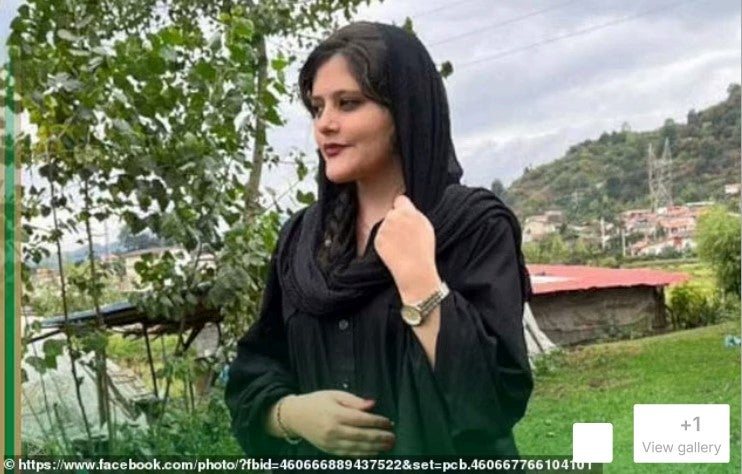
Mahsa Amini picture initially used by Mail Online sourced from Facebook
A news agency journalist says the Mail and Telegraph have racked up around £100,000 in legal fees defending claims for picture usage worth less than £200.
The case centres around the long-standing practice of news agencies billing retrospectively on a per-use basis for words and images sent out to publications.
Costs have mounted as the publishers have employed specialist external legal counsel to fight the small claims court cases in hearings and exchanges of legal letters.
Michael Leidig and Central European News sued The Telegraph over a picture of Joseph Bynans, who died in a shark attack in Mexico. The picture was sourced from social media, but CEN claims to have sourced and verified the picture and embedded a digital provenance marker in it to prove usage.
The Daily Mail claim relates to a picture of Iranian woman Mahsa Amini , who was beaten to death in Iran in 2022 for not wearing a headscarf. Again the picture was sourced from social media and verified by CEN’s sister agency Newsflash, which added markers to the supplied image to prove usage.
The Telegraph spent £50,000 on counsel and pre-trial documents for three county court small claims hearings, and has racked up another £18,000 preparing for other hearings, according to documents shared with Leidig.
Given the Mail claim has been running longer and involves the same external law firm (Wiggin) and barrister, Leidig believes £100,000 is a conservative estimate for the total costs he could ultimately be held liable for across both claims.
He said: “Both publishers argue that because facts or orphan illustrations cannot be copyrighted, they have no obligation to pay for content sourced through aggregators and syndication platforms from the editorial work of the agencies Newsflash and CEN.
“That argument misrepresents how the industry has worked for over a century. Payment was never for copyright ownership. It was for the editorial labour of identifying, verifying and distributing the material in the first place.
“When a publisher takes that work from a secondary source and uses the absence of a copyright claim to avoid paying the agency that originated it, it is not applying copyright law. It is using copyright law as a mechanism to extract value from editorial work without paying for it.
“The rest of Fleet Street continues to apply the existing standard: payment is due if proof of use is shown.”
In a submission about the Telegraph case to the UK Department of Culture Media and Sport, Leidig said: “This story started with a routine request like thousands of others before it – correct a photo credit, pay a standard agency fee.
“That refusal has now become a legal dispute lasting years that has cost not only time and tens of thousands of pounds on both sides, but more importantly, accelerated the quiet erosion of a principle that once held the UK media economy together.
“The principle is that when an accredited news creator provides clearly identifiable editorial work – identifies a story, verifies the facts, prepares the material, and delivers it to a publisher who benefits from it, then that contribution needs to be recognised.”
In rejecting Leidig’s claim, The Telegraph said it sourced the image in question from another agency – Jam Press – who were credited as the source. It also said that Leidig’s claim must fall down because he does not own the copyright for the image.
But Leidig said: “The fact is that the image telegraph.co.uk published was from CEN as it had the CEN secret mark, but the CEN metadata had been removed, and it had been published with a third party’s credit.
“CEN cannot know who did this, but presumably, somebody copied it from the Daily Mirror, which had credited CEN as the source and had published more than 24 hours earlier.”
Mail publisher Associated Newspapers has sought to get Leidig’s claim thrown out because he does not own the copyright in the Mahsa Amini image.
It also said that it published several stories about Amini and credited and paid whichever agency supplied the images in each case. It said CEN was credited and paid for use of the image on four occasions.
A spokesperson for DMG Media said in February 2025: “The social media image around which this case centres was supplied by a number of news agencies, none of whom asserted copyright. Nonetheless, each separate version used was attributed correctly according to its origin.
“Mr Leidig’s agency is not owed any payment by Mail Online for the image and we intend to vigorously defend ourselves against his baseless claim.”
Email [email protected] to point out mistakes, provide story tips or send in a letter for publication on our “Letters Page” blog