
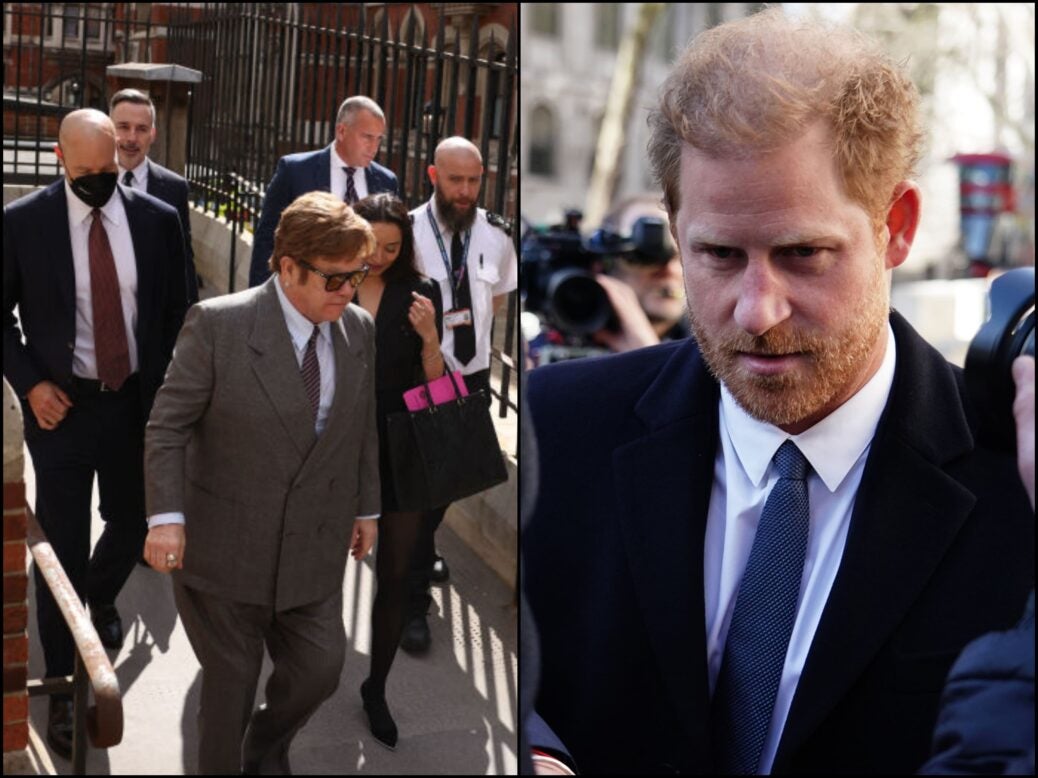
Sir Elton John and David Furnish (left) and Prince Harry (right) arrive at the High Court in London on Monday 27 March 2023 for a hearing in their unlawful information gathering action against Mail publisher Associated Newspapers. Pictures: Dan Kitwood/Getty Images and PA Wire/Jordan Pettitt
At the close of an epic 11-week privacy trial Associated Newspapers contended that “ordinary, legitimate journalism” was behind the stories at the centre of legal claims – not phone hacking.
The Duke of Sussex , Sir Elton John and Baroness Doreen Lawrence are part of a group alleging stories dating back 20 years or more were the result of hacking, landline tapping, blagging and other illegal methods at the Daily Mail and Mail on Sunday.
Lawyer for Associated Antony White KC said that the group of claimants, which also includes David Furnish, Liz Hurley, Sadie Frost and Sir Simon Hughes, “bear the burden of proof” over their allegations.
He said: “Where criminal conduct is alleged, the starting point is not an assumption that it happened unless it is disproved.”
And he said there was an “inherent improbability” in the case.
He said: “Ordinary, legitimate journalism, often drawing on previous reporting or confidential sources, is usually more likely than phone hacking or phone tapping or other forms of unlawful information gathering.”
The barrister said that 40 journalists had been identified in the claims, with many of them giving evidence.
He continued: “What is even less likely still… is that if the 40 journalists were all engaged in serious unlawful information gathering, they would have all made witness statements and queued up to come to court to be cross-examined.”
He said the claim had been conceived by press reform campaign group Hacked Off as a “political campaign”, and that the publisher had mounted a “robust and comprehensive” defence.
Referring to the allegations made by Harry, the barrister said the duke was “inclined to see unlawful evidence gathering, in particular voicemail interception, everywhere”.
He added that the claims were “without any foundation” and that “the evidence at trial has shown that the information in the articles was sourced conventionally from a mix of contacts of the journalists responsible”.
Selected Press Gazette trial coverage:
Signature on crucial Prince Harry privacy case statement ‘forged’, says key witness
Mail’s Katie Nicholl says ‘nonsense’ hacking claims damaged her career
‘Hacked’ Daily Mail Harry story came from press office, says royal editor
Stories came from lonely celebs and ‘hangers on’ says former Mail on Sunday editor
Senior former policeman casts doubt over key Prince Harry privacy case source
Daily Mail’s Stephen Wright ‘devastated’ by Doreen Lawrence hacking claims
Paul Dacre says hacking and tapping claims ‘grave, preposterous, deeply upsetting’
Doreen Lawrence accuses Mail of ‘pretending to be her friend’ while stealing her private information
Most serious allegation against Mail struck out ahead of Prince Harry privacy trial
Cash for witnesses: Prince Harry legal team’s tactics revealed ahead of Mail privacy trial
Celebrity claimants seeking substantial damages
David Sherborne, for the group of household names, said in written submissions that unlawful information gathering was “carried out by a range of characters”, including freelance and staff journalists as well as private investigators.
He continued: “All are unlawful, and all offend the private lives of those at whom they are targeted.
“The defendant has never accepted responsibility for a single such act.
“This striking position has been maintained throughout the trial.”
The barrister also told the court in London that the evidence of ANL’s witnesses was in “a great many cases not relevant, or simply entirely ineffectual because they claimed not to remember anything material”.
He added that as a result of allegedly unlawful articles, Lady Lawrence feels a sense of “profound betrayal”, Hurley has a clear sense of “violation”, and Sir Elton and Furnish “feel that their home, and the safety of their children and loved ones, has been violated”.
In relation to Harry, he said the duke set out his “shock and horror” that ANL has used its ”journalistic power and privilege to commit unlawful acts against him without any legitimate justification and in order to compete with other tabloid newspapers for profit”.
Sherborne said that the group of household names should be awarded “substantial” damages for misuse of their private information, as well as for breach of confidence in Lady Lawrence’s case.
Judge Mr Justice Nicklin said a decision in the case “will take some time” with his written judgment expected at some point in the summer.
Highlights of the 11-week High Court showdown
The civil trial included:
– During around two hours of cross-examination in January, Harry said he could not complain about some of the 14 articles in his case at the time “because of the institution I was in”. He also said in his written evidence that “knowingly false” information was added to stories to “put me off the scent”, to conceal unlawful methods, including voicemail interception.
– Lady Lawrence claimed the Daily Mail was “pretending” to support her in getting justice for her son Stephen Lawrence, who was murdered in a racist attack in 1993. Her lawyers claim she was “extensively targeted” by private investigators to obtain information, including through corrupt payments to police.
– Sir Elton and Furnish alleged ten articles about them were based on unlawful information gathering, including unlawfully obtained medical information and landline tapping. The couple claimed their son Zachary’s birth certificate was stolen before they received a copy, with the Rocketman singer telling the court their case “contains the most horrendous things in the world that you can ever suffer from a privacy point of view”.
– Frost claimed that information behind some articles about her had been “hacked from my voicemails”, as they “were word for word” from her messages. Part of her claim relates to an unpublished article about a 2003 ectopic pregnancy, which Frost said she only told her partner and “maybe also one of her very close friends”. The group’s barrister, David Sherborne, said an ANL journalist found out details about the pregnancy and subsequent termination which “must be from unlawful information gathering”.
– Sherborne said that ANL would not have needed to use private investigators to find information available through lawful resources, such as directory enquiries and genealogists, but instead used them “to obtain information that by its very nature, is bound to have been obtained unlawfully in the absence of evidence to the contrary”. This included the alleged blagging of medical records, bank information and travel arrangements.
– ANL said legitimate sources for stories included friends and “leaky” social circles, press officers and spokespersons, as well as previous reporting, freelance journalists and stories from other newspapers and news agencies. Giving evidence in March, Katie Nicholl, the former diary editor of the Mail on Sunday, said that not all of Harry’s close friends were “tight lipped”, and that she had “real contacts genuinely close to Prince Harry”.
– More than 40 witnesses were involved in the trial on behalf of ANL, including former Daily Mail editor Paul Dacre, who said in his written evidence it was “inconceivable” that anyone at the paper would have carried out the alleged activities. He later said the claims had had a “deeply upsetting” and sometimes “traumatic” impact on staff at the paper, adding: “I have witnessed the anguish of honest, dedicated journalists who, for three years now, have had an insidious dark shadow hanging over their lives.”
– ANL said the claim had been conceived by press reform campaign group Hacked Off, as part of a “political campaign to show that Associated had misled the Leveson Inquiry with a view to putting pressure on the Government to implement part two of that inquiry”. Dacre told the court he “emphatically” denied an allegation that he lied to the inquiry into press standards.
– The trial also heard arguments over whether the cases were brought in time, as the law states that legal action related to unlawful information gathering must be launched within six years of someone discovering they could have a claim.
– ANL argued the cases were brought too late and the group should have known that they could have brought a claim sooner through media reporting of the phone hacking scandal and the Leveson Inquiry. White said there was evidence of “actual knowledge” in Hurley’s claim, and “an overwhelming case of constructive knowledge” for the whole group. White also said that Sir Simon and Frost took steps to “camouflage the true position” in relation to when they knew they could have a claim.
– The court heard evidence from private investigator Gavin Burrows, who allegedly said in a witness statement in August 2021 that he targeted “hundreds, possibly thousands of people” through voicemail hacking, landline tapping and accessing financial and medical information for a journalist at the Mail On Sunday. But in a statement last year, Burrows denied ever conducting unlawful information gathering on behalf of ANL and said that his purported signature on the 2021 statement was forged.
Email [email protected] to point out mistakes, provide story tips or send in a letter for publication on our “Letters Page” blog