
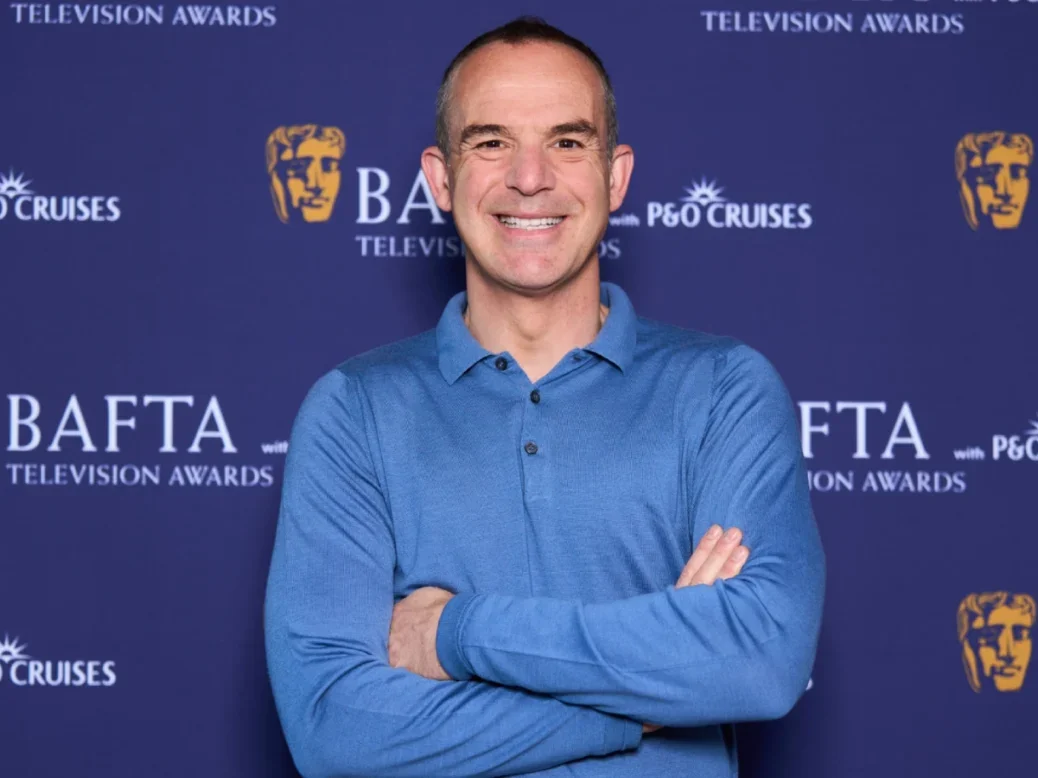
Martin Lewis at the BAFTA Television Special Award Media Breakfast on Wednesday 29 April 2026 in London. Picture: BAFTA/Scott Garfitt
Financial journalist Martin Lewis CBE has said social media scam ads that use his name and face to dupe unsuspecting consumers have become “worse than ever”.
Lewis sued Facebook for defamation in 2018 over ads appearing on the platform which stole his image and settled the case after Meta agreed to donate £3m to charity and create a new reporting button.
But such ads continue to proliferate years later, conning people out of money by wrongly making them believe Lewis has backed questionable financial products.
Lewis was speaking at a press conference on Wednesday as it was announced he had been awarded the BAFTA Television Special Award in recognition of his “extraordinary and lasting impact on British consumers and public life”.
Lewis founded the Money Saving Expert consumer finance website, has an ITV show called The Martin Lewis Money Show Live, and is a presenter and expert on Good Morning Britain.
In response to a question from Press Gazette about how he continues to fight the tech giants on scam ads, Lewis said it is “worse than ever” and described the ads as a “deliberate perversion of my name, reputation and work by organised criminals around the world”.
In 2024, Lewis’s identity was used in 44% of 537 reports made to Action Fraud relating to ads using someone else’s name , just ahead of Elon Musk (40% of reports).
Even as Press Gazette was writing this story on Wednesday, a member of the team saw Lewis appear in a scam ad alongside their Yahoo email inbox. The ad clicked through to a fake news website emulating BBC News branding.
Many other scam ads make it appear Lewis has endorsed products when he has not, leading to consumers who thought they were receiving advice from him ending up out of pocket.
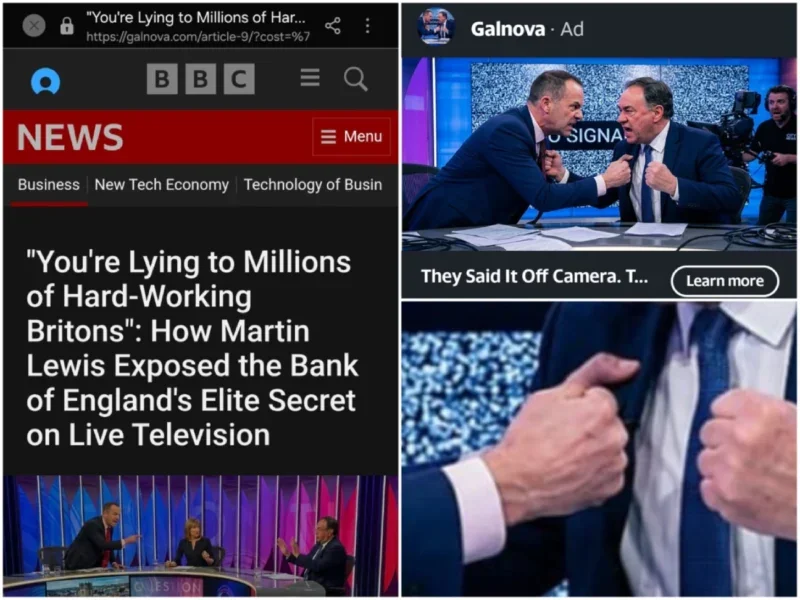
Fake news scam ad including Martin Lewis, and the ‘news story’ it clicks through to, spotted by Press Gazette on Wednesday 29 April. Image also includes close-up of AI hand.
Other journalists whose trusted expertise has been used by ad scammers include CNN anchor Richard Guest, CNBC commentator Karen Finerman and Financial Times commentator Martin Wolf.
Meta earns $3.5bn (£2.6bn) every six months from only the portion of scam ads that “present higher legal risk” such as those impersonating public figures like Lewis, according to Reuters which revealed data from internal documents last year.
Martin Lewis ‘angry’ about scam ads and ‘bullshit’ from tech companies
The issue has got worse, Lewis said, because these ads now extend to deepfake AI videos appearing to show him recommending financial products and investment schemes.
Lewis said there is a limited amount he can do about the ads as “I’m not Meta, I’m not X. I can’t take them down.” But he has the equivalent of one member of staff working on the issue full-time. “We’re having to pay for that,” he added.
“The problem is television, when it does advertising, has to vet its advertising. A newspaper, when it does advertising, has to vet its advertising and make sure it’s fine. The way social media advertising works is they want it to be quick and easy, so there’s no vetting,” Lewis said.
“So it’s not that they want scam ads, it’s that they just want anybody to be able to advertise at an instant, without checking. I have been in meetings with these people, and they always talk to me about technological solutions.”
He described this as “bullshit” and said he told a tech company: “You’re framing this as a technology problem. Employ people to vet every advert. It’s only your choice that this is a technology problem. That’s a function of profitability. Now, if you have a moral compass, you stop scam adverts that destroy lives.”
Lewis noted that regulators will have more powers to tackle scam ads under the Online Safety Bill but that this is not coming into force until 2027 at the earliest – and will only cover the big tech giants, meaning the issue could continue on smaller websites.
“So social media is still an absolute wild west. You have no protection… We have an absolute epidemic of scams in this country.”
Lewis said that as well as being angry with the criminals themselves, he is “massively angry with social media companies who should be denying them the oxygen and publicity [and] hugely angry with the political classes who dithered…”
Meta introduced a tool for businesses to report scam ads on its platforms “at scale” last summer and has built specific detection models for what it calls “celeb-bait” including facial recognition technology.
Meta spokesman Andy Stone said last year that Meta “aggressively fight[s] fraud and scams because people on our platforms don’t want this content, legitimate advertisers don’t want it and we don’t want it either”.
Why Martin Lewis is ‘proudly a journalist’
Lewis told the press event he defines himself as a journalist rather than a financial advisor, which he said is a common misconception he has faced.
He did a postgraduate diploma in broadcast journalism at Cardiff University before working at the BBC and a satellite channel called Simply Money and then setting up Money Saving Expert in 2003.
The website is now ranked 12th in Press Gazette’s list of the 50 biggest newsbrands in the UK , with a monthly audience of 14.3 million people and 201 million minutes spent with its content in March.
Money Saving Expert has been a winner in recent Google algorithm updates , likely due to Google prioritising the type of original and trusted expertise it publishes.
Lewis said: “I’m so proudly a journalist. I think we have an amazing trade that can really do great. And look, there’s a lot of crap stuff that’s written out there and horrible clickbait that goes on out there that is disruptive and terrible for our industry marketisation.
“But I’m really proudly a journalist, and think we can do a lot, so to get this from BAFTA, which is effectively recognising the journalism I do – finally, I’ve managed to get people to realise that you can give activist information and direct help as a journalist, not an advisor.”
Martin Lewis says TV remains more impactful than social media views
He added that although linear TV viewership is in decline, he believes it is remains much more impactful than social media.
The Martin Lewis Money Show Live, which began in 2012 and went live in 2020, today gets an average of 2.5 million viewers with a 20% audience share according to BAFTA.
Lewis is also one of the most-followed journalists on Twitter ( according to research carried out in 2023 before the platform’s name change to X and other alterations under Elon Musk’s ownership.
Lewis said: “As someone who has a big social media presence and a TV presence, you cannot compare the two. It always makes me laugh when I see people talking about, you know, social media is taking over from television.”
He said there is “absolutely no doubt linear television is in decline” but said that social media stats include people who have only watched a video for three seconds.
“My ITV show is an average of 2.5 million people watching for an hour. The impact of those media is so resolutely different…
“I would take one million viewers on linear television for an hour over ten million people watching a social media video and I think the one million would probably have ten to 20 times the impact.
“And so I think there’s a little bit premature announcement of the death of linear television in terms of an impactful media. For the type of activist journalism I have, activist in terms of getting people to do stuff, then I don’t think anything comes close.”
Alongside his TV show, Lewis said the other “most powerful outreach” tool he has is the weekly Money Saving Expert email newsletter which has about 9.5 million people signed up.
Email [email protected] to point out mistakes, provide story tips or send in a letter for publication on our “Letters Page” blog