
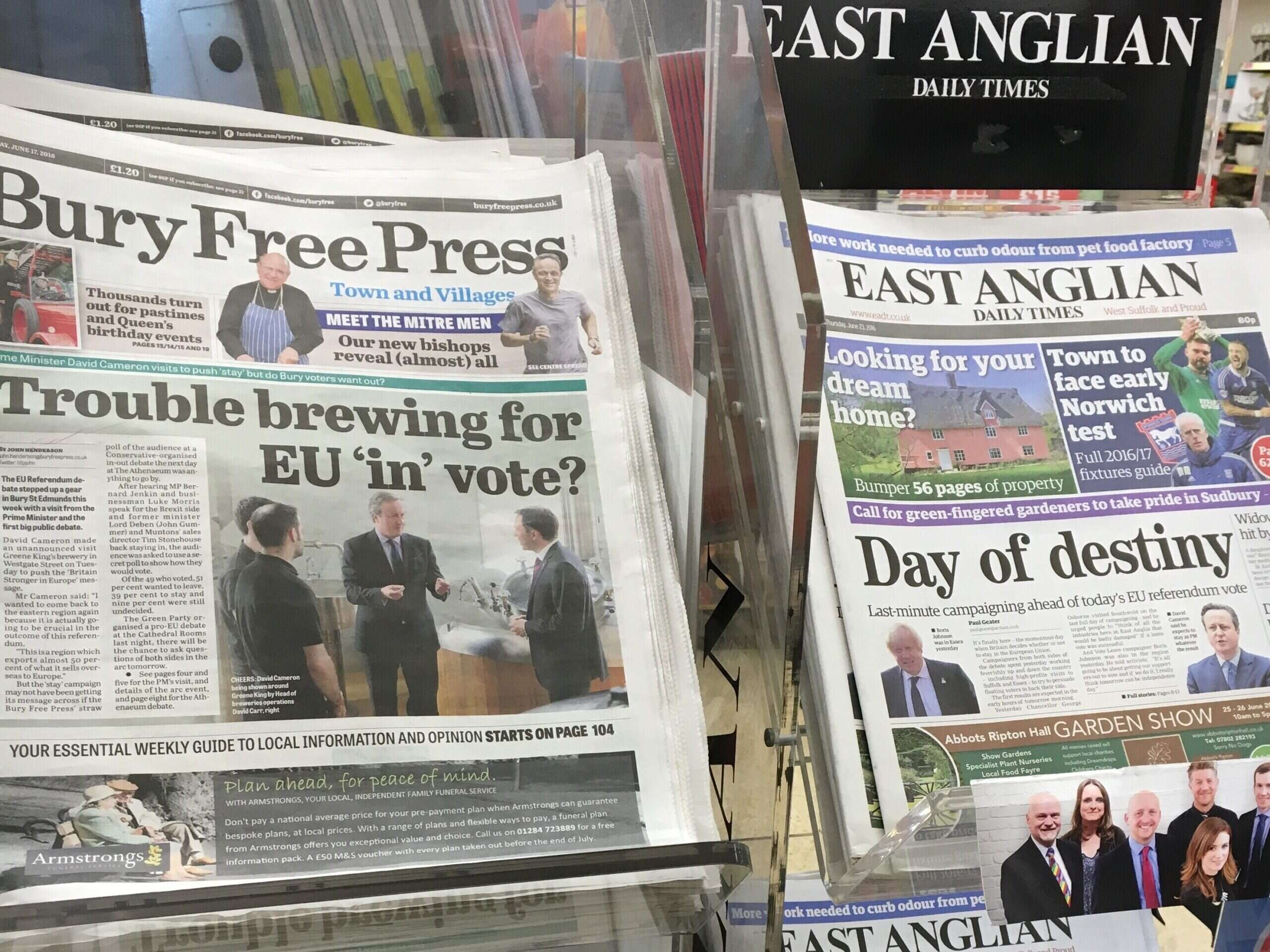
Local newspapers Bury Free Press and East Anglian Daily Times. Picture: Shutterstock
The UK Government will pay up to £12m to local media outlets over the next two years to support innovation and help fill “news deserts”.
The Local News Fund is part of the Local Media Strategy, aiming to “guarantee the long-term sustainability of local journalism” as part of wider plans to boost social cohesion in the UK .
The Department for Culture, Media and Sport (DCMS) described the Local Media Strategy as the “first action plan to back local news in a generation”.
The Local News Fund will distribute up to £12m to local media outlets publishing in print, online, radio or TV through a “centrally-managed competitive bidding process”.
The aim is to help these news publishers transition to “online-focused business models”.
The DCMS cited research from the Public Interest News Foundation that purports to show up to 37 local authority districts are effectively “news deserts” with no dedicated print, online, TV or radio outlets, affecting 4.4 million people.
Some of the funding will be reserved for a parallel process open to the third parties that are developing tools that could help the industry, such as app, adtech and website infrastructure providers.
This could help local news publishers tap into new or younger audiences or revenue streams, or help their journalists access public records in a simplified way.
The DCMS said more information on the Local News Fund will be shared in the coming weeks.
More funding will also go into community radio stations, doubling funding from £500,000 in 2024/25 to £1m over the next three years.
The DCMS said this would support the long-term sustainability of almost 400 stations and encourage more stations in underserved areas.
Culture Secretary Lisa Nandy said: “This strategy will provide unprecedented funding for local media outlets to invest in innovation and infrastructure, almost tripling the size of funding for community radio, harnessing the power of local and national government and giving more young people access to high quality journalism and the opportunity to pursue careers in it.
“Because local media was and always has been a ladder of opportunity to help new voices break into journalism. This is not a nice to have. It is essential to a cohesive country. Our debate is too narrow and too small. We will change that.
“The strategy we publish today is the start – not the end point – and we recognise there is more to do. But it is the start of a new approach to local media, which nurtures it and places it directly at the heart of our government’s support for our country. Because the future of news is local.”
The strategy also includes a review of statutory notices, which currently must be published in local print newspapers by councils on matters including planning, road management and alcohol licensing.
As of 2020, planning notices brought £10m into the local news industry each year while a further £30m came from other types of public notices. But there has been increasing criticism that digital-only publishers with at times higher readership than print and digital brands were missing out on being able to receive a slice of this revenue.
David Floyd, managing director of London non-profit newspaper publisher Social Spider CIC, told Press Gazette public notices are already a useful subsidy in the local news system but that it is not always working well. Social Spider cannot win public notice contracts as its newspapers are printed too infrequently (monthly).
Floyd said: “There’s a couple of boroughs in London where the legacy corporate newspapers have circulations of significantly under 1,000 in boroughs with populations of 250-300,000. They have no on the ground journalism activity other than publishing some LDR content, and they receive the public notice contract for that borough which could be worth £60,000, £80,000, £100,000 in some cases.
“You could do a lot with that money and that money is going out there. But currently it’s not getting the information about public notices out there for people to read them. So it’s not fulfilling that democratic function. It’s not subsidising journalism. It’s subsidising the production of a weekly newspaper read by a vanishingly small number of people.”
Speaking after the announcement of the fund, Floyd told Press Gazette: “This is really exciting news. All areas in the UK need and deserve high quality local news, written by locally-based journalists – but too many already lack this and the situation risks getting much worse.
“I hope this fund is able to kickstart sustainable new models for local news that prioritise on the ground journalism that is valued by local communities.”
The Government also promised to “endeavour to make best use of local media outlets”, including assessing the value of increased use of hyperlocal outlets, in its advertising campaigns.
It said: “Where local channels are identified as a good fit for a campaign, the government will always use local media as a trustworthy communications channel with a loyal and engaged audience.”
The Government also announced it would launch an “Inspiring the Future” campaign to connect local media employers and journalists with schools to talk about careers through showcase events and visits, initially in the North West.
Last week Joanne Forbes, chief executive of training body NCTJ , wrote in Press Gazette that “the future of journalism depends on whether the next generation chooses to join the profession” and that there are several misconceptions about the industry as a potential career.
A Department of Education-funded scheme in which all state-funded primary and secondary schools have access to local and national news titles will also be improved, the DCMS said.
Finally a Regional Media Forum will be launched in the West of England with the aim of improving dialogue between local media outlets and councils, emergency services, health services and the courts by creating a best practice framework around how they should engage. The lessons will then be rolled out nationwide.
Ensuring publishers are ‘properly rewarded’ is vital but more detail is needed
Nottinghamshire Live editor Natalie Fahy , who was involved in the working group feeding into the plan, told her readers: “This package of support is welcome, but we are clear this is the beginning of the conversation. There will be more challenges ahead, and as an industry we are ready to tackle them together.”
News Media Association chief executive Owen Meredith said: “The Government’s focus on the sustainability of local journalism and its importance to communities through the package of measures announced in the Local Media Strategy today are very welcome.
“As reader habits change and the way we all access local news evolves with technology, ensuring publishers are properly rewarded for their investment in local journalism is vital, rather than the lion’s share of the value being siphoned off by Big Tech.
“We are particularly pleased to see a clear commitment to make better use of trusted local news environments – which reach 77% of UK adults – for central government advertising, as well as a new £12m fund to boost local news provision. We are also delighted to be supporting a new campaign aimed at inspiring young people to take up a career in local news media.
“The strategy also rightly identifies a need to improve transparency in local public bodies – maintaining a strong link between public notices and local news media will be critical to the success of that important work.”
Public Interest News Foundation executive director Jonathan Heawood said more detail about the fund is needed.
“Local news is part of the fabric of our society, but it’s under huge pressure. We’re very glad that the Government is planning to create a Local News Fund, as the PINF Local News Commission recommended last year, but we urgently need to see more detail about how the fund will operate.
“The fund must support the regeneration of local news by helping community-centred local news providers who are fighting to build sustainable business models and develop audiences for high-quality local journalism amid an existential threat from big tech. We also believe that the fund should be administered independently of politicians.
“If the Local News Fund is designed and delivered in the right way, then this could be an important first step towards a new era for local news and local communities in the UK.”
Email [email protected] to point out mistakes, provide story tips or send in a letter for publication on our “Letters Page” blog