

Paul Dacre outside the High Court 11/3/2026. Picture: Lucy North/PA Wire
Ex- Daily Mail editor Paul Dacre has described allegations of phone hacking, tapping and illegal newsgathering levelled against his former team as “grave and sometimes preposterous”.
In written evidence to the privacy trial pitting Prince Harry and others against the paper , he repeatedly emphasised the high editorial standards and family values he said characterised the Daily Mail during his time as editor and editor-in-chief from 1992 to 2018.
During this period his journalists are accused of illegally accessing phone and medical records and using unlawful surveillance techniques to invade the private lives of Sir Elton John, Liz Hurley, Baroness Doreen Lawrence and others.
Dacre said: “I captained a tough ship which employed some of Fleet Street’s best writers and produced some remarkable journalism…
“The grave and sometimes preposterous allegations made in these proceedings have astonished, appalled and – in the small hours of the night – reduced me to rage.
“Equally, they have had a deeply upsetting and, in some instances, traumatic impact on many of the Daily Mail’s staff, both present and past (more than a few of them now retired with several having died or suffering from debilitating illnesses). I have witnessed the anguish of honest, dedicated journalists who, for three years now, have had an insidious dark shadow hanging over their lives.”
He said the claims brought by Baroness Lawrence in relation to the Mail’s 15-year campaign to secure justice for her murdered son Stephen “are especially bewildering and bitterly wounding to me personally”.
“Throughout my 26-year editorship this, of all my countless campaigns, many of which made a significant contribution to the public weal, is the campaign of which I am most proud and to which I devoted the most space.”
He also voiced his regret that several key players involved in the case are no longer alive to give evidence including: chief lawyer Eddie Young, executive editor Robin Esser, former diary writer Nigel Dempster and former editorial executive Paul Field.
Baroness Lawrence claims against Mail ‘defy reason’
Baroness Lawrence has claimed that Daily Mail journalist Stephen Wright targeted her with landline tapping, hacking, bugging and hidden electronic surveillance, obtained her and her family’s telephone records, made payments to corrupt police officers for confidential information and monitored her bank accounts.
Dacre said it was a “bitter irony” that these “lurid allegations” were put together by a legal research team who “in a flagrant abuse of due process, themselves resorted to the kind of tactics and ploys that would have shamed even the most malfeasant of red top reporters ”.
Dacre said: “It is inconceivable to me that [Wright] or anyone at the Daily Mail would have engaged in such activities as outlined by Baroness Lawrence and I certainly would never have countenanced them had they been suggested which they never would have been.
“And it is, frankly, preposterous to say that such activities were ‘habitual and widespread’.
“I have known Stephen Wright for three decades and do not believe he is remotely capable of doing the things alleged in this claim. He did not ever raise or discuss using these methods with me, or ever mention Baroness Lawrence’s bank accounts, telephone records or transcripts of calls and I would have been appalled if he had.”
He added: “I do not know whether Mr Wright used inquiry agents. I knew he had excellent police sources, but do not believe he ever paid serving police officers as it was written in blood at the Daily Mail that you did not do that.”
Dacre said: “It simply defies reason that the Daily Mail would have resorted to illegality, as it is claimed, to find out if other newspapers were getting involved in the Lawrence story.”
In 1997 the Daily Mail named five men believed to have been involved in the murder of Stephen Lawrence and dared them to sue the paper.
Eighteen-year-old Stephen was stabbed to death in a racially motivated and unprovoked attack in 1993 and his family was subsequently failed by the Met Police whose investigation did not bring his killers to justice despite their identities being known.
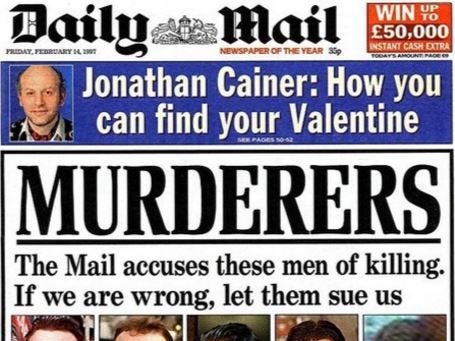
Baroness Lawrence has alleged that the Mail accessed her bank records to see if she was being paid by other newspapers. Dacre said: “After the ‘Murderers’ headline in 1997 and the huge controversy it provoked, Stephen Lawrence was indubitably a Daily Mail story and other papers supporting our campaign would have been hugely welcome. The truth, however, is that, for the most part, a fiercely competitive Fleet Street generally ignored the campaigns of commercial rivals out of a reluctance to give them either publicity or credibility.”
Dacre also rejected the claim made by Baroness Lawrence that its campaign was motivated by “self promotion” and a desire to “sell newspapers”.
He said: “Campaigns are important in that they prove to the readers that their paper is prepared to take up cudgels on their behalf giving voice to the voiceless and fighting for justice, fairness and decency.
“But as any editor will tell you, most campaigns do nothing to drive circulation. Devoting huge amounts of space, day in day out to one subject (often at the expense of fresher stories) and the constant repetition necessarily involved can – while providing a paper with authority and gravitas – have a dampening effect on sales.
“The Stephen Lawrence campaign, as I have said, is the one I am most proud of because it helped bring about justice for someone who had no voice and changed society for the better. The suggestion that we ran the campaign to generate exclusive headlines, sell newspapers and profit is sickeningly misplaced and bleakly cynical.”
One allegedly illegally-sourced story came from Dacre himself
Dacre said he was personally involved in sourcing one of the stories that Baroness Lawrence claims was sourced illegally, headlined: “Exclusive: Straw orders major investigation after Daily Mail campaign”.
Baroness Lawrence claims the story was sourced by freelance journalist and private investigator Christine Hart who “blagged” her in a misleading telephone call and sold the information to Stephen Wright.
But Dacre says he sourced the story himself and that Wright was not involved in it. He said Wright’s byline was added only as a tribute to the work he had done on the Lawrence campaign.
He said: “I have a very clear recollection that the then Home Secretary Jack Straw personally gave the story to me.
“We were on friendly terms (having been students together at Leeds University) and occasionally had lunch or dinner. The media had been anticipating for a month or so that an announcement of a move by the Home Secretary was imminent.
“At some stage in July 1997 Mr Straw called me to a meeting and volunteered the information that he was setting up an inquiry. He told me that the Daily Mail’s campaign for justice for Stephen Lawrence had been a significant factor in his decision to order this inquiry and that is why he felt it right to give the story to me before officially announcing it to the House of Commons.”
Paul Dacre received death threats as result of Lawrence campaign
Dacre said of the ‘Murderers’ front page: “The truth is that having failed in the courts and against a background of police complacency, political inertia, judicial stasis and public indifference, Mrs Lawrence’s and [her lawyer] Mr Khan’s quest for justice for Stephen Lawrence was dying, fading from people’s memories as it disappeared in the sands of time.
“That ‘now infamous’ headline and the subsequent furore it detonated, in which I and the Daily Mail were vilified, was a seismic moment and changed all that.
“The oped page cartoon in the Telegraph had me flicking ink at Lady Justice. The Times editorial railed against the Daily Mail and its editor.
“A former Master of the Rolls accused me of contempt and called for my jailing.
“I received death threats and, as two of the ‘Murderers’ whose pictures the Daily Mail carried on its front page were connected to notorious gangland figures, my family was given round the clock security for some months. Even today, my wife is advised by the police not to allow any pictures of herself online.
“In spite of all this, the Daily Mail stepped up its campaign, devoting countless pages to Stephen over the ensuing years.
“As recounted, the then Home Secretary, Jack Straw, said that it was the Daily Mail’s campaign that persuaded him to commission the Macpherson Inquiry. Another Labour Home Secretary, David Blunkett, said that the Daily Mail’s campaign was a significant factor in his changing the law on double jeopardy allowing the eventual re-trial of the original suspects.
“When, in 2012, two of the people identified on our front page as murderers were finally, after 15 years of our campaigning, found guilty of Stephen Lawrence’s murder, everyone on the Daily Mail felt a huge surge of pride.”
Daily Mail and the use of private investigators
Dacre also used his evidence to give a detailed backgrounder on the rising use on Fleet Street of private investigators (or inquiry agents) many of whom have since been connected with illegal newsgathering.
He said they came to prominence in the early 2000s, when the digitalisation of public records made it easy for specialist services to track down people on behalf of journalists.
Dacre himself admitted to having a “somewhat antediluvian appreciation and understanding of matters digital”.
Around 2005, the Information Commissioner raised concerns that inquiry agents could be breaching data protection law.
At this stage, Dacre said, one of the Mail’s three managing editors – Robin Esser – looked into the matter for him.
Dacre said: “For journalists who were always working against inexorable deadlines, the purpose of using these new agencies was to speedily acquire addresses and phone numbers so they could contact people with a view to checking facts or providing them with the opportunity to comment. I can’t remember exactly, but I have vague memories of him telling me that all other papers, law firms and local councils were using them.
“This seemed fairly uncontroversial at the time as such activity would have been in accordance with reporters’ duties as responsible journalists under the Editors’ Code to put a story to the subject which would have meant tracking him or her down.
“Such a process would involve obtaining information that in the past had lawfully been obtained from public records, libraries, town hall electoral lists, Companies House, Somerset House or newspapers’ own retained sources which included vast collections of phone directories covering the whole of Britain.
“For parts of London, there were even printed reverse telephone directories from which addresses for specific phone numbers could be identified and vice versa. These ‘paper’ methods were legal but often cumbersome, slow and laborious.
“Inquiry agents who had developed expertise in searching databases and could provide information extremely quickly. For reporters, this was a huge boon.”
In 2006 the UK Information Commissioner published the report “What Price Privacy Now” which revealed that 305 journalists from nearly every UK national newspaper had used private investigator Steve Whittamore to buy information which was sometimes obtained illegally.
Dacre said as a result, in April 2007, use of most inquiry agents was banned at the Mail.
Paul Dacre stands by hacking evidence to Leveson and claim that Hugh Grant lied
Claimants in the current privacy case against the Mail allege that phone hacking and tapping was “habitual and widespread” at the paper.
Dare said: “I utterly reject this. Such blatant illegality would not, I believe, have been countenanced at an level on the paper I edited.
“It would have been anathema to everything I and the senior executives believed in and the culture that existed on the paper. If I had heard of such things going on, I would have been appalled and would have taken the most draconian measures to expunge them.”
Dacre said: “Over many years, I worked like a Trojan to attain a respected position in the highest echelons of the newspaper industry. I would not have risked damaging this hard-earned status by allowing these criminal activities to take place. It would have been insanity on my part.”
He also rejected the allegation made by the claimants that he lied under oath when he told the Leveson Inquiry in 2011 that there was no phone hacking at the Daily Mail.
“I trusted my managing editors, and [lawyers] Liz Hartley and Eddie Young when they conducted the internal review, to find out if we did have an issue. I totally believe that they would have informed me if they had discovered anything. They all repeatedly assured me that they were not aware of and had not found any evidence of Daily Mail journalists hacking phones.
“As I stated in my evidence at the Leveson Inquiry, I never placed a story in the Daily Mail as a result of phone hacking or that I knew came from phone hacking and I knew of no cases of phone hacking at the Daily Mail. That remains as true now, as it was when I gave the evidence to the Inquiry.”
He also stood by his assertion that actor Hugh Grant’s allegation (also made at the Leveson Inquiry) that the Mail hacked his phone was a “mendacious smear”.
“Hugh Grant had been told repeatedly that we did not hack phones… I believe that the Daily Mail was entitled to suggest that Mr Grant knew or ought to have known that he had no proper basis for smearing our company, its titles and the staff in this manner.”
Email [email protected] to point out mistakes, provide story tips or send in a letter for publication on our “Letters Page” blog