
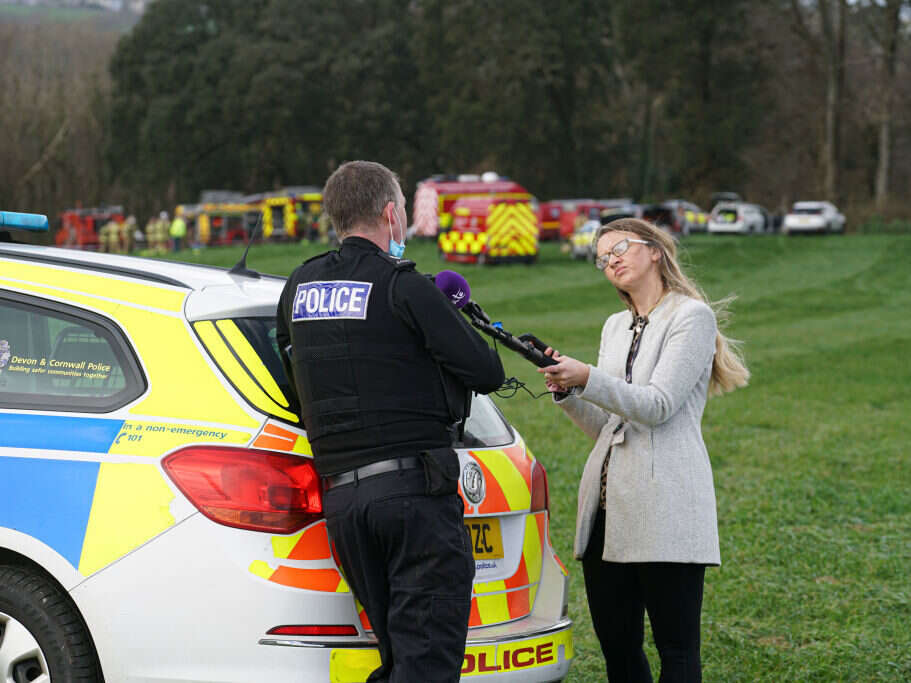
A member of the police gives an interview to a local radio journalist near where a Royal Navy jet came down around on 25 March 25 2021 in woods near Helston, England. Picture: Hugh Hastings/Getty Images
Crime reporters have welcomed updated police media guidelines for England and Wales which could draw to a close 15 years of frosty relations between officers and journalists.
Since the Leveson Inquiry in 2011 police have tended to see journalists as a corruption risk. For three years to 2025 the College of Policing bracketed journalists with criminals as individuals with whom staff had to disclose any association.
A number of UK journalists have been arrested and detained whilst trying to cover protests in recent years.
And police refusal to provide off-the-record guidance to the media fuelled a wave of misinformation during the disappearance of Nicola Bulley in Lancashire in 2023 and following the murder of three children by a man with a knife in Southport in 2024 .
The new standards for communications from the College of Policing encourage police officers to interact with journalists at all levels, allow for off-the-record briefings, and explicitly protect the right of journalists to cover public incidents without interference
Chair of the Crime Reporters Association Rebecca Camber, who is crime editor for the Daily Mail, said: “This guidance has the potential to fundamentally transform the relationship between police forces and the media which remains essential to public confidence and policing legitimacy in the UK.
“For the first time engagement between officers of all ranks and the media is being encouraged and police forces face new obligations to release information and respond at pace in major investigations.”
Highlights from police communications standards
Officers ‘encouraged’ to engage with media :
“Engagement between police and the media is encouraged for officers and staff of all ranks and roles, providing the person is responsible for communicating about the issue at hand and there is a clear policing purpose in doing so.
“The foundation for all conversations between journalists and police, including communications officers, should be mutual respect, professional courtesy and cooperation.”
Police have no power to stop media filming/photographing public incidents :
“Reporting or filming from the scene of an incident is part of the media’s role. They should not be prevented from doing so from a public place.
“Police have no power to stop the filming or photographing of incidents or police personnel. It is for the media to determine what is published or broadcast, not the police. Once an image has been recorded, the police have no power to seize equipment, or to delete or confiscate images or footage, without a court order.”
Nationality/ethnicity confirmed on arrest :
“Police may consider disclosing the nationality and/or ethnicity of the suspect on arrest, where this is known or recorded, in high-profile or sensitive investigations…
“Police should confirm the nationality and/or ethnicity of the person (where known or recorded) on charge in high-profile or sensitive investigations, using the same guidance as on arrest. This information will be provided only on a contemporaneous basis.”
Pictures of criminals should be released by police on conviction:
“Where practicable and proportionate, press offices should be prepared to release the image of a person found guilty on the day of conviction, where there is a policing purpose or at the request of the media. This is unless there is a court order or other legitimate reason not to do so
“Press offices should release images on all custodial sentences at the request of the media, unless exceptional reasons exist. Approval and verification processes for the release of images should be agreed locally.”
When criminals are charged information should be released straight away :
“This information should be given as soon as possible at the point of charge. If charges are withdrawn before someone first appears in court, this information should be released as soon as possible, especially if a case has been previously publicised.”
Off-the-record guidance allowed:
“Experienced and senior communications officers should be empowered to make reasoned judgements on the issuing of non-reportable information.”
Police will respect exclusives:
“Where a media organisation generates an exclusive, their right to share information in confidence with the police should be respected. This means that where an enquiry is put to police by a journalist, the information being sought will not be proactively issued to other media outlets, except for operational reasons or unless it was already planned for release into the public domain.”
Updates will be issued to combat misinformation:
“To manage the risk of information disorder, policing leaders should establish systems to monitor, access and counter information disorder. This should include, but is not restricted to, the following stages…
“Recognise and make provision for proactive communications across a range of reliable channels and platforms to help prevent misinformation, disinformation and malinformation…
“Where false or manipulated information has been identified and assessed to have an impact on public safety or public trust in policing, steps should be taken to act swiftly to avoid false information spreading unchallenged. Ensure that monitoring is sufficient or that it can be escalated out of hours for critical incidents.”
Police misconduct cases should be open :
“Allegations of misconduct or crimes by police officers are a matter of considerable and legitimate public interest.
“There should be a presumption of openness and transparency in police misconduct cases held in public, in line with the principles of open justice.
“The starting point should be that it is in both the police’s and the public’s interest to be as open as possible about the disciplinary process, unless there is a legitimate reason for not doing so.”
More information on dropped cases :
“When forces confirm that no further action will be taken, they should give reasons for discontinuing an investigation and state whether the CPS was consulted in the decision.”
Victims and relatives should decide whether they speak to media:
“Family liason offices and communications officers should support victims to speak to the media directly, when they wish to do so, and should ensure that victims and families feel free to express their own views.”
Police should hold media briefings :
“Media briefings linked to criminal proceedings, particularly in high-profile or sensitive cases, should be considered.
“Pre-trial briefings are most commonly used in high-profile, sensitive or complex trials.”
Press officers should release ‘readily available’ information:
“If a member of the media requests information that is readily available but is not on the force website, it can be provided by the corporate communications department (CCD), unless there is any risk in doing so.
“In cases where it would require a disproportionate amount of time to secure the information, or if it is unclear that it should be released, the media representative should be referred to the force’s freedom of information team. Each force should have its own publication scheme.”
Police forces will continue to maintain secrecy over the name of arrested suspects unless there are exceptional circumstances . They will release outline details of arrests only if journalists have specific information:
“CCDs should only release the name of those arrested or suspected of a crime in exceptional circumstances, where there is a legitimate policing purpose to do so:
- a threat to life
- the prevention or detection of crime
- where police have made a public warning about a wanted individual – in certain circumstances, this may include people who have failed to answer bail
“After arrest, information limited to gender, age, where they live, date of arrest.
“Individuals charged with an offence, including those who receive a summons to court, should be named on charge.
“If a name is provided to the police with a request for confirmation of an arrest, the response should be, “we neither confirm nor deny”. No guidance should be given. Communications officers should not respond by supplying other information that has the effect of confirming the person’s identity.
“To receive any information in response to an enquiry about an arrest, the media need to provide sufficient details to allow that arrest or incident to be traced, including location, date and type of offence. If confirming that an arrest has been made, communications officers should state that they are not confirming the identity of the arrested person.”
Email [email protected] to point out mistakes, provide story tips or send in a letter for publication on our “Letters Page” blog