
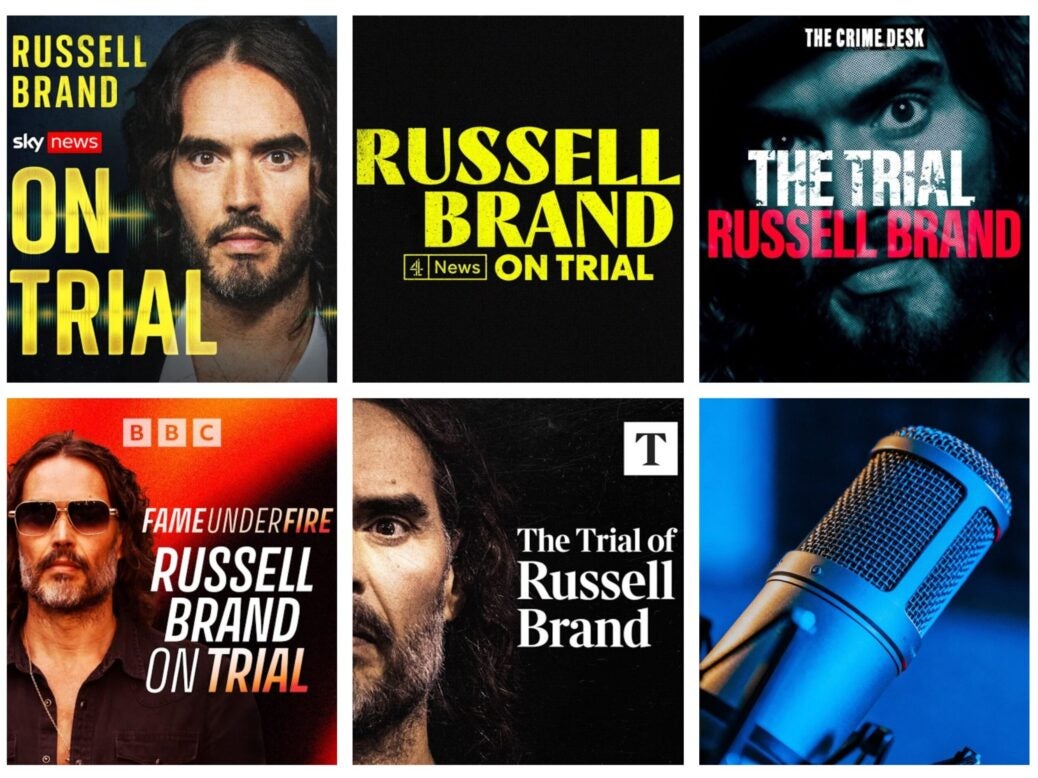
Russell Brand trial podcasts reached nearly 10m views on Youtube. Picture: Collage / Shutterstock
Five dedicated podcasts sprung up to cover the live trial of disgraced comedian and activist Russell Brand, reaching nearly ten million combined views on Youtube alone.
The Times (Times Radio), Channel 4 News, Sky News, the Daily Mail and BBC all delivered regular updates on court proceedings during the four-week trial, both as audio and video podcasts.
The Times launched The Trial of Russell Brand on Times Radio. Channel 4 News launched Russell Brand On Trial. Sky News launched Russell Brand: On Trial. The Daily Mail launched The Trial: Russell Brand as part of its ongoing The Trial podcast series. And the BBC’s Fame Under Fire podcast also dedicated coverage to the trial.
Brand, who was found guilty of rape and sexual assault, has been sentenced to ten years and six months in jail . The allegations against him were first reported in a joint investigation by The Times newspapers and Channel 4 Dispatches.
Channel 4 and the BBC attracted the biggest audience on Youtube with more than three million views each over the course of the trial. Podcast listening numbers are not made publicly available.
Other publishers have ‘hopped on board’ format pioneered by Daily Mail
The Daily Mail pioneered the daily podcast covering a live trial with The Trial of Lucy Letby in 2022 , itself an “experiment” at the time. “It’s our successful format that people have hopped on board with really, not to sound too bullish about it,” said Jamie East, head of podcasts at Mail publisher DMG Media.
The Trial now covers upwards of 30 trials a year and includes editions for the US and Australia. Part of the Mail’s dedicated Crime Desk vertical, The Trial releases two episodes a week, “rain or shine”, one free to all and the other only for subscribers. The intensity of a trial depends on the frequency of the episodes – for the Brand trial it was daily.
“There is some editorial thinking behind the trials that we choose to cover,” said East.
“Something like Russell Brand is pretty full on because there’s huge interest in it, but we tend to cover [trials] that we feel have human interest, that are going to raise questions our listeners and viewers are intrigued by, or confused by, or touched by. They tend to be more on the – what’s the word I’m looking for – ‘grimmer’ side.”
Previous coverage has included the robbery of reality TV star Kim Kardashian and the trial of the two men found guilty of cutting down the iconic Sycamore Gap Tree.
East said part of what sets a live trial podcast apart from a news podcast is that people can go back and listen to the whole thing in its entirety, beginning at day one, something he said many of The Trial’s listeners do. This trend of serialising a true crime story began with Serial, an investigative journalism podcast released in 2014 that became a global hit.
“True crime for most people was their entry point into podcasting, with something like Serial,” said East. “True crime is a huge genre within podcasting for a myriad of reasons. In my opinion no-one really does it does it any better than [the Mail]. Crime is one of the most powerful parts of [the Daily Mail’s] journalism.”
Brand’s trial marks first time The Trial podcast has also been released as a video podcast, published on Youtube. East said it was a “really good success” but would not lead to a video-first strategy for the podcast, rather the team would continue to do video podcasts “where it’s appropriate”, taking each trial “on its own merits”.
“Youtube is a very helpful platform – it’s eminently searchable, the algorithm is helpful, and the data you get back off it is pretty good,” said East, a former producer at Netflix who has also worked in radio.
“We just go where the audience is. If the audience is on Tiktok, we’ll be on Tiktok, if they’re on Youtube, we’ll be on there, but at its core [ The Trial ] is an audio-first product. It’s an immersive journalism-led audio product, but we visualise it because that’s where the audience is at the moment.”
[ Read more: How publishers can find a podcast audience and make money from it ]
East said there was a “different offering” between audio and video podcasts, labelling the latter essentially a filmed “conversation”. “I don’t see any of the immersive kind of documentary-style investigative podcasts being done on video. Serial could never be a video podcast, otherwise it may as well just be a Netflix documentary.”
“Audio podcasts are one of the only passive forms of media we’ve got,” he said.
“With the exception of radio, everything else demands that you stop what you’re doing and pay attention. [A podcast is] something you can you can lose yourself in, which is why it’s become so popular. Video podcasts don’t do that – they require you to stop and focus your entire attention on it.”
He added: “I think you forget your audio listeners at your peril. Video podcasts are fine, but I’ll believe the data when I see it… [showing] me that people are actually watching all of these podcasts. They’re consuming them, but I also see lots of people pressing play on Youtube and putting their phone in their pocket.
“You must always remember that audio is king, ultimately.”
The Mail’s podcast offering forms part of its effort to reach one million paying digital subscribers by late 2028 .
East said court reporting was “very tricky” but The Trial team had decades of experience. “We understand the law, and everything we do, every word, every quote, every clip, it all goes through many, many checks,” he said. “If anything, we err on the side of caution.”
Reporters are generally cautious when covering a trial, as only revelations heard in court, during live proceedings, are offered legal privilege that protects against contempt and/or defamation claims, provided reporting is fair and accurate. But podcasts, with their conversational nature, could run the risk of saying too much.
UK trial podcasts face strict legal curbs
Journalist and media law consultant David Banks, who offered expert insight on an episode of the Daily Mail’s Lucy Letby trial podcast , told Press Gazette: “It is obvious that something as conversational as a podcast runs the risk of falling foul of contempt of court. If those involved stray away from simply recounting what a jury has heard and get into for example, evaluation of the weight that should be given to witnesses, then you could get into very tricky territory.
“Jurors are warned to avoid research into a defendant, but they are not generally banned from reading news reports of the evidence they have already heard – so the trick for podcasters is to stick to what the jury have heard, but don’t run commentary that might seriously prejudice them against the defendant. So good podcasts will carefully brief guests and edit their contributions to avoid such risks.”
However these rules only apply to podcasts based in the UK. Those based overseas “can safely ignore the restrictions to which UK media have to adhere”, added Banks.
Topics in this article : Daily Mail
, podcasts
, YouTube
Email [email protected] to point out mistakes, provide story tips or send in a letter for publication on our “Letters Page” blog