
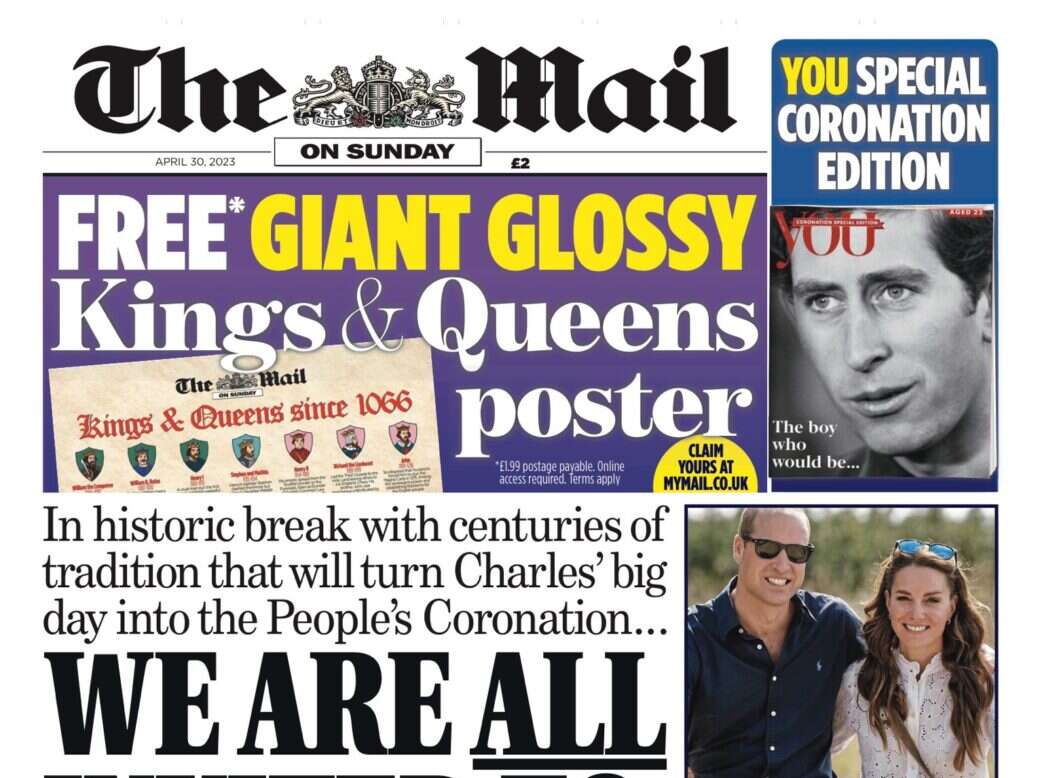
The Mail on Sunday, 30 April 2023
Celebrities are often lonely and confide in journalists, according to former Mail on Sunday editor Peter Wright who said Prince Harry’s accusations of illegal newsgathering at the paper are false.
Along with other high-profile claimants, Harry has claimed the Mail on Sunday engaged in widespread use of phone hacking, tapping and illegal bugging as well as commissioning detectives to obtain private information like phone and medical records. The claims are the subject of an ongoing privacy trial.
Wright , who was Mail on Sunday editor from 1998 to 2012 and is now editor emeritus at publisher Associated Newspapers, said in his witness statement: “Journalists have a very wide variety of sources of information, including one-off tips, regular freelancers, and well-connected individuals with whom the journalist may have spent years building a trusted relationship.
“In the political, Royal and showbiz worlds, for example, journalists would spend many of their evenings at social events meeting and cultivating these existing and potential sources.
“This is particularly true on Sunday newspapers, where the journalists’ week is not dictated by the breaking news agenda, and the greater time available is used to cultivate contacts in order to develop exclusive stories which can be kept under wraps until Sunday.
“Included in these contacts would be the numerous cronies and hangers-on who, like moths to a flame, are drawn to the social circles of celebrities and royal figures, all too ready to ‘big themselves up’ and bask in reflected glory (or even earn some money) by passing information to journalists.
“Such tipsters are part of the lifeblood of Sunday newspapers, particularly their diary columns.
“So, for example, the Duke of Sussex, like any Royal, was surrounded by a large number of staff, friends and hangers-on, many of whom briefed journalists, either directly, or by speaking indiscreetly to third parties who had their own contacts with journalists.
“When an article quoted a ‘royal insider’ or a ‘palace source’ it was not a cover for so-called unlawful information gathering, but a simple statement of fact. I know that because at various points in my career I had just such royal sources myself and would share information they had given me with reporters, who would in turn attribute it to ‘a source’.”
He added there was another source of stories: celebrities themselves.
“Some people who have very successful careers tend to be egocentric, which may mean they do not have many friends.
“They are drawn to journalists because journalists understand the world in which they live and are always ready to listen to them, and once they have formed a friendship with a journalist, they may use them as a mouthpiece.”
Addressing the issues at the heart of Prince Harry’s legal claim, Wright said: “In all the years that I was editor of the Mail on Sunday, I was never informed by anyone working for me that a story had been sourced by way of phone hacking, tapping or bugging.
“The first intimation I had that any journalist on any newspaper had hacked mobile phones was when Clive Goodman of the News of the World was arrested in 2006.”
Grant’s claim related to a 2007 story alleging that his relationship with Jemima Khan was on the rocks because of late-night calls with a “plummy-voiced studio executive”.
Grant said he could think of no conceivable source for the story other than voicemail messages being intercepted.
Responding to this, Wright said: “Had I been asked about it at the Leveson Inquiry, I would have rejected the allegation entirely. I am satisfied based on information provided to me by the bylined journalist and the freelance journalist, Sharon Feinstein, who had provided the story that it came from a human source.
“Hugh Grant made no allegations of phone hacking at the time of publication. He sued for libel and accepted a settlement with damages on the grounds that the article was untrue and, according to him, there was no plummy-voiced woman.
“I have also been shown a contemporaneous email from Sharon Feinstein to Katie Nicholl, pitching the ‘plummy voiced woman’ story… it tallies with the account that I was given by Katie Nicholl in 2011 when this came up at the Leveson Inquiry, which was that Sharon Feinstein gave us this story and had a very good human source who could be relied upon to give accurate information.”
Wright said he could not recall many of the complained-about stories but did remember the article headlined: “Harry Besotted with Chelsy, his ‘first true love’”, which was published on 21 November 2004. This was the first story to publish the name of Harry’s then girlfriend Chelsy Davy.
He said: “From that point onward everything blew up and her life as she knew it was over; her ability to enjoy some semblance of privacy evaporated instantly.”
Harry contends that the story was obtained illegally.
Wright said: “I remember the story itself partly because it was the end of the week and it was touch and go if it could be made to work.
“However, I remember that by Saturday morning [journalist] Caroline Graham had been able to confirm the name of the girl that Prince Harry was travelling with, so the story went in the paper…. My memory is that Caroline Graham was given the name by a member of the staff (I think the manager) at the ranch where Prince Harry was staying.”
He added: “While I was editor of The Mail on Sunday, to the best of my knowledge the paper did not carry out or commission, or knowingly use information derived from, phone hacking, landline phone tapping, bugging vehicles or using sticky window mini-microphones, computer or email hacking as alleged in these claims.”
Email [email protected] to point out mistakes, provide story tips or send in a letter for publication on our “Letters Page” blog