
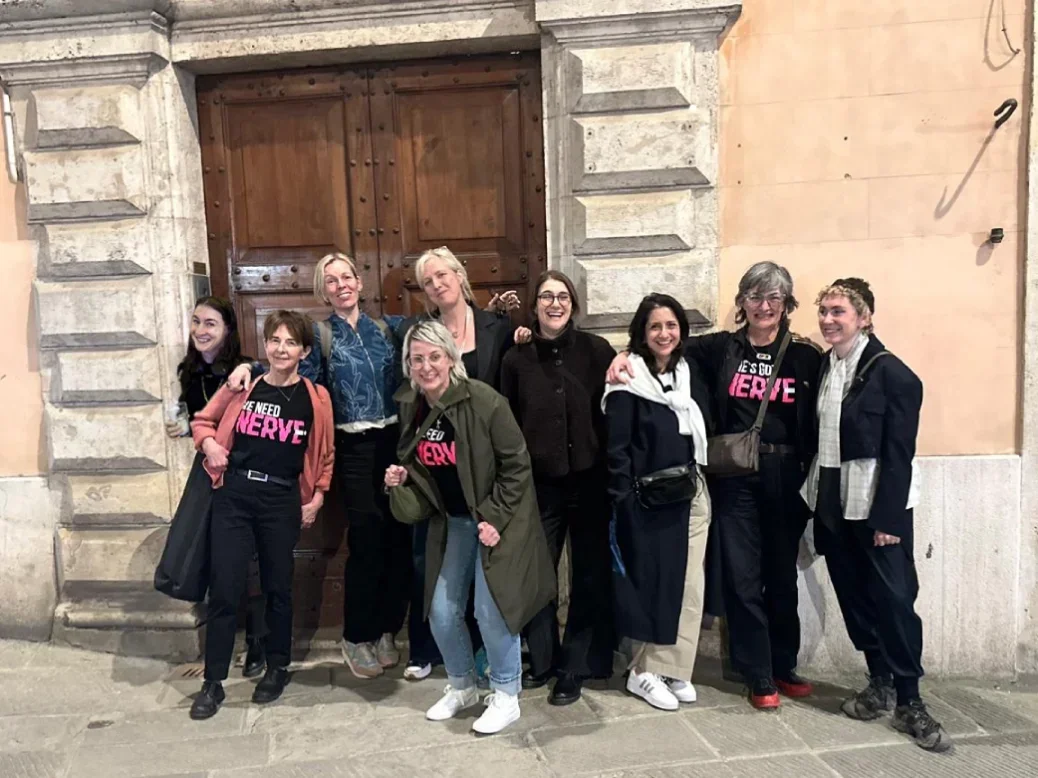
The Nerve team including co-founders and new hires at the International Journalism Festival in Perugia in April 2026. Picture: Supplied
The Nerve, the “small and punky” publication launched by five former Observer journalists, has reached 5,000 paying subscribers in its first year.
The culture, politics and tech newsbrand marked the anniversary of its first newsletter on Wednesday, 30 September.
Some 70% of its revenue comes from paying readers, while 30% is made up of two grants from individual philanthropic supporters who wish to remain anonymous.
This is despite content being provided for free to all readers via a website and a twice-weekly newsletter hosted on the Beehiiv platform.
Paying members (at £6.95 per month or £68 per year) access perks such as members-only events or discounted event tickets and access to “ask us anything” online sessions with the team.
There are also more than 400 founder members paying £250 a year to show their support and get additional benefits such as a new twice-a-year print magazine.
This means subscriber revenue will be a minimum of £412,800 (at the lowest subscription cost of £68 per year from 4,600 paying subscribers plus £250 from 400 founder members).
With subscribers making up 70% of total revenue, this means The Nerve has additional grant revenue of around £177,000.
Chief executive and editor-in-chief Sarah Donaldson said The Nerve is now financially sustainable and has exceeded their highest expectations for its first year.
Former Observer New Review deputy editor Donaldson started The Nerve along with investigative journalist Carole Cadwalladr, ex-New Review editor Jane Ferguson (The Nerve’s executive editor), former Observer senior editor Imogen Carter (now head of culture), and former Observer creative director Lynsey Irvine (in the same role at The Nerve).
The launch was funded via voluntary redundancy payments from The Observer after four of the women made the choice not to transfer from Guardian News Media to Tortoise Media when the Sunday newspaper brand was sold in April 2025. Cadwalladr, who had a long-standing contract arrangement on The Observer, was dropped by new owner Tortoise Media .
Donaldson said British Journalism Awards winner Cadwalladr’s reputation and social media audience (with 631,000 followers on X and 235,000 on Bluesky), alongside the profile of well-known columnists such as comedian Stewart Lee and former Observer agony aunt Philippa Perry, helped The Nerve get noticed and bring in early supporters.
Around 1,000 people signed up to pay for The Nerve within a week of its launch being announced at the end of September last year.
After launch, Donaldson attributed its continued growth to “an alchemic mix” of big-hitting investigations, videos shared on social media, successful events, and relationship building with readers via the newsletters.
The Nerve’s major investigations so far have included a series on the size of tech company Palantir’s UK contracts and work on cryptobillionaire Christopher Harborne’s Reform funding.
In video, Donaldson highlighted a clip of Cadwalladr interviewing Facebook whistleblower Sarah Wynn-Williams at the Hay Festival where she was unable to speak due to a legal threat against her.
Events have included film screenings and “in conversation” talks in London, South Wales, Manchester, Brighton and Bristol. On Sunday The Nerve hosted a first birthday celebration featuring contributors John Sweeney and Sangita Myska, satirist Cody Dahler appearing with Cadwalladr, and comedian Kiell Smith-Bynoe in the culture slot.
Donaldson added: “Our timing was also lucky. We knew before we launched that SEO and digital advertising were a busted flush. So, for example, we get a small but steady stream of income from Beehiiv’s ad platform, but we’ve not wasted resource pursuing ad partners ourselves (although we will be looking to build some brand partnerships in year two).”
The brand is now generating more than 500,000 page views a month according to Similarweb.
“It was a huge risk but it’s been mind-blowing that we’ve been able to build a successful new title from scratch,” Donaldson said.
“It’s beyond our wildest dreams that we’re able to publish – and pay – brilliant writers, critics and columnists, such as Stewart Lee, Sangita Myska, Natasha Walter, Cory Doctorow and Philippa Perry, invest in groundbreaking public interest investigations, make serious inroads with video (over 100 to date) and punch way above our weight with interviews, including Gisele Pelicot and Salman Rushdie.
“None of this would be possible without our members. These are readers who rose to support us and it’s genuinely been a joint enterprise between them and us. We’ve worked harder than we knew was possible and learned on the fly, and the members have been with us all the way.”
Donaldson said The Nerve had deliberately started small and grown as its reader and grant funding came in.
“We didn’t have any money so it was a virtue born of necessity,” she said. “But it turned out to be the perfect accidental strategy because it made us super focused on sustainability. We had to make sure we didn’t run before we could walk.”
The Nerve has expanded to a team of five full-time and six part-time staff including investigative reporters Lucia Osborne-Crowley and Alice McCool, multimedia journalist Brenna Spain, and more former Observer staffers commissioning editor Ian Tucker and production editor Ed Latham. Ed Campbell, formerly of Politics Joe, is a part-time video reporter while there is a roster of ten regular columnists and critics.
“I love being small and punky but our next step is to grow the title and pay for an investigations editor. There’s so much more we can do,” Cadwalladr said.
Print and podcast expansion planned
Two podcast series are in development and The Nerve also plans to produce two print titles next year after creating an experimental 36-page “zine” for its high-paying founder members to mark its anniversary (with an initial run of 1,000). The print magazines will also go to annual paying members who resubscribe for year two.

The Nerve’s packshot for its first print zine. Picture: The Nerve
The Nerve is based on website and newsletter hosting platform Beehiiv and was the first UK member of its Media Collective, meaning the platform does not charge it the normal flat fee for its first two years and it will also cover any legal expenses. Donaldson said this made a “real difference to our cost base”.
Donaldson also praised the simplicity of Beehiiv as a content management system and how easy it was to create their own distinctive design – something she said would have been out of reach on Substack.
“The design functionality is so superior to other newsletter platforms,” she said. “We were adamant that we wanted to launch with a bold, fresh, distinctive design that moved the dial for digital news journalism and Lynsey has done just that.”
Irvine, who led The Observer’s design team for 20 years, said: “I’ve always pushed the idea that the design is as important as the journalism. We knew from the start that we wanted The Nerve to have a punk, ‘fuck-you’ energy, and my aim is to bring that to every article we publish.”
Donaldson added that this extended beyond the website to the newsletters which she described as “bright and bold, with really strong use of pictures. It has so much more energy than the average email.
“Our research shows that our engaged audience often read the summaries of our articles within the email rather than clicking on all the links to the full articles – they feel up to date and enlivened within that format. We’ve turned an email into a mini magazine.”
Donaldson also praised how easy Beehiiv made it to communicate differently with free versus paid members, even down to hiding individual paragraphs in newsletters, meaning they don’t need a separate email list for each tier. “Time is everything on a start-up – we are never on top of the to do list, so these kind of time-saving tricks are golddust.”
The Nerve now has 130,000 social media followers including 51,000 on Instagram, 40,000 on X and 23,100 on Bluesky. In comparison, The Observer (which had to build its own digital presence for the first time after leaving The Guardian) has 109,000 followers on Instagram, 45,500 on X and 5,500 on Bluesky and it had a web/app audience of 1.2 million people in August according to Ipsos iris.
Email [email protected] to point out mistakes, provide story tips or send in a letter for publication on our “Letters Page” blog