
When it comes to press freedom and the president of the United States, this will go down as one of the stranger and more disruptive weeks in recent memory.
Thursday, in particular, was astounding, confusing, unprecedented and ultimately troubling as President Donald Trump continued his attacks on the press.
The week started with Trump banning CNN, MS NOW and Politico from White House grounds, essentially because he doesn’t like their coverage. On Wednesday, a federal judge heard arguments from the outlets and the administration about the bans.
Then came Thursday, a day like we’ve never seen.
In the wee hours of Thursday morning, U.S. District Judge Timothy Kelly ruled in favor of the media outlets . He issued a 14-day temporary restraining order and ordered the White House to “immediately return, reinstate, and restore” their press credentials. Kelly said at Wednesday’s hearing that before getting to the “core First Amendment issues,” there was a due process question to resolve. His ruling focused on the Fifth Amendment, writing, “Defendants do not dispute that Plaintiffs did not receive notice and an opportunity to be heard before their hard passes were revoked.”
In addition, the judge said he was skeptical of the administration’s claims that the ban was put in place for national security reasons, writing, “Certainly, that is not what President Trump said when he announced that he was ‘banning’ Plaintiffs from the White House — instead, he focused on the alleged lack of truthfulness and negativity of Plaintiffs’ reporting.”
So that was it, right? Case closed, problem solved, democracy restored.
Not by a long shot.
Journalists from all three of the banned outlets were still not permitted onto the White House grounds Thursday morning, and some even had their press credentials seized.
CNN media reporter Brian Stelter wrote , “It is nothing short of astonishing.”
That led lawyers for CNN, MS NOW and Politico to request an emergency hearing. Theodore J. Boutrous, a lead attorney for the media outlets, argued that the White House was noncompliant with the judge’s ruling, writing, “Defendants have already repeatedly violated the Court’s Order.”
Kelly gave the White House until 12:30 p.m. to respond.
White House press operations director Micah Stopperich did respond , saying press badges were restored at 7:25 a.m. and that the Secret Service said the badges were “back on” at 9:07 a.m.
Ultimately, the ban was officially lifted and the outlets were able again to enter the White House grounds. But the White House’s timeline is in dispute. There clearly was a time when journalists were still not allowed to return even after the judge blocked the ban.
The Washington Post’s Scott Nover and Victoria Craw wrote that the “timeline does not comport with what happened: Reporters did not regain entry until around 12 p.m. The judge denied the request for an emergency hearing, citing the government’s response.”
During an appearance on CNN’s “Inside Politics” on Thursday afternoon, CNN senior justice correspondent Evan Perez said, “Of course, we know that that is not true, because (CNN senior reporter) Betsy Klein was there after 11 a.m. She had tried at 6 a.m. She had tried a couple of other times this morning. And then at 11 a.m., she was still being denied access. We just saw that she was finally allowed in, during earlier this hour.”
So it would appear that some journalists were denied access to the White House for hours after Kelly’s order.
This drama was all playing out while Chinese leader Xi Jinping was at the White House. How ironic. At one point, CNN’s Kaitlan Collins told Stelter, “The Chinese communist state media is allowed onto the White House grounds … but we are not.”
CNN “Inside Politics” host Dana Bash said on air , “Instead of showing (Xi) by example how important it was to have a free press, and abide by the checks and balances of democracy, (Trump) was until just a few moments ago blocking American media and defying a federal judge.”
Stelter added on air, “That’s why this is a symbol of something so much bigger. … It’s about so much more than these three banned news outlets. This is about the rights of Americans to show up at town hall meetings and at courthouses and at protests and at other public spaces, and to be heard. This is about First Amendment rights that all Americans value. … There’s an old saying that press freedom is your freedom.”
Because of the morning chaos, the TV pool remained suspended as of Thursday afternoon.
The New York Times’ Michael M. Grynbaum wrote , “The networks had indicated that they would not resume coverage of the president until the White House had formally agreed to allow CNN to participate once again in the pool.”
Then there were more issues Thursday night. CNN and MS NOW both reported the White House barred their reporters from covering the arrivals at a White House state dinner.
Deadline’s Ted Johnson wrote , “The coverage at the North Portico was scheduled to be open to pre-credentialed media, a wider scope of reporters and photographers than the White House press pool. CNN White House correspondent Kristen Holmes said that they were told that their credential to cover the event was only for a camera and audio, not an editorial presence. She had requested that she and her producer attend.”
Holmes said, “Again, no editorial presence, just a camera and audio, which certainly seems like a reaction to President Trump saying that he wanted the CNN coverage of the event.”
MS NOW White House reporter Laura Barrón-López said she was also stopped from covering Xi’s arrival. Appearing on MS NOW with host Symone Sanders Townsend, Barrón-López said, “I was told, ‘I’m sorry, I can’t let you in.’ … The big question is — is this going to continue? Are we not going to be credentialed into these daily events?”
So the weird week continues to get even weirder. And more troubling.
Boutrous speaks
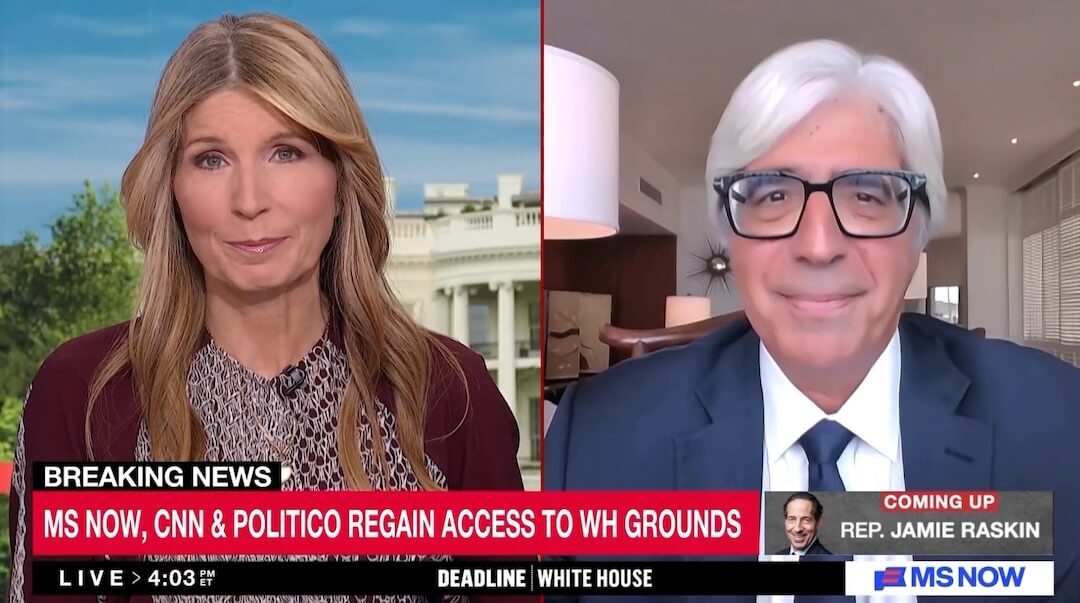
MS NOW’s Nicolle Wallace, left, speaks with media attorney Theodore J. Boutrous. (Courtesy of MS NOW)
Theodore J. Boutrous, the lead attorney for the banned media outlets, appeared on MS NOW’s “Deadline: White House” with host Nicolle Wallace and talked about what’s next in this press ban case. The judge’s restraining order is for 14 days, so the Trump administration could decide to fight back.
Boutrous said, “They’re going to try to come up with some rationale. National security was their first stab. I imagine they’ll keep pushing that as we go to the next stage of this litigation, the preliminary injunction stage, and try to flesh it out somehow. But it’ll be impossible for them to do it, because the president, over and over again, stated that the reason for this ban was his antipathy towards the content of the — the reporting and the editorial viewpoints of the networks and Politico and the journalists. So I think it’s going to be very difficult for them.”
While it’s likely that the media outlets will continue to prevail, Boutrous remains troubled by the government’s stance.
Wallace asked him, “(Have you had) any sort of oh-my-god moments — that this is happening in America?”
He told Wallace, “I really can’t believe it because one of the rationales in the government’s brief that they filed, basically, was that there shouldn’t be a free press, that journalists shouldn’t be able to gather information about the government that the government doesn’t want to see the light of day. They shouldn’t be able to write critical stories. And it’s really shocking that that’s the position of the United States government. And so it is really not something I ever expected to see.”
Perhaps the good news is that the Constitution held up against the president’s actions.
Boutrous said, “Today was a feel-good moment for the First Amendment and for democracy. When I saw the (MS NOW) reporters back in the White House and on the White House grounds and the CNN reporters and Politico and everybody else and the cameras, I felt really good about our country.”
He added, “People are going to understand, again, how important journalism is to the country and to democracy, because it gets people the information they need so they can decide how to govern themselves, how to vote, who to vote for.”
Media news, tidbits and interesting links for your weekend review
- The Washington Post’s Miriam Waldvogel and Scott Nover with “What happens to CNN when Paramount and Warner Bros. merge?”
- Speaking of the merger, there was a hearing Thursday to go over Paramount’s settlement with a group of state attorneys general. Here’s Variety’s Todd Spangler with “Judge Questions Legal Points of Paramount’s Settlement With States at Hearing, Says a Ruling Will Come in ‘Due Course.’”
- Deadline’s Jake Kanter with “BBC Cuts Latest: Around 150 Tech Staff Expected To Take Voluntary Redundancy, Saving Millions.”
- For Poynter, Alexandra Zayas, the deputy managing editor at ProPublica, with “Want your next investigation to make an impact?”
- For Nieman Lab, Neel Dhanesha with “When disaster strikes, newsrooms scramble. A new website aims to help tame the chaos.”
- Veteran sportswriter Michelle Kaufman, a former colleague of mine many moons ago at the then-St. Petersburg Times, was recently among those laid off at the Miami Herald. Here’s her final piece for the Herald: “Thirty years and 12,000 bylines at the Herald; it’s been quite a ride.”
- President Donald Trump is expected to attend this Saturday’s college football game between Texas and Tennessee in Knoxville. That led to speculation that he could appear on ESPN’s “CollegeGame,” which is in Knoxville for the game. However, Awful Announcing’s Drew Lerner reports that an ESPN source told him Trump is not anticipated to join the show. However, Fox’s “Big Noon Kickoff” pregame show will also be in Knoxville, and it’s always possible that Trump could go on that program, especially since conservative commentator Clay Travis, who is also a big Tennessee fan, will be there.
- The latest target of the Pulitzer Prize-winning podcast “Pablo Torre Finds Out” is former college football star (and current ESPN analyst) Tim Tebow and his association with a Christian organization called Life Surge. Here’s the YouTube link.
More resources for journalists
Learn how to write a memoir
with expert guidance in a five-week virtual workshop. Enroll now
.
Strengthen your editing skills and earn an industry-recognized certificate from Poynter and ACES
. Choose from Introductory, Intermediate or Advanced pathways covering current editing standards, tools and best practices. You can start at the level that’s right for you and learn at your own pace.
Protect your sources, your audience and yourself with specialized training on trauma, suicide, addiction and mental health disparities with The Mental Health Reporting Project
— developed in partnership with The Carter Center. Free due to the generous support of the Brain & Behavior Research Foundation.
Have feedback or a tip? Email Poynter senior media writer Tom Jones at [email protected] .
The Poynter Report is your daily dive into the world of media, packed with the latest news and insights. Get it delivered to your inbox Monday through Friday by signing up here . And don’t forget to tune into our biweekly podcast for even more.