
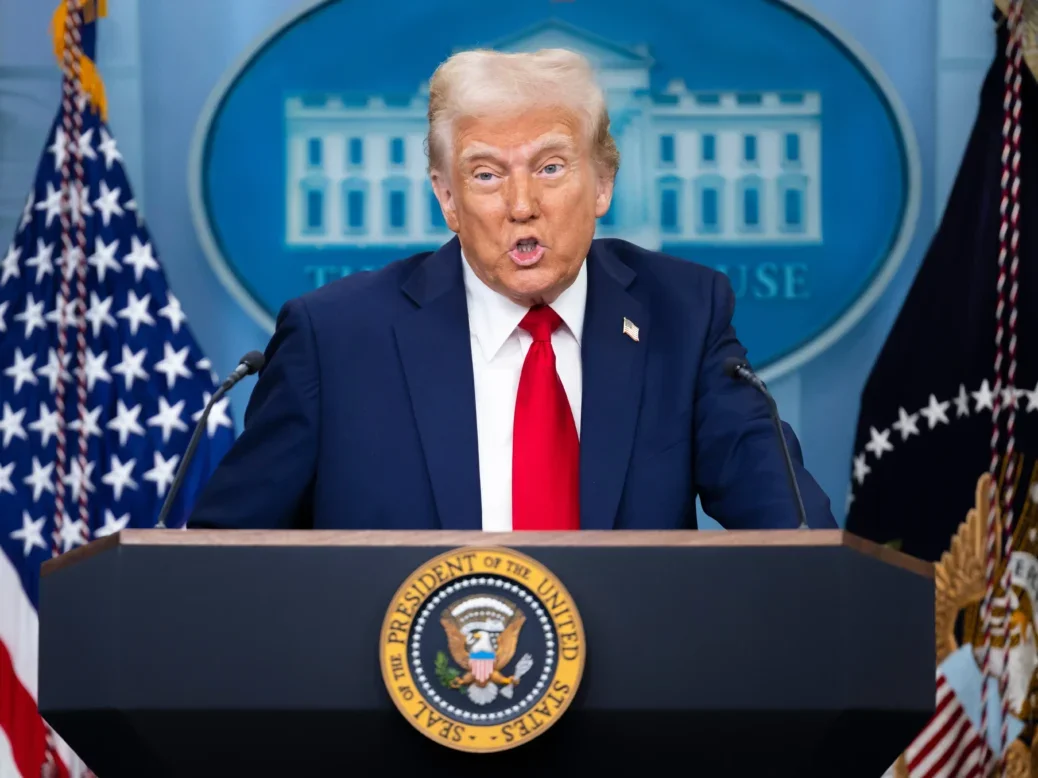
Donald Trump. Picture: Shutterstock
US President Donald Trump has filed a defamation lawsuit against the BBC seeking up to $10bn (£7.5bn) in response to the editing of a speech he made before the 2021 attack on the Capitol.
Documents filed at a court in Florida asked for $5bn (£3.7bn) in damages for defamation, as well as the same amount for a claim of violating trade practices under the the Florida Deceptive and Unfair Trade Practices Act.
The 33-page lawsuit accuses the organisation of broadcasting a “false, defamatory, deceptive, disparaging, inflammatory, and malicious depiction of President Trump”, calling it “a brazen attempt to interfere in and influence” the 2024 US presidential election.
It also accused the BBC of “splicing together two entirely separate parts of President Trump’s speech on January 6, 2021” in order to “intentionally misrepresent the meaning of what President Trump said”.
The Panorama programme was not shown in the US, but the lawsuit says it can be watched on the BritBox subscription streaming platform.
It also claims “millions of Florida citizens use a virtual private network (VPN) to view content such as the Panorama documentary”.
The lawsuit also alleges a Canadian third-party media group, Blue Ant Media Corporation, had licensing rights to the documentary outside the UK and distributed the programme “in North America, including Florida”, though the BBC has not yet responded to these claims.
The lawsuit names BBC, BBC Studios Distribution and BBC Studios Production as defendants.
The complaint from Trump’s legal team alleges there is “substantial evidence” that demonstrates the BBC and its leadership “bore President Trump ill will, wanted him to lose the 2024 presidential election, and were dishonest in their coverage of him”, before the broadcast of the Panorama documentary.
The document also repeats statements by UK politicians including Culture Secretary Lisa Nandy and former prime minister Liz Truss, the latter of whom discussed “the BBC’s pattern of actual malice”.
A BBC spokesperson said on Monday night: “We have had no further contact from President Trump’s lawyers at this point. Our position remains the same.”
A spokesperson later confirmed the BBC “will be defending this case”.
The scandal unfolded earlier this year after a leaked memo highlighted concerns about the way clips of Trump’s speech on 6 January 2021 were spliced together so it appeared he had told supporters he was going to walk to the US Capitol with them to “fight like hell”.
After the report, which was written by Michael Prescott, a former external adviser to the BBC’s editorial standards committee, was leaked, BBC chairman Samir Shah apologised on behalf of the BBC over an “error of judgment” and accepted the editing of the 2024 documentary gave “the impression of a direct call for violent action”.
The programme was broadcast a week before the US election in November 2024.
The fallout from the report led to the resignation last month of both BBC director-general Tim Davie and BBC News chief executive Deborah Turness.
Despite the apology, Trump said he would proceed with legal action for “anywhere between $1bn (£759.8m) and $5bn (£3.79bn)”.
Trump has a history of suing news organisations in the US and is engaged in legal action with The New York Times and The Wall Street Journal.
The BBC previously set out five reasons why it did not think there was any basis for a legal claim. These were:
Trump: A Second Chance? did not air in the US, nor was it available on iPlayer.
The programme could not have caused the US president “overwhelming reputational harm” because he went on to win the US presidential election after it was aired.
There was no malicious intention in the editing of the clip (this must be proved under US law).
The film as a whole was balanced and did not harm Trump’s reputation.
Free speech around politics and political opinion is heavily protected under US law, particularly under the First Amendment to the US constitution.
If Trump tried to sue in the UK, the case would be too late as it has been more than one year since the Panorama episode aired.
Speaking to reporters on Monday evening, Trump told reporters: “In a little while, you’ll be seeing I’m suing the BBC for putting words in my mouth. Literally, they put words in my mouth. They had me saying things that I never said coming out. I guess they used AI or something. So we’ll be bringing that lawsuit.
“A lot of people were asking, ‘When are you bringing that lawsuit?’ Even the media can’t believe that one. They actually put terrible words in my mouth having to do with January 6 that I didn’t say and the beautiful words that I said … talking about patriotism and all of the good things that I said, they didn’t say that but they put terrible words.
“They actually have me speaking with words that I never said and they got caught because I believe somebody at BBC said, ‘This is so bad, it has to be reported’. That’s called fake news.”
Email [email protected] to point out mistakes, provide story tips or send in a letter for publication on our “Letters Page” blog