
Research proposal · Version 0.1 · 15 November 2026. TRACE has not yet been empirically evaluated. This paper is neither peer reviewed nor preregistered.
Read the accessible overview · See the proposed evaluation protocol · Download PDF · Download LaTeX source
Abstract
Conflicting reports can expose measurement differences, copied evidence or omitted explanatory conditions. TRACE (Testing Rival Accounts through Contrast and Evidence) investigates whether explicitly locating these differences improves discovery beyond established contrastive and abductive methods given the same source evidence and resources. The procedure aligns claims, accounts for evidence lineage, generates rival explanations and tests committed predictions. Its primary comparison adds a generated conflict record to a common contrastive-discovery scaffold, holding downstream selection and prediction scoring fixed. Further comparisons distinguish lineage handling, extraction and candidate ordering. Success requires a measurable explanatory relationship absent from the source packet and accurate predictions on sealed observations. The proposed first study uses 12–20 development cases followed by a separate 30–60-case exploratory pilot. Reliability measures constrain interpretation; adaptive investigation and larger studies depend on the pilot’s findings. TRACE integrates established techniques and proposes a test of their incremental value. No implementation or experiments are reported, and neither superiority nor methodological novelty has been established.
1. Introduction: when disagreement is informative
Imagine one report stating that enabling a cache reduces request latency and another reporting that it increases latency. Both statements can be compatible with reality if request reuse, update frequency, resource pressure, or freshness constraints differ. They can also be incompatible because a measurement is faulty, a source copied erroneous numbers, or one account simply makes a false generalization. The correct response is not necessarily reconciliation. A system ought to distinguish different questions, reject unsupported accounts when warranted, and preserve genuinely unresolved alternatives.
This example exposes a gap between answer selection and explanatory discovery. Selecting the more credible report can be useful. So can identifying the source of a contradiction or expressing uncertainty. An established goal of abductive research is to infer a measurable condition not stated in either report, state what new observations that condition predicts, and seek an observation capable of refuting it. If the condition merely redescribes the evidence already seen, no discovery has occurred. If the model uses hidden evaluation labels to invent it, the result is invalid. If a simple fitted regression does as well, the more elaborate synthesis process has not justified its cost.
The Against All Likelihood essay by Lopez-Paz argues that language likelihood is neither necessary nor sufficient for objective truth and explores invariance across relevant transformations as a guide to more robust knowledge [1]. That argument motivates testing an account across contexts, but does not by itself resolve the crucial question of which transformations should preserve which aspect of an answer. A stable false statement survives every harmless paraphrase. A correct account may need to change after a new measurement or a regime shift. For TRACE, this suggests that truth-seeking requires both robustness to irrelevant differences and correct responsiveness to relevant differences—not a blanket rule that all answers should agree.
Earlier CNS work proposes synthesizing Structured Narrative Objects, rather than merely voting on isolated claims. It includes critics, evidence grounding, access states, predicate invention subject to stated limits, and the possibility of unresolved contradiction [2, 3, 4]. TRACE retains those useful aims while shifting the scientific burden to new predictions and comparisons with ordinary alternatives. An independent evaluator must measure whether the procedure improves predictive outcomes.
Why begin with narrative disagreement? Sparse reports can contain clues about omitted conditions that are absent from a ready-made table. TRACE proposes that comparing opposing accounts can focus a finite search over those clues. This is a mechanism hypothesis, especially relevant when measurements are scarce and candidate moderators are numerous, not a theorem that prose beats tabular learning. Shared false assumptions, copied reports or abundant well-measured structured data may remove the benefit. A common-extractor learner and generic hypothesis-refinement comparator must receive the same records and budget; matched contradiction-uninformative packets test whether disagreement adds value beyond hypothesis generation itself.
Method in brief. TRACE records where accounts differ in target, evidence lineage, assumptions and explanatory relationships. Its generator uses those contrasts to propose explanations with measurable variables and distinguishing predictions. Acquisition can supply initially missing context, while warrant remains separate from hypothesis generation. Sections 4.1–4.6 specify the record types, generator interface, numerical compiler, action policy and stopping states. The primary research question concerns the incremental predictive value of localized source disagreement beyond existing discovery methods; generation and ordering experiments distinguish possible mechanisms behind any improvement.
Scope. The proposed procedure addresses empirical claims with explicit target variables, accessible records, or feasible observations. It does not claim a universal criterion of truth, solve disputes of values, or recover causal structure without identification assumptions. We propose a concrete representation, a discovery loop with fixed search and action budgets, and an evaluation whose failure would count against central TRACE claims. No experimental findings are offered here.
2. Related work and contribution boundary
2.1 Closest source-conflict and discovery precedents
Contrastive Discovery represents a scientific question through competing explanations and uses evidence-induced belief redistribution to evaluate and guide discovery [5]. Its data-and-metadata experiments directly precede TRACE’s rival-comparison loop. TRACE cannot claim priority for contrastive experimentation; the proposed distinction is the incremental value of source-conflict localization, tested without withholding source facts from that comparator.
POPPER implements agentic falsification with sequential statistical safeguards [6]. Its guarantees require valid implications and conditionally valid tests; TRACE’s deterministic set-separation heuristic does not inherit those guarantees. A later investigation study must compare against a faithful POPPER adaptation wherever valid statistical tests are available, and report task incompatibilities instead of replacing it with a weak prompt.
Claim Cards records explicit interpretations before evidence gathering [7]. ConfRAG evaluates reasoning over conflicting web references [8]. Perceive-Then-Adjudicate addresses conflicts between model knowledge and retrieved evidence [9]. These precedents constrain claims for alignment, conflict organization and agent arbitration; their outcomes are not equivalent to new held-out predictive conditions.
Contradiction-driven explanation itself is established: Behfar and Okhuysen discuss abductive inquiry into discordant findings [10]. PARADOX analyzes pharmacological contradictions and contextual differences [11]. The publisher links an official repository containing sentence-pair classification, iterative refinement, GPT contradiction checking and graph construction. In the inspected evaluation notebook, the reference labels are GPT labels, not independent outcome measurements. No committed held-out condition-prediction workflow was identified in the inspected notebooks. The full article remains subscription-only, so this implementation inspection does not settle full-method differentiation. Contextual reconciliation is already prior art; TRACE must establish added predictive value. Earlier clinical work also uses ChatGPT to differentiate conflicting scientific evidence [12]. Failing to Falsify supplies a required simple counterexample-prompting control [13].
Contribution boundary. The remaining question is whether a particular representation of documented disagreement improves candidate generation and independently predictive scope discovery under matched information and cost. Neither source independence nor useful localization is assumed from a citation count. The prior-art audit records inspection depth, assumptions and access gaps; the contribution matrix assigns each proposed contribution a precedent and a comparison that could eliminate it. These are targeted searches, not an exhaustive novelty certificate.
2.2 Invariance and its limitations
Invariant causal prediction studies stable relationships under environmental changes subject to explicit assumptions about the causal system [14]. Invariant Risk Minimization (IRM) proposes a representation in which the same predictor is optimal across training environments [15]. These precedents motivate the question, “Which relationship remains useful under which changes?” They do not show that passing prompt-paraphrase tests establishes world truth, or that the prompt context generated by a language model is equivalent to an observed intervention. Negative analyses of IRM and comparisons with tuned empirical-risk baselines are central warnings against treating invariance as a solved optimization problem [16, 17, 18]. Work on discovering environments adds possible future tools but not a reliable admissibility oracle [19].
Lopez-Paz motivates the joint investigation of explanations and admissible transformations, including the use of new predictions and attempted falsification [1]. TRACE adopts that motivation; it does not claim these principles as original contributions. His inference-time sketch generates answers under varied contexts and extracts an invariant core. TRACE proposes a different operational procedure: retain competing scoped explanations, commit their distinguishing predictions before acquiring outcomes, and select evidence-gathering actions using a specified rival-separation rule. Explicit provenance, transformation contracts, and failure states make that procedure inspectable. Whether this combination improves predictive synthesis or investigation over simpler alternatives remains an empirical question.
Behavioral testing supplies a practical precedent for structured perturbations, and counterfactually augmented examples distinguish robust behavior from sensitivity to superficial cues [20, 21]. However, a transformation that removes the only relevant source is not a mere nuisance. Neither is changing a measured causal input. A benchmark must state the expected response for each transformation instead of rewarding identical strings under every condition.
2.3 Evidence, source dependence, and warranted assertion
Retrieval-augmented generation and chain-of-verification can help connect an answer to accessible evidence [22, 23]. Source dependence is a separate issue: many reports may reproduce the same originating record and therefore should not be treated as independent confirmations [24]. This is particularly important when a seemingly broad consensus is produced by copying. TRACE distinguishes (i) whether two claims address the same estimand, (ii) whether they rely on the same record, and (iii) whether nominally distinct sources share a lineage. These are not interchangeable quantities.
A cited source can establish that a statement was reported, not that the statement is automatically correct. Likewise, a valid deduction from premises remains conditional on the premises. SNOs therefore preserve exact source spans, time, access and dependency, while a separate warrant field records whether the claim is source-reported, derived given premises, empirically supported within scope, refuted within scope, or unresolved. Existing CNS 8.0 material recognizes the distinction between an internally stable orthesis and metaphysical truth; our proposal makes predictive and observation-based tests additional explicit gates, not a retrospective claim that the prior work ignored uncertainty [2, 3, 25].
2.4 Aggregation, debate, abduction, and argumentation
Self-consistency aggregates multiple reasoning samples; debate structures disagreement between models; verification asks targeted subquestions [26, 27, 23]. Results of multi-agent comparisons suggest that debate must be compared against simpler voting or aggregation rather than credited with improvement by default [28]. Model-generated reasons can also be unfaithful to the causes of a model’s answer [29], so TRACE audits short, externally checkable justifications rather than treating hidden reasoning traces as evidence.
The distinction between supporting and attacking arguments has a long formal tradition in abstract argumentation [30]. Abductive inference generates candidate explanations from observations; computational forms include cost-based first-order abduction [31]. Inductive logic programming (ILP) supplies a precedent for rule and predicate learning in a specified language [32]. These traditions already cover substantial ground claimed informally by many “discovery” systems. TRACE does not claim to invent abduction, argument attacks, or predicate invention. The proposed artifact is a procedure and comparative design for testing conflict-conditioned predictive discovery. Combining familiar components does not establish methodological novelty. The empirical question is whether explicit source-conflict localization adds predictive value beyond those methods.
Iterative hypothesis generation is already a close precedent. HypoGeniC updates a bank of natural-language hypotheses using prediction errors on labeled examples [33]. Qiu and colleagues propose, select and refine rules with symbolic interpretation, distinguishing rule induction from reliable application [34]. These methods motivate a required refinement comparator, rather than treating discovery as a comparison only with answer aggregation. Causal Modelling Agents combine LLM metadata reasoning with data-driven structural causal models [35]; that is relevant hybrid causal-modeling precedent, not evidence for the proposed TRACE procedure or a universal intervention capability.
2.5 Choosing observations and existing discovery agents
AutoDiscovery already generates contexts, derived variables and relationships, including hypotheses across datasets; its released implementation also defines structured hypothesis dimensions [36]. These capabilities are inherited, not distinctive to TRACE. Its search uses model belief change, which is not an external correctness label. A credible comparator must retain its ability to propose conditional explanations. Piriyakulkij and colleagues combine LLM-proposed natural-language rules, probabilistic belief updates and experiment design [37]. This is a close precedent for the hypothesis–experiment loop. TRACE therefore tests the added value of explicit comparison between source accounts, including their measurement and lineage differences, rather than claiming to originate automated experimentation.
Bayesian experimental design gives a principled account of selecting actions to reduce uncertainty when the relevant hypotheses, likelihoods and priors can be specified [38]. Active learning for causal structure makes the experimental-choice problem concrete [39]. TRACE uses a set-separation heuristic when probability models are unspecified and compares it with relevance-based and random acquisition. Predicting intervention outcomes does not by itself identify a causal graph.
Modern work already explores agentic scientific workflows: The AI Scientist automates parts of idea generation, experimental code and reporting [40]; Co-Scientist develops scientific hypotheses through agent coordination and evaluation [41]; and Robin connects literature agents, analysis and experimental biology [42]. These workflows provide established alternatives for hypothesis generation and experiment planning. TRACE focuses on the additional value of explicitly locating disagreement in their source evidence. DiscoveryBench provides a separate transfer diagnostic, while FEVER, SciFact and AVeriTeC test forms of source-grounded verification rather than universal truth [43, 44, 45, 46].
3. Epistemic commitments and nonclaims
Four distinctions govern the proposal.
Truth is not identical to current warrant. Whether a scoped proposition is true in the world is separate from whether the available record supports saying so. The system can update warrant after evidence arrives without changing the historical fact being described. A true claim with inaccessible support remains unwarranted; a previously strong citation can later be retracted.
Coherence is not correctness. Propositions can agree because they share a mistaken assumption, training artifact or copied source. A stable internal model can be a sensible computational stopping condition, not proof of objective truth. This applies to deductive closure, round-trip translation, majority vote, and invariance over model-generated perspectives.
Stable mechanism is not constant output. A representation-only nuisance change should preserve the relevant meaning, up to an explicit transformation of units or format. If the population, intervention or measurement changes, a credible explanation may predict a different outcome. If a unique support record disappears, the empirical event need not change but the warrant may weaken. We therefore use transformation-specific output relations.
Uncertainty is not lack of access. Observation noise, unavailable records, open-world ambiguity, and observationally equivalent mechanisms imply different limitations. Two worlds that supply exactly the same permitted observations but require different conclusions cannot be separated merely by more model deliberation. The legitimate output may be a set of live alternatives and an identification boundary.
TRACE treats a proposed new scope condition as a hypothesis until its operands are observable and it has predictive consequences not exhausted by the source examples. A cause is not identified merely because a story explains a correlation. A probabilistic forecast must refer to a specified event; token likelihood is not used as its substitute. These commitments are falsifiable at the level of system behavior and externally measured outcomes; they are not axioms purportedly guaranteeing truth.
4. Method: alignment, explanation generation and investigation
4.1 Four-stage procedure and common records
TRACE asks whether comparing the explanatory structure of conflicting accounts helps generate independently predictive explanations. Its four stages are alignment, lineage accounting, rival generation, and investigation with warrant assignment. The numerical compiler in Section 4.4 is one component of rival generation. Cases can stop at any stage with a recorded reason; successful normalization alone does not count as explanatory discovery.
A question is \(q=(Y,\mathcal P,t,\mathcal I,u,\tau)\): outcome definition and aggregation, population, time/window, intervention or observation context, units and tolerance. An evidence atom records its source, exact span or measurement, timestamp, access state, measurement lineage and collection context. A report contains atomic claims, assumptions and asserted explanatory relationships, each linked to evidence atoms. The record distinguishes source_stated content from extractor_inferred interpretation. Neither attribution nor extraction establishes truth.
Stage A: alignment. Compare the questions and create a conflict record \(\Delta(A,B)\). Its estimand_status is same, unit_convertible, different or unknown. A unit mapping records its formula and preconditions; apply it only when the outcome definition, aggregation and relevant scope match. Median and p99 are different targets, not convertible units. Preserve them as separate questions unless the required underlying distribution is available. Different context populations may motivate a transport/scope hypothesis; do not silently treat their observed effects as contradictory measurements of one fixed population. Record separately whether the sources assert incompatible generalizations, whether their observed intervals differ, and what context differences might explain the contrast.
Stage B: lineage accounting. Record shared_origin, distinct_origins, mixed or unknown, with evidence for each lineage link. Collapse only duplicate measurements, retaining source attribution and any additional observations. Distinct origins do not guarantee statistical independence. Copied support contributes once; copying does not refute the claim, validate its rival, or identify the true mechanism. Unknown dependence remains explicit and receives prespecified sensitivity analysis. A defective measurement can be excluded only for a recorded defect criterion; the exclusion does not establish the competing account.
Stage C: rival generation. Use the report claims, assumptions, relationships and conflict record to propose conditional explanations or rival mechanisms (Section 4.3). Variables can enter through three provenance states: observed_shared (values recorded in both accounts), observed_asymmetric (recorded in one but missing in another), or inferred_unmeasured (proposed, with no measured values). These states apply relative to the cited report pair; cell-level missingness remains recorded. A variable’s conflict_ids lists applicable conflict records and may be empty during extraction. If its provenance state differs across pairs, use pair-specific variable records linked to the same operational definition. Observed in prose need not mean numerically fit-ready. No missing value may be inferred merely because an explanation needs it.
Stage D: investigation and adjudication. Commit testable predictions, acquire permitted observations and update claim-specific warrant. A candidate requiring new measurements remains pending until it can predict or be fitted. A case with no available identifying observation remains unresolved. Runtime cannot certify global non-identifiability; that classification belongs to the sealed evaluator. Runtime records which alternatives remain and why its permitted actions cannot separate them.
Common export. Every run uses the same linked tables, including runs that never generate a fitted rule. IDs join records within a case; null denotes unknown, never false or zero.
| Table | Required scientific content |
|---|---|
questions, evidence, reports | Target/scope; source spans and measurements; claims, assumptions and explanatory relations with attribution type |
conflicts | Report and question IDs; estimand and lineage statuses; incompatible claims; context differences; transformations and unresolved fields |
variables, observations | Definition, units/type, provenance state and measurement procedure; observed values, time and lineage, including missing cells |
candidates | Conflict IDs; retained/rejected claim IDs; added relationship; assumptions; variable IDs; executable prediction or pending dependencies; generation rank and status |
predictions, actions | Candidate, target and action IDs; prediction region, tolerance, commitment time; requested measurement, response and cost |
decisions | Stage, affected claim IDs, reason, evidence IDs, warrant and unresolved alternatives |
scores | Evaluator-only outcomes, errors, endpoint verdicts and mechanism-family strata, appended after commitment |
The downloadable record schema defines these fields and types. Referential integrity, source-span fidelity, units and temporal availability are semantic requirements beyond JSON shape validation. Candidate and decision traces describe program operations, not private model reasoning. Aggregate by independent root, not by the number of candidates or observations. This allows the same analysis to distinguish alignment corrections, dependence adjustments, new conditions, refuted candidates and unresolved cases across F1–F8 without passing family labels to runtime.
Role of the architecture. Alignment and provenance accounting implement inherited safeguards. Stage C is the principal experimental target: does an explicit conflict record improve the proposed conditions and their predictions? Stage D implements investigation using established experimental-design ideas. Neither multiple agents nor the numerical compiler is required to be an innovation. The primary mechanism comparison in Section 8 holds downstream compilation and evaluation fixed; a separate end-to-end comparison measures the cost and errors of producing the conflict record itself.
4.2 Transformation contracts
Three records must remain separate. A representation/evidence-integrity contract \(c_T=(T,\operatorname{pre}_T,r_T,v_T,z_T)\) declares an operation, preconditions, a property that should be preserved or converted, a validator and a state \(z_T\in\{\text{validated},\text{rejected},\text{unknown}\}\). Unit conversion can require numerical equivariance; a demonstrably redundant copy must not count as another independent observation. The preconditions matter: order can encode chronology, a paraphrase can change scope, and a copied document can contain new evidence. Semantic validity is not universally decidable by deterministic code. Removing evidence can change warrant, but does not impose a universal direction of confidence change.
A rival-indexed response commitment \(r_{T,h}\) states how hypothesis \(h\) predicts an outcome will respond to a world, regime or evidence change. Different rivals may make incompatible commitments. The runtime need not know which mechanism is true before recording that disagreement. Knowing that an operation preserves units does not establish that a disputed world change preserves the outcome.
An evaluator-only relation specifies the benchmark’s expected behavior from its sealed state. It scores the method after outputs are locked and is never passed to runtime as a validated contract. Gold-admissibility access is a diagnostic ceiling, excluded from superiority claims.
For a representation/evidence-integrity contract, the check remains three-valued:
\[ C_T(x)=\begin{cases} \mathrm{pass},&z_T=\mathrm{validated}\text{ and }r_T\text{ is verified},\\ \mathrm{fail},&z_T=\mathrm{validated}\text{ and }r_T\text{ is violated},\\ \mathrm{unknown},&\text{the contract or necessary evidence is unresolved}. \end{cases} \]For a rival-indexed commitment, the system records predictions and later adequacy checks, not an oracle verdict about admissibility. Validators, tolerances and expected evaluation relations must be frozen before confirmation. A failed or unknown contract cannot be discarded merely because its result is inconvenient.
4.3 Rival generation and prediction commitments
Generator interface. A run begins with one extraction call over the permitted source packet. The extractor produces source-linked report and observation records. Its instruction is: “Preserve each account’s question, claims, assumptions and asserted relationships with exact evidence IDs. Separate explicit statements from your interpretations. Record missing or ambiguous values as null. Do not reconcile accounts or supply absent measurements.” Deterministic code performs verified unit conversions, duplicate-measurement accounting and record joins; uncertain semantic alignments stay unknown.
One generation call then receives the complete permitted packet, its extracted records, the conflict records, the action menu and the remaining budget. The instruction is: “For each unresolved comparable conflict, propose explanations that account for its observations. For each candidate, identify the claims retained or rejected, the added condition or relationship, its assumptions, and a prediction that differs from a rival. Cite the conflict and evidence IDs motivating it. Mark every added variable as observed_shared, observed_asymmetric or inferred_unmeasured. For missing measurements specify a procedure and permitted action, or mark unavailable. Include an account-rejection explanation only when evidence supports a defect; allow all accounts to be inadequate. Output candidate records, not a consensus essay.”
The TRACE implementation permits up to eight proposals per generation call, one schema-repair call containing only structural errors, and two generation rounds in an adaptive run. A separate localization call turns the extracted records into conflict records, cites supporting spans, preserves unknowns and proposes no explanatory condition. Its tokens and errors count toward the run. These call allocations describe TRACE and the matched scaffold comparison; faithful method-level competitors can allocate their calls differently within the same total resource ceiling. A static run has one round and no acquisition. The second adaptive round receives acquired observations and the preceding candidate records, with old predictions immutable. These are proposed engineering limits, to be fixed with the model version, inference settings and packet construction before confirmation. Invalid or excess proposals remain logged and consume generation budget; repairs cannot receive scoring outcomes.
Variable acquisition. An asymmetric variable cites the source passage establishing its presence and the rows where its value is missing. An unmeasured variable includes an operational definition, units or categories, when it would be observed, motivating evidence or an explicitly labeled mechanistic conjecture, and a permitted measurement action if one exists. Neither variable state is a supported explanation. After acquisition, update cell values and availability while preserving the original provenance state. Missing context can become a measured predictor within the run. If no permitted action can supply it, record measurement_unavailable and retain uncertainty rather than filling the column by inference.
Candidate representation. A candidate must explain which original observations it accommodates, which claims it changes and why its added relation would account for the difference. Prediction forms are: a numerical expression over defined variables; a conditional rule; or a categorical/interval commitment for a specified action. Executable expressions use constants, variable IDs, arithmetic, comparisons and conditional selection; division by zero or unavailable operands yields an unknown prediction. No generated code executes outside this expression interpreter. Parameters must be declared as fitted from identified observations, source-specified, or conjectured. Conjectured parameters can make testable predictions but acquire no empirical warrant from being written down. Narrative-only candidates remain pending_prediction and cannot earn H2 credit. Causal candidates additionally declare intervention assumptions; predictive success alone cannot establish a causal graph.
Candidate validity requires resolvable IDs, supported source attributions, consistent units, an identified target and no use of future outcomes. Semantic fidelity is assessed with a frozen rubric and blinded independent adjudication for the study; these judgments score the run and do not feed back into runtime. An explanation is allowed to retain one account, reject both, introduce a scope condition or preserve competing mechanisms. The parser enforces format and dependencies, not truth.
Prioritization. At most four candidates are active for investigation. Order valid proposals first by whether they address an explicitly localized incompatibility, then by the number of distinct observed report contexts they account for without an unsupported value assignment, then by fewer newly assumed variables; break ties by canonical candidate ID. These are auditable proposal features, not calibrated truth probabilities. Include measurable pending candidates as well as currently executable ones. Log all proposals and rankings so candidate generation can be separated from selection effects. In the complete TRACE procedure, select a final prediction candidate using the same ordering among candidates that remain adequate; report unresolved where none qualifies. The controlled C–B generation experiment replaces this conflict-sensitive selector with the common selector specified in Section 8.2. The numerical compiler may rank alternative parameterized rules within a candidate using Section 4.4; its training score cannot compare arbitrary prose mechanisms or confer warrant.
Before any scored observation is revealed, write a prediction commitment \(k=(h,q,\hat y,\tau,a,t_0)\) with the candidate, question, prediction, tolerance, action/context and timestamp. Preserve the record immutably. Operational novelty requires a new relationship or scope condition and a distinguishing consequence absent from the initial accounts; merely translating units, extracting an existing qualification or changing a source weight does not satisfy H2. An explanation must also account for the motivating observations under its stated assumptions. Its held-out predictions, rather than its rhetorical plausibility, determine predictive success.
For task-appropriate loss \(\ell\), predictive error remains
\[ R_e(M)=\mathbb E_{(x,y)\sim P_e}[\ell(M(x),y)]. \]Report risk alongside coverage and false promotions. A binary world-event forecast can use Brier loss \((p-y)^2\) [47]; a document-entailment confidence is a different quantity. The evaluator’s task definitions and tolerances are fixed before confirmation.
4.4 Numerical rule compiler and search-order experiment
The numerical compiler implements one candidate form within Stage C. It accepts numerical outcomes and predictor measurements available in every fitting row, including variables measured through an earlier permitted action. Other candidate forms use the prediction interface in Section 4.3. The compiler’s restricted language does not define the full TRACE architecture or cover every benchmark mechanism.
A compiled rule predicts one constant, or two constants separated by one predicate or a conjunction of two predicates on distinct variables. Numeric predicates use midpoints between consecutive observed values; categorical predicates test equality to observed categories. Each conditional branch requires at least two distinct measurement-lineage units. Copy duplicates count once; repeated readings within a lineage/context first form a mean. Missing cells produce requires_measurement, not silent complete-case selection. Record identifiers, source identities and target-derived variables cannot be predictors. Numeric extrapolation, unseen categories and missing prediction inputs return unknown under this compiler.
For the complete lineage-aware procedure (D), fit branch constants by weighted least squares and rank fitted alternatives by
\[ J(g)=\sum_i w_i\left(\frac{y_i-g(x_i)}{s_q}\right)^2+\lambda k(g),\qquad w_i=\frac{1}{L n_{\ell(i)}}. \]Here \(L\) is the number of identified measurement lineages, \(n_{\ell(i)}\) is the number of context rows in row \(i\)’s lineage, \(s_q>0\) is a prespecified target scale, and \(k\) is the predicate count. Equal lineage weights prevent duplicated reporting from increasing weight; they do not establish independence or optimal statistical weighting. Unknown lineage is retained for dependence sensitivity analysis. In the controlled B/C conditions, fitting uses equal weights over unique observed rows and the same minimum row count per leaf; exact repeated records are removed in all conditions. D instead uses the lineage weights above and requires distinct lineages per leaf. Distinct records sharing an origin therefore remain a meaningful test of D. The D–C contrast measures this explicit accounting package, including its eligibility and warrant rules, rather than a weighting formula alone. Classical learners may use supplied lineage facts with their documented methods. The initial penalty \(\lambda=0.01\) is an engineering setting requiring development-stage justification. Training fit chooses alternatives to test; only subsequent observations can support the predictions. Tolerance-expanded prediction regions are not asserted to be calibrated confidence intervals.
For small tables, enumerate all admissible conditions. Do not withhold inexpensive classical computation to manufacture an advantage for TRACE. B8 may use ordinary trees, regression or exhaustive rules within the common measured resource budget, rather than inheriting an artificial 64-rule cap.
A separate search-order experiment fixes the extracted variables and complete candidate language. For each eligible report pair and predicate, take the absolute difference in its observed context frequencies, then average over pairs. A pair with missing predicate values receives no contrast score for that predicate; log its missingness. Order single predicates and then two-predicate conjunctions by decreasing mean contrast score, with canonical-ID ties. Compare this order with a fixed seeded permutation and exhaustive enumeration, using identical fitting and selection. A 64-condition prefix is one explicitly labeled diagnostic on distractor-heavy/high-dimensional cases, alongside the full budget curve. It is not the primary TRACE definition or a resource ceiling imposed on B8. Report candidate count, CPU time, model calls/tokens, external actions and total measured cost. If all conditions fit within the budget, rankings should coincide and there is no search-order advantage to explain.
The generation experiment in Section 8.2 compares a contrastive generator with and without supplied conflict localization. It uses the same facts, prediction interface and downstream selector; differences in candidate pools concern generation. The ordinary iterative-refinement system A is an additional method-level comparator. To study prioritization alone, freeze a candidate pool generated without evaluator outcomes and change only its ordering. Numerical search ordering is a further, separate intervention over a fixed table and rule language. A positive pipeline comparison cannot identify which of these mechanisms caused an improvement without the corresponding controls.
4.5 Selecting evidence
Stage D first seeks an action with comparable predictions from every active rival. A pending candidate cannot be silently removed to make the separation score computable. If none is scorable because required measurements are missing, use a prerequisite measurement policy: among permitted actions that supply an explicitly named missing variable, unit-mapping input or lineage record, choose the lowest declared cost; ties follow candidate priority and stable action ID. Log the dependency and the action’s purpose. This is data completion, not claimed information gain. Recompute candidate eligibility after observing the response. Such actions consume the same three-action/12-unit budget and may fail to enable a prediction. An unavailable measurement or absent separating action leads to unresolved status, not an invented value. Static branches cannot use this policy to obtain new evidence.
The proposed discrimination policy is a deterministic set-separation heuristic. Let \(\mathcal H_c\) be the deduplicated live candidates with executable commitments on a common outcome, and let \(A_h(a)\) be candidate \(h\)’s prediction region after the frozen measurement-noise and decision-tolerance expansion has been applied exactly once. For feasible actions with strictly positive, declared costs, define
\[ U(a)=\frac{1}{\operatorname{cost}(a)} \frac{\displaystyle\sum_{\{h,h'\}\subseteq\mathcal H_c} \mathbf 1\!\left[A_h(a)\cap A_{h'}(a)=\varnothing\right]} {\displaystyle\binom{|\mathcal H_c|}{2}}, \qquad a^*=\arg\max_{a\in\mathcal A_{\mathrm{feasible}}}U(a). \]This policy is defined only when at least two comparable candidates exist and every retained candidate supplies an admissible prediction for the action. Zero-cost lookups are part of the common initial evidence, not a division by zero. Missing predictions make an action unscorable under this policy; they are logged rather than silently excluded from its denominator. Deduplication uses a frozen candidate-normalization rule, with residual duplicates audited. Ties use a stable action ID assigned independently of the hidden mechanism. If no action has positive score, return no_separating_action; do not claim that uncertainty is resolved. The prerequisite policy applies only to explicit missing dependencies; it does not replace a zero separation score with an unsupported certainty claim. Other policies can be studied as labeled alternatives under the same budget.
For certain set-valued predictions, disjointness means that one observed value cannot satisfy both commitments. Probabilistic intervals are different: a tail observation does not logically falsify a stochastic model. Overlapping intervals may still allow useful repeated or multivariate observations, so this heuristic can miss informative actions. The heuristic provides no optimality, version-space reduction or causal-identification guarantee. Candidate misspecification remains a failure mode.
When a prior and observation likelihood are actually specified, expected information gain minus cost is a conventional alternative [38]:
\[ a^*=\arg\max_a\{\mathbb E_{y\mid D,a}[D_{\mathrm{KL}}(p(h\mid D,a,y)\Vert p(h\mid D))]-\lambda\operatorname{cost}(a)\}. \]The initial heuristic does not execute this Bayesian objective or manufacture numeric posteriors for prose. Its actual utility must be compared with random, relevance-only, uncertainty-based and model-based policies where those are well defined.
4.6 Warrant, promotion and stopping
A system records claim-specific warrant using these statuses:
source_reported: attributed to an available source.derived_given_premises: follows subject to stated premises.candidate_prediction: committed but not yet adequately tested.empirically_supported_in_scope: meets declared evidential criteria.refuted_in_scope: fails the relevant adequacy criterion.unresolved: available evidence does not settle the claim.
These states are not a ladder that turns derivability into truth. A compound SNO can contain differently warranted claims. A conditional synthesis may be promoted at runtime only when scope and measurement are explicit, its essential evidence is traceable, and independently acquired permitted observations meet a prespecified adequacy criterion. Sealed benchmark outcomes score the run afterward and never change its runtime warrant. That promotion is provisional and revisable.
Warrant is tracked through the evidence/assumption dependency graph, not a scalar weakest-link ladder. Derivation preserves its premise qualifications; several independent support paths may strengthen a claim, and defeat of one path need not erase the others. Promotion requires independently checked evidence and prespecified, noise-aware adequacy criteria. A single missed probabilistic interval is not automatic model refutation. Sequential checks and stopping rules must be fixed rather than selected after outcomes are seen.
If all candidates fail those adequacy criteria, record all_candidates_inadequate: repeat candidate generation within the stated limits if budget remains, otherwise return an unresolved/model-inadequate result. A least-bad candidate cannot be promoted solely because its failed rivals are worse. An inability to score a candidate remains unknown, not a pass.
The system must stop when actions or compute are exhausted, no available action distinguishes remaining rivals, the estimand is underspecified, or further acquisition has no defensible value. Stopping cannot be reported as certainty. The proposed objective is fewer unjustified claims and more useful independent predictions, not a universal solver for every empirical question.
5. Proposed operational algorithm
The proposed loop in Figure 1 separates runtime evidence acquisition from sealed experimental evaluation. Functional roles—proposer, critic, synthesizer, verifier—do not require separate models; multiple prompts from one model do not become independent sources. Deterministic validators should handle units, type checks, timestamps, schemas and executable rules. Human or model-assisted semantic review may be necessary, but review uncertainty must remain visible.
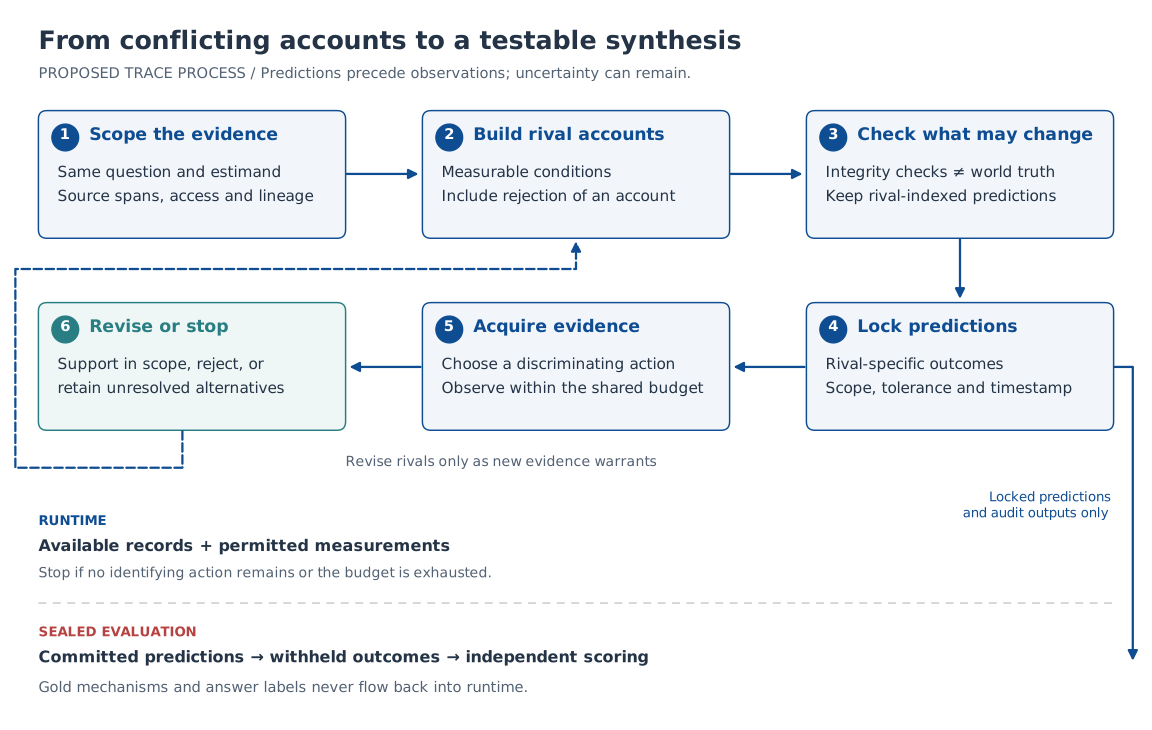
INPUT: source packet, questions, permitted actions, resource budgets
1  Extract source-linked claims, assumptions and observations.
2  Align questions; apply valid unit mappings; preserve unknowns.
3  Account for measurement lineage; record conflicts and context gaps.
4  Generate typed rivals and variable measurement requirements.
5  Validate dependencies; compile eligible numerical rules.
6  Rank proposals; activate at most four; preserve pending candidates.
7  Lock predictions before observation; run integrity checks.
8  Select a separating action or a logged prerequisite measurement.
9  Acquire within budget; update records and candidate adequacy.
10 Regenerate at most once; preserve all earlier commitments.
11 Assign warranted conclusions or unresolved status; export records.
OUTPUT: conflict, candidate, prediction, action and decision tables
A contract should not be validated by the same example whose result it was invented to rationalize. Development can refine the grammar and validator; calibration can tune abstention; confirmatory cases must be new. The system may request a measurement from an outcome service, but that service must return an ordinary reading rather than a hidden label such as “hypothesis true.” The benchmark evaluator sees sealed mechanisms and withheld predictions only after the runtime outputs have been committed [25].
Validation should be adversarial. A candidate that says “the cache helps exactly when it helps” is circular. A rule invented solely to rescue every negative example is disallowed by specified rule grammar and held-out tests. A stable false answer fails external correctness. A continually abstaining system fails coverage. A model that always reconciles fails on direct-rejection controls. Conversely, a model that refuses to synthesize whenever sources disagree should fail discovery-eligible cases. These negative cases test whether the procedure can reject inappropriate synthesis.
6. Worked example: caching, mechanisms and refutation
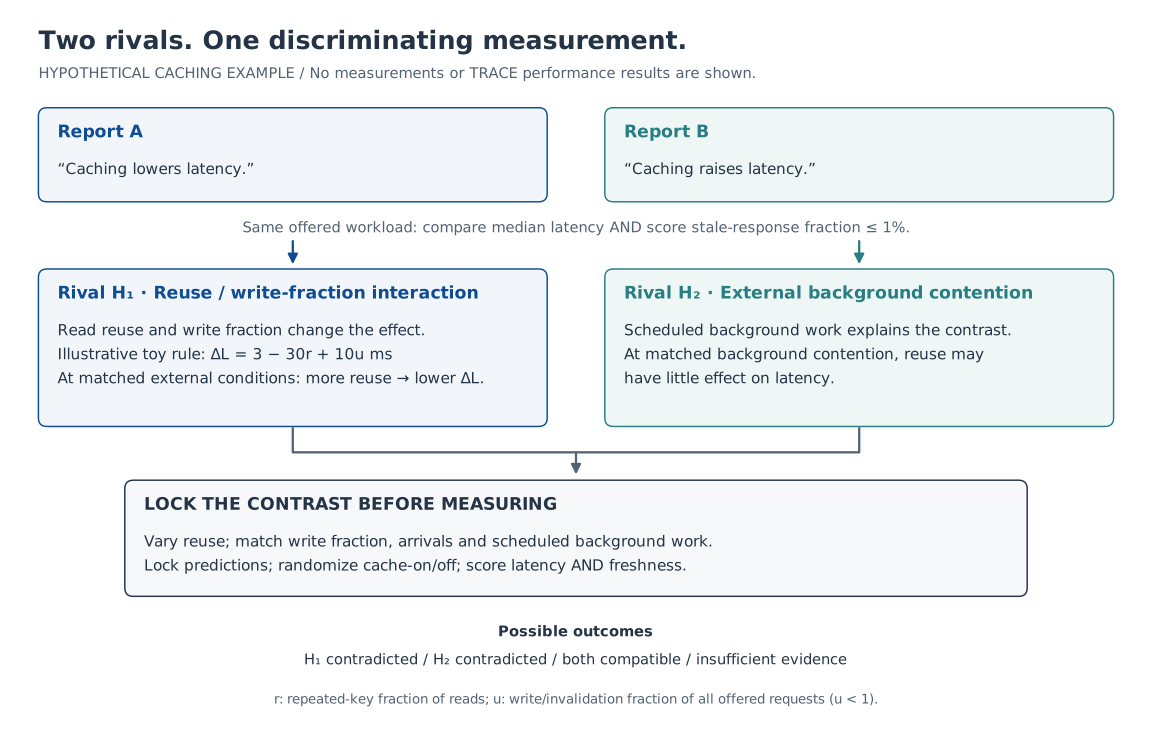
Figure 2 is a hypothetical illustration, not a TRACE run. Define \(\Delta L=L_{\mathrm{cache\ on}}-L_{\mathrm{cache\ off}}\) in milliseconds for a fixed offered workload. Negative values indicate lower median latency. Separately predict and measure staleness; a workload is a deployment-success case only if its declared freshness bound (for example, stale-response fraction at most 0.01) is satisfied. Do not drop freshness failures after seeing them or condition the latency estimate on selected successful requests.
Let \(r\) be the fraction of read requests repeating a key already requested within a prespecified reuse window, and \(u\) the fraction of all offered requests that are writes/invalidation requests. Both are dimensionless workload settings, not an observed cache-hit rate or writes per second. The denominator of \(r\) requires \(u<1\); feasible key schedules, arrival rate and request mix must be specified. A relation for communication only is
\[ \Delta L_{\mathrm{toy}}=(3-30r+10u)\ \mathrm{ms},\qquad 0\le r\le1,\quad0\le u<1. \]This invented relation illustrates a possible data-generating mechanism. The TRACE numerical compiler fits piecewise-constant approximations to observations; it does not infer the displayed formula or its coefficients from prose. Two reports do not identify its coefficients. Rival \(H_1\) proposes dependence on reuse and write fraction. Rival \(H_2\) proposes that externally scheduled background contention explains the contrast. External offered traffic and background work can be controlled; backend utilization caused by cache hits is a mediator, not a quantity to match across treatment arms. Concurrency policy, hardware capacity, payload distribution and reuse-window definition must also be fixed or explicitly varied.
Before observing a new workload, lock each rival’s latency and freshness predictions. A feasible contrast varies reuse while matching write fraction, offered arrival rate and scheduled background contention; a complementary contrast varies external contention at matched workload settings. Randomize cache-on/off order and monitor carryover. Do not artificially hold downstream CPU/database work constant while claiming the total caching effect. If neither contrast separates the rivals, record that limitation. If all candidates fail noise-aware adequacy checks, reopen within budget or remain model-inadequate.
The cross-case record makes this example operational. Suppose background work is recorded in report B but absent from A. The conflict row identifies the incompatible latency generalizations and this context gap. A candidate names contention as observed_asymmetric, retains the two reported measurements, and adds the hypothesis that contention changes the caching effect. An action requests A’s missing context or a permitted matched workload. Its response populates an observation row; it cannot retroactively alter the candidate’s earlier commitments. A mechanistic candidate may instead propose a new measurable factor as inferred_unmeasured, with a measurement procedure and a falsifiable prediction. If no action can measure it and no justified prediction is available, it remains pending.
What would distinguish TRACE here? Every comparator receives the same report spans, workload facts and available measurements. Ordinary refinement and the Contrastive Discovery adaptation may discover reuse, write fraction or contention without supplied localization. TRACE additionally organizes the conflicting latency generalizations and their missing-context links; its lineage variant accounts explicitly for shared measurement origins. The example establishes no advantage. Only a different, valid candidate pool followed by stronger sealed predictions at matched cost would support the localization hypothesis. Naming the same moderator more fluently earns no credit.
Other outcomes follow the same record path. A milliseconds/seconds difference yields a validated mapping and an alignment decision, with no H2 discovery credit. A p99/median difference yields distinct questions. Copied reports yield a lineage adjustment without a truth verdict. Rival causal accounts that no permitted action separates yield unresolved decisions. These records permit comparisons of failure and resolution types across cases while preserving their evidential differences.
The prospective evaluator scores commitments against withheld measurements collected later. Runtime may receive only the outcomes of permitted acquisition actions, not gold mechanisms or evaluation verdicts. The same extracted measurements must be available to direct rule/regression learners. Correct predictive scope need not identify a unique causal graph; causal wording requires defensible interventions and assumptions.
7. Primary question and supporting hypotheses
H2 — Independently predictive discovery (primary). Does explicit conflict localization improve the discovery of measurable conditions beyond an established contrastive-discovery adaptation receiving the same source facts? The primary comparison is C versus B in Section 8. Each system locks its explanatory relationship, parameters and final candidate before receiving the five prediction contexts. It then applies that fixed candidate to those contexts and commits the outputs before any outcome is revealed. All systems receive the same context fields from a task dictionary fixed during development; field selection must not disclose the correct moderator. New variables require an operational mapping to available fields or remain unmeasured. The evaluator selects challenge settings before generation, independently of each system’s proposals. Success requires a source-faithful explanatory relationship not explicitly supplied in the packet, a distinguishing new prediction, and at least four of five predictions correct under frozen tolerances, including every prespecified diagnostic setting needed to distinguish the task’s principal unconditional alternative. Alignment, copying detection and restatement earn no discovery credit. Candidate novelty is relative to the initial packet, not a claim of novelty to science. A condition may be new even when its variables occur in the reports; what must be absent is the explanatory relationship. No credit requires guessing an unobservable latent variable. A blinded semantic rubric and held-out prediction scoring assess different requirements; neither substitutes for the other.
The generation-only study uses a fixed permitted evidence snapshot. A variable absent from the measurements can support a conjecture, but unsupported assignments cannot manufacture fit or warrant. A case needing further measurements remains pending on the static branch; discovery following acquisition belongs to the subsequent adaptive study. Each positive challenge set must distinguish a plausible unconditional alternative; use mixed regimes and boundary settings where appropriate, rather than require sign reversals for every mechanism family.
H1 — Reliability (supporting quality measure). Report base-answer correctness, response to nuisance and relevant changes, coverage, false promotion and unsupported resolution. A system that wins H2 by inventing conditions indiscriminately or refusing difficult cases has not established a useful discovery method. Include negative controls where no new condition is justified and cases where accessible evidence cannot identify the answer. Report denominators and unconditional scores; do not select only successful generations for analysis.
H3 — Investigation (conditional subsequent study). Only after the representation and generation stages show credible predictive value, compare evidence acquisition against Contrastive Discovery, POPPER where its statistical assumptions can be met, ordinary experimental design and simple random/relevance policies. All receive the same action access and costs. The endpoint is an evidence-supported scoped conclusion within budget, not the number of self-declared resolved questions. Static and adaptive outcomes remain separate.
H2 is the scientific priority. H1-only improvement supports a narrower reliability tool; H3-only improvement may support ordinary active learning. Neither rescues a failed claim about conflict-conditioned discovery. No superiority, fixed effect size or statistical power is claimed for the exploratory pilot.
8. Proposed evaluation design and decision gates
8.1 Development and exploratory pilot
Start with 12–20 manually inspected development cases. Include genuine same-estimand conflicts, apparent unit/measurement differences, copied sources, asymmetric missing context, an unstated measurable condition and non-identifiable alternatives. Use the eight mechanism families as a coverage taxonomy, not a forced equal-size factorial grid. Experts must check whether the target is identifiable from each permitted evidence view and whether the five withheld settings can distinguish a plausible wrong rule. A realistic source packet may contain several issues at once.
Then freeze the extractor, models, prompts, schemas, candidate limits, tolerances, costs, adjudication rubric and scoring process for a separate 30–60-case exploratory pilot with unseen outcomes and disjoint generating episodes/source clusters. These counts diagnose feasibility; they are not powered sample sizes for a superiority claim. Include eligible discovery cases and prespecified no-discovery/non-identifiable controls; publish their actual counts and uncertainty separately. Eligibility is fixed before any system runs; all eligible cases remain in the H2 denominator, including abstentions, invalid outputs and missing predictions. Control strata have their own denominators. Case selection must not depend on TRACE succeeding or competitors failing. Family labels and eligibility certificates remain evaluator-only.
All development and pilot cases produce the common records in Section 4.1. Repeated prompts, five predictions, source copies and model seeds are not independent research cases. Pilot revisions require fresh cases for a subsequent evaluation. No benchmark data, pilot or implementation has yet been produced.
8.2 Identical facts, different evidence organization
The common-input study freezes source-linked questions, measurements, missingness, report text and available lineage facts. An evaluator may certify targets but must never supply the true moderator or causal mechanism to runtime. All systems can inspect the same original spans and infer their own conflicts or dependencies.
| System | Proposed operation on the common evidence |
|---|---|
| A | Strong iterative hypothesis refinement, with an additional counterexample-prompting variant; adapted from established hypothesis-refinement methods |
| B | Contrastive Discovery adaptation: explicit alternative explanations; generation and scoring documented against the original method |
| C | Same scaffold as B, augmented with a generated conflict-alignment record and conflict-directed generation; common row-based fitting and warrant rules |
| D | Same as C plus explicit dependence-aware weighting and warrant accounting from the available lineage facts |
C versus B is the primary comparison. Both propose explicit rival explanations. C receives an additional generated conflict record and conflict-directed instruction; B may identify conflicts itself. Hold the model, source packet, proposal capacity, prediction interface and final selector fixed. This measures the localization package, not the isolated effect of a single field or instruction. A matched auxiliary condition gives B an equally budgeted source-summary call, using the same evidence without instructions to localize conflicts. It tests whether extra preprocessing explains an apparent gain. All preprocessing consumes the common resource ceiling.
Common selection. After structural validation, a shared selector receives source evidence and candidate predictions/assumptions, with system identity, conflict IDs and generation order hidden. Order candidates by coverage of observed contexts without invented values, then fewer unsupported assumptions, then canonical candidate ID. Within the numerical form, apply the same training-loss criterion and row weights. This selector uses no test outcomes or localization-specific score. It can select an unresolved result. Log candidate-pool quality separately from the selected-candidate endpoint. The full TRACE ranking in Section 4.3 is tested separately.
Comparator fidelity. B is a static adaptation of contrast-set generation to a fixed evidence snapshot. It does not reproduce Contrastive Discovery’s adaptive search, and the common selector replaces its native scoring for this mechanism experiment. Its alternative set should cover a declared question with disjoint explanations; log incomplete or overlapping coverage. An explicit residual explanation means none of the specified explanations applies; uncertainty about which explanation holds is a separate decision state. Neither makes an arbitrary set logically exhaustive.
Transfer to an existing discovery method. Compare the same capable discovery implementation with and without generated TRACE conflict records. Preserve its native hypothesis generation, belief scoring, search, revision and stopping rules; the intervention supplies source-linked localization and instructions for using it, not TRACE’s selector or rule compiler. Both conditions receive identical source facts and access to the same analysis service. Include an equally budgeted source-summary condition. Charge extraction, localization, elicitation, failed attempts and analysis to a common resource ceiling established during development that permits the native workflow to operate. Record any interface changes and pin code, prompts and model versions. Sealed outcomes remain inaccessible to all search tools. At the budget boundary, lock each method’s selected explanation and use the same outcome-blind prediction interface and held-out scoring; report this external endpoint separately from native belief-based resolution.
Contrastive Discovery is the closest contrastive comparator, but its author page lists code as forthcoming. A paper-based implementation must be labeled a reproduction attempt, with unresolved fidelity differences disclosed. AutoDiscovery offers a released implementation for a complementary transfer comparison; its current defaults differ from its paper and must not be presented as the original experimental configuration. Report either comparison separately from static C–B, and report adaptive evidence acquisition separately from fixed-evidence analysis. Belief scores are not correctness labels. If the native procedure cannot operate within the task interface, disclose the incompatibility. A static C–B gain supports that scaffold-specific intervention; evidence for a transferable component requires improvement within an existing method with its native scoring and search preserved.
D versus C tests lineage handling, not the benefit of giving D extra source facts. Both receive identical lineage metadata; C can reason about it ordinarily, while D applies explicit accounting. In the controlled compiler, B/C use row-based fitting and D uses the lineage-aware fitting and eligibility rules in Section 4.4. The comparison therefore isolates the accounting package, not an information advantage. A full two-by-two localization/lineage factorial can be added if interaction is itself a research target. Without that factorial, D–C is conditional on localization and cannot establish an independent main effect of lineage.
The common-input experiment tests evidence organization on a frozen, source-faithful extraction. Because that extraction may favor some methods, its errors and construction procedure must be disclosed. Also run an equal-access end-to-end comparison in which extraction and localization are generated separately for each method and all their costs/errors count. Common-input records produced by TRACE must not contain its inferred answer. Human-corrected conflict records are an oracle diagnostic reported separately, never the primary result. Freeze provenance of every field so an apparent algorithmic advantage cannot conceal additional information.
Retain an ordinary common-extractor rule/tree/regression learner (B8), with exhaustive search when inexpensive. It tests whether tabular learning explains any gain. A and B should receive serious development tuning, the same evidence and comparable tuning resources; the counterexample-prompting control tests whether a simple instruction captures the effect. Prior RAG, verification, debate, AAL-sketch and CNS-subset comparators are optional diagnostics rather than a mandatory ten-system first study. Our AAL implementations remain operationalizations of Lopez-Paz’s sketch, not author-released systems.
8.3 Outcomes, budgets and causal attribution
Score the final locked candidate per case, all five predictions, and all invalid or missing outputs. Report the H2 success proportion, prediction loss, source-fidelity errors, new measurable candidate yield, false-condition promotion, unsupported resolution, coverage and actual cost. Log every proposed candidate before selection so a predictive gain can be distinguished from more proposals or better selection. Candidate equivalence is judged through variable definitions, relationships and predicted consequences rather than different prose alone; adjudicators are blinded to system identity and disagreements are retained. For continuous targets, the primary correctness score uses a point prediction and a tolerance fixed from the measurement design; each candidate cannot choose its own acceptance width. For categorical targets, require one category. Optional uncertainty intervals are scored separately with a width-sensitive rule, and probabilistic forecasts with an appropriate proper score. Wide intervals and multiple guesses cannot satisfy the primary prediction gate. Specify how noisy repeated measurements form the target estimate before unblinding.
Two independently blinded reviewers apply the source-fidelity and packet-relative novelty rubric to candidate records. Resolve disagreements with a third reviewer and report initial agreement and unresolved cases. Human decisions never return to runtime. On the small pilot, inspect all cases rather than extrapolate from a favorable subset. Outcome scoring uses the frozen executable rule wherever possible.
For TRACE and the controlled B/C scaffold, start with one shared extraction, one preprocessing call per condition, up to eight proposals, one structural repair and at most four active rivals. The common selector is also charged. Faithful iterative or adaptive method-level competitors may divide the same total budget differently. For the pilot, propose a common per-case ceiling of 16,000 input and 4,000 output tokens across all static stages, including extraction, localization and repair. Context packing must preserve the same evidence across systems; if this is infeasible, change the setting during development, then freeze it. Report usage rather than require waste to equalize totals. Measure CPU time for ordinary learners and model tokens, calls and latency for every method. Generated localization consumes the common budget; an oracle-localization result is a separate diagnostic.
Freeze one model/version and seed for the exploratory primary configuration; additional seeds are paired sensitivity runs. In candidate-generation comparisons, common compilation and scoring follow generation. In prioritization diagnostics, freeze the candidate pool and vary only ranking. In numerical search-order diagnostics, freeze the extracted table and rule language, compare contrast order, seeded permutation and exhaustive enumeration, and report the complete cost curve. These are different interventions.
8.4 Interpretation and stop decisions
Report paired case-level differences and uncertainty, errors by case type, all exclusions and the full candidate/commitment records. The pilot is exploratory: neither a favorable p-value nor four correct predictions in one case demonstrates scientific superiority. State the sampled population and source clustering before selecting an interval method; avoid a nominal precision calculation that treats related packets as independent. Do not infer equivalence from a nonsignificant difference.
Proceed through four gates: representation, can claims, scope and lineage be extracted without unsupported values; generation, does localization produce different measurable candidates from B; prediction, do those candidates improve sealed predictions without unacceptable false promotion or coverage loss; cost and transfer, does the pattern survive metered budgets and genuinely different case construction? Publish paired estimates at every gate. Gates guide continuation, not post hoc filtering of reported failures. If candidate content and frequency are similar but selection improves, investigate selection as the mechanism. If neither candidate yield nor sealed prediction shows useful change, stop scaling until a concrete repair warrants fresh cases. A small inconclusive pilot warrants an uncertainty assessment, not a declaration that the methods are equivalent.
Before a confirmatory study, choose a smallest worthwhile effect and safety margins with domain justification; estimate paired discordance and source clustering from development/pilot data; then select a sample size with power and sensitivity calculations. Freeze the primary C–B comparison, its independent unit, valid interval/test, treatment of invalid outputs and multiplicity family. D–C and other comparisons remain secondary unless additional error control is specified. The pilot cannot certify a 5% false-promotion ceiling on a small control stratum. Report exact counts and sampling-appropriate uncertainty instead of treating absence of observed errors as safety.
Stop or reduce the proposal if ordinary refinement or contrastive discovery produces equivalent candidates and predictions at lower cost, if localization mainly inserts unsupported assumptions, or if all benefit is extraction/deduplication. A useful benchmark or reliability tool would require its own contribution argument; neither is an automatic consolation prize. If prior work already specifies the same operational distinction, withdraw the methodological claim rather than add machinery to protect it.
8.5 Conditional extensions
A later H3 study may use the same three-action/12-cost-unit engineering ceiling, but must define action costs and identifying evidence independently of the hidden answer. A faithful POPPER comparison requires valid test statistics and implication checks; when these are unavailable, disclose incompatibility and report only a labeled falsification-style adaptation without inheriting its statistical guarantee. Compare full search policies separately from experiments that hold the candidate pool fixed. TRACE’s set-separation score is a heuristic, not sequential error control.
Larger synthetic studies across F1–F8, source-clustered verification panels, DiscoveryBench and prospective caching measurements remain possible extensions [43, 44, 45, 46]. ConfRAG is an additional conflict-reasoning diagnostic, not a substitute for predictive discovery [8]. Sample sizes and execution counts for these extensions require a separate design after feasibility is established. A prospective study must first specify service regimes, hardware/day/carryover blocks, withheld measurement collection after commitment and uncertainty at the independent regime level. Workload seeds and repeated requests do not establish independent mechanisms.
All phases require sealed evaluator outcomes, source-cluster separation, immutable prediction commitments and publication of failures. Runtime receives only permitted records and measurement results, never gold mechanisms, eligibility labels or evaluator judgments. Leakage, changed tolerances after unblinding or source overlap invalidate confirmatory interpretation.
9. Relationship to earlier CNS and design choices
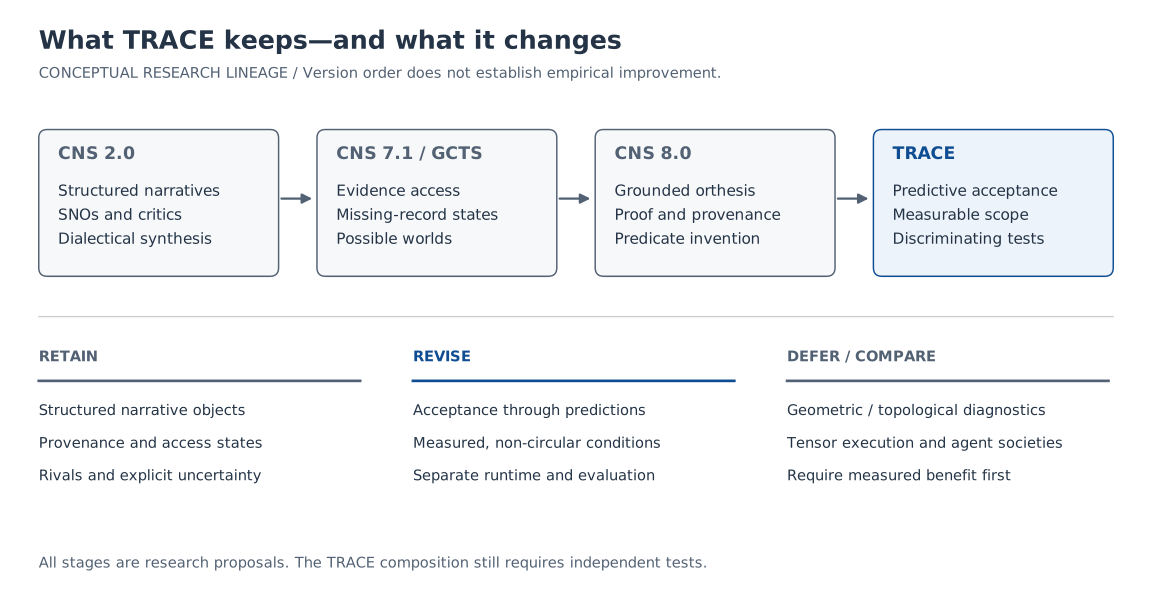
Figure 3 depicts conceptual lineage rather than measured improvement. CNS 2.0 introduced a research program around SNOs, chiral opposition and criticism; GCTS 7.1 emphasized grounded evidence and access-state distinctions; CNS 8.0 restored synthesized SNOs and proposed orthesis conditions, proof traces and predicate invention with complexity limits [48, 4, 2, 49]. CNS 8.0 already states that orthesis stability is not metaphysical truth and can preserve unresolved contradictions. TRACE develops this lineage through predictive acceptance criteria and explicit comparison of explanatory accounts.
The proposal retains structured accounts, provenance, versioned revisions, rival interpretations, and the ability to construct a conditional new account. It revises the meaning of productive conflict: shared target, explicit evidentiary relationships and testable differences in predictions matter more than a single combined chirality score. The previous literature’s use of “Evidential Entanglement” conflated at times shared evidence identifiers with comparable study endpoints; TRACE records semantic comparability, shared records and source copying independently [49].
Proof closure remains useful for checking derivability from stipulated premises. Round-trip language-to-logic fidelity remains useful for identifying translation errors. Both checks concern the representation and its premises; neither independently verifies the world claim. Manifold geometry, curvature, holonomy, topological reduction, tensor execution and large multiagent societies are optional future comparators, not prerequisites. They should return only if a specific reproducible task demonstrates gains beyond simpler representations at acceptable cost. The original work is preserved as prior art rather than rewritten as validated implementation evidence.
10. Risks, limits, and alternative explanations
Admissibility is underspecified in the world. A model may call a transformation irrelevant even though it changes the question, or reject a relevant change because it undermines a preferred answer. Independently reviewed development contracts and held-out contract families reduce—but cannot eliminate—this risk. Unresolved contracts retain their unknown status in the output.
The hypothesis interface introduces bias. The numerical compiler can miss relationships outside its rule language. Generated mechanisms can also omit relevant variables or rely on unsupported assumptions; an executable prediction does not remove that risk. Expanding the language risks overfitting, combinatorial search and post hoc excuses. The primary study should report both failures to represent the truth and unjustified inventions; neither can be cured silently after unblinding.
Synthetic worlds may reward the generator’s assumptions. A test set built from the designer’s mechanism families can privilege algorithms that match those families. External tasks, unseen families and prospectively acquired data must therefore count heavily in interpretation, even though none establishes universality. Publication of generator code after evaluation is necessary but not sufficient if the models’ training corpora contain familiar templates.
Evidence is not independent just because prose differs. Copied records, model-generated perspectives and repeated calls may share the same error. The dependency graph itself can be uncertain. A fair comparison must give baseline systems the same provenance fields and assess the ability to detect unknown dependencies rather than scoring a fabricated certainty.
Observation policy can be harmful or uninformative. High information gain may target the wrong hypothesis class or exceed a privacy, safety, or resource budget. The first prospective example is a sandboxed software service, not human subjects or clinical interventions. External actions require domain-specific permission and governance; the proposal confers no authority to run arbitrary experiments.
The explanatory narrative may be unfaithful. A plausible causal sentence is not proof of the model’s actual inference process [29]. The deliverable should be a compact, source-linked and checkable claim, its prediction record and its test outcome. Causal language should be reserved for designs where the identification assumptions are defensible.
Alternatives may explain any future gain. A structured SNO schema, more compute, a better retrieval index, source deduplication, direct regression, or simpler active learning could capture all apparent improvement. The proposed ablations and well-resourced baseline suite are required to distinguish the proposed mechanism from these alternatives.
The ambition is domain-limited. Scientific and software observations sometimes admit controlled interventions and clear metrics. Historical claims, sparse observational science and normative disagreement may not. TRACE must say “unresolved” where there is no permitted identifying observation, rather than imply that every contradiction hides a discoverable conditional truth.
11. Research agenda and conclusion
The immediate work is a faithful representation and comparator exercise on a small development set, followed by a frozen exploratory pilot. Sections 4.1–4.6 define interfaces for that exercise; they do not require a production agent platform before the central comparison can be examined. Expert review should challenge source fidelity, comparator adaptations and case identifiability before more resources are committed.
TRACE asks whether localized disagreement between documented accounts adds predictive value beyond existing contrastive and abductive discovery methods. The common records and controlled comparisons specify what evidence would answer that question. A contribution requires demonstrated incremental value and adequate differentiation from prior work. If the primary comparison fails, the appropriate outcome may be a simpler reliability tool, a separately justified benchmark, or retirement of the proposed method.
Citation and version note
GTCode.com (15 November 2026). TRACE: Contrast-Guided Discovery from Conflicting Accounts. Research proposal, version 0.1. Canonical edition: https://gtcode.com/papers/trace/. This version is not peer reviewed, not preregistered, and contains no TRACE experimental results. The web research article, the compiled PDF, and the supplied LaTeX source correspond to the same v0.1 substantive manuscript. A public companion overview and proposed evaluation specification are separate interpretive and protocol documents.
References
[1] David Lopez-Paz (2026). Against All Likelihood.
https://arxiv.org/abs/2611.09385v1
[2] GTCode Editorial / GTCode.com (2026). CNS 8.0 Theory.
https://gtcode.com/guides/cns/theory/
[3] GTCode Editorial / GTCode.com (2026). CNS 8.0 Theory Claims and Assumptions.
https://gtcode.com/guides/cns/theory-claims-assumptions/
[4] GTCode Editorial / GTCode.com (2026). Grounded Chiral Tensor Synthesis Theory.
https://gtcode.com/guides/cns-gcts/theory/
[5] Ziang Liu; James J. Kim; Yijia Dai; Jennifer J. Sun (2026). Contrastive Discovery: Open-Ended Scientific Discovery over Competing Explanations.
https://arxiv.org/abs/2611.14514v1
[6] Kexin Huang; Ying Jin; Ryan Li; Michael Y. Li; Emmanuel Candes; Jure Leskovec (2025). Automated Hypothesis Validation with Agentic Sequential Falsifications.
https://arxiv.org/abs/2502.09858v1
[7] Delip Rao; Ahmed Muharram; Chris Callison-Burch (2026). Same Claim, Different Interpretations: How LLM Agents Resolve Ambiguity in Scientific Claims.
https://arxiv.org/abs/2610.20457v1
[8] Yizhen Yuan; Rui Kong; Dongze Li; Yuanchun Li; Yunxin Liu (2026). Benchmarking LLM’s Capability in Reasoning over Conflicting Web References.
https://aclanthology.org/2026.acl-long.11/
[9] Yongcheng Zhang; Xin Zhang; Fei Li; Chong Teng; Jiang-Ming Yang; Donghong Ji; Zhuang Li (2026). Perceive-Then-Adjudicate: A Multi-Agent Framework for Resolving Knowledge-Evidence Conflicts in LLM Fact-Checking.
https://aclanthology.org/2026.findings-emnlp.1445/
[10] Kristin Behfar; Gerardo A. Okhuysen (2018). Perspective—Discovery Within Validation Logic: Deliberately Surfacing, Complementing, and Substituting Abductive Reasoning in Hypothetico-Deductive Inquiry.
https://doi.org/10.1287/orsc.2017.1193
[11] Ali Fata; Hossein Rahmani (2026). PARADOX: pharmacological analysis of relation anomalies and drug contradictions extraction.
https://doi.org/10.1007/s10822-026-00965-5
[12] Shiyao Xie and colleagues (2024). Utilizing ChatGPT as a scientific reasoning engine to differentiate conflicting evidence and summarize challenges in controversial clinical questions.
https://doi.org/10.1093/jamia/ocae100
[13] Ayush Rajesh Jhaveri; Anthony GX-Chen; Ilia Sucholutsky; Eunsol Choi (2026). Failing to Falsify: Evaluating and Mitigating Confirmation Bias in Language Models.
https://arxiv.org/abs/2604.02485v2
[14] Jonas Peters; Peter Buhlmann; Nicolai Meinshausen (2016). Causal inference using invariant prediction: identification and confidence intervals.
https://arxiv.org/abs/1501.01332
[15] Martin Arjovsky; Leon Bottou; Ishaan Gulrajani; David Lopez-Paz (2019). Invariant Risk Minimization.
https://arxiv.org/abs/1907.02893
[16] Elan Rosenfeld; Pradeep Ravikumar; Andrej Risteski (2021). The Risks of Invariant Risk Minimization.
https://arxiv.org/abs/2010.05761
[17] Pritish Kamath; Akilesh Tangella; Danica Sutherland; Nathan Srebro (2021). Does Invariant Risk Minimization Capture Invariance?.
https://proceedings.mlr.press/v130/kamath21a.html
[18] Ishaan Gulrajani; David Lopez-Paz (2021). In Search of Lost Domain Generalization.
https://arxiv.org/abs/2007.01434
[19] Mohammad Pezeshki; Diane Bouchacourt; Mark Ibrahim; Nicolas Ballas; Pascal Vincent; David Lopez-Paz (2024). Discovering Environments with XRM.
https://proceedings.mlr.press/v235/pezeshki24a.html
[20] Divyansh Kaushik; Eduard Hovy; Zachary C. Lipton (2020). Learning the Difference That Makes a Difference with Counterfactually-Augmented Data.
https://arxiv.org/abs/1909.12434
[21] Marco Tulio Ribeiro; Tongshuang Wu; Carlos Guestrin; Sameer Singh (2020). Beyond Accuracy: Behavioral Testing of NLP Models with CheckList.
https://aclanthology.org/2020.acl-main.442/
[22] Patrick Lewis and colleagues (2020). Retrieval-Augmented Generation for Knowledge-Intensive NLP Tasks.
https://arxiv.org/abs/2005.11401
[23] Shehzaad Dhuliawala and colleagues (2023). Chain-of-Verification Reduces Hallucination in Large Language Models.
https://arxiv.org/abs/2309.11495
[24] Xin Luna Dong; Laure Berti-Equille; Divesh Srivastava (2009). Integrating Conflicting Data: The Role of Source Dependence.
https://www.vldb.org/pvldb/vol2/vldb09-pvldb47.pdf
[25] GTCode Editorial / GTCode.com (2026). CNS 8.0 Oracle Boundary.
https://gtcode.com/guides/cns/oracle-boundary/
[26] Xuezhi Wang and colleagues (2023). Self-Consistency Improves Chain of Thought Reasoning in Language Models.
https://arxiv.org/abs/2203.11171
[27] Yilun Du; Shuang Li; Antonio Torralba; Joshua B. Tenenbaum; Igor Mordatch (2024). Improving Factuality and Reasoning in Language Models through Multiagent Debate.
https://proceedings.mlr.press/v235/du24e.html
[28] Hyeong Kyu Choi; Xiaojin Zhu; Sharon Li (2025). Debate or Vote: Which Yields Better Decisions in Multi-Agent Large Language Models?.
https://arxiv.org/abs/2508.17536
[29] Miles Turpin; Julian Michael; Ethan Perez; Samuel R. Bowman (2023). Language Models Do Not Always Say What They Think: Unfaithful Explanations in Chain-of-Thought Prompting.
https://arxiv.org/abs/2305.04388
[30] Phan Minh Dung (1995). On the acceptability of arguments and its fundamental role in nonmonotonic reasoning, logic programming and n-person games.
https://doi.org/10.1016/0004-3702(94)00041-X
[31] Naoya Inoue; Kentaro Inui (2013). ILP-based Inference for Cost-based Abduction on First-order Predicate Logic.
https://doi.org/10.5715/jnlp.20.629
[32] Andrew Cropper; Sebastijan Dumancic (2022). Inductive Logic Programming at 30: A New Introduction.
https://arxiv.org/abs/2008.07912
[33] Yangqiaoyu Zhou; Haokun Liu; Tejes Srivastava; Hongyuan Mei; Chenhao Tan (2024). Hypothesis Generation with Large Language Models.
https://arxiv.org/abs/2404.04326v3
[34] Linlu Qiu; Liwei Jiang; Ximing Lu; Melanie Sclar; Valentina Pyatkin; Chandra Bhagavatula; Bailin Wang; Yoon Kim; Yejin Choi; Nouha Dziri; Xiang Ren (2024). Phenomenal Yet Puzzling: Testing Inductive Reasoning Capabilities of Language Models with Hypothesis Refinement.
https://arxiv.org/abs/2310.08559v4
[35] Ahmed Abdulaal; Adamos Hadjivasiliou; Nina Montana-Brown; Tiantian He; Ayodeji Ijishakin; Ivana Drobnjak; Daniel C. Castro; Daniel C. Alexander (2024). Causal Modelling Agents: Causal Graph Discovery Through Synergising Metadata- and Data-Driven Reasoning.
https://discovery.ucl.ac.uk/id/eprint/10195820/1/8513_Causal_Modelling_Agents_C.pdf
[36] Dhruv Agarwal; Bodhisattwa Prasad Majumder; Reece Adamson; Megha Chakravorty; Satvika Reddy Gavireddy; Aditya Parashar; Harshit Surana; Bhavana Dalvi Mishra; Andrew McCallum; Ashish Sabharwal; Peter Clark (2025). AutoDiscovery: Open-ended Scientific Discovery via Bayesian Surprise.
https://proceedings.neurips.cc/paper_files/paper/2025/hash/23b127521af7ca7a42f5cdb7507be4f2-Abstract-Conference.html
[37] Wasu Top Piriyakulkij; Cassidy Langenfeld; Tuan Anh Le; Kevin Ellis (2024). Doing Experiments and Revising Rules with Natural Language and Probabilistic Reasoning.
https://proceedings.neurips.cc/paper_files/paper/2024/hash/5f1b350fc0c2affd56f465faa36be343-Abstract-Conference.html
[38] Tom Rainforth; Adam Foster; Desi R. Ivanova; Freddie Bickford Smith (2024). Modern Bayesian Experimental Design.
https://arxiv.org/abs/2302.14545
[39] Simon Tong; Daphne Koller (2001). Active Learning for Structure in Bayesian Networks.
https://ijcai.org/proceedings/2001/118
[40] Chris Lu; Cong Lu; Robert Tjarko Lange; Jakob Foerster; Jeff Clune; David Ha (2024). The AI Scientist: Towards Fully Automated Open-Ended Scientific Discovery.
https://arxiv.org/abs/2408.06292
[41] Juraj Gottweis; Wei-Hung Weng; Alexander Daryin; Tao Tu; et al. (2026). Accelerating scientific discovery with Co-Scientist.
https://doi.org/10.1038/s41586-026-10644-y
[42] Ali E. Ghareeb; Benjamin Chang; Ludovico Mitchener; et al. (2026). A multi-agent system for automating scientific discovery.
https://doi.org/10.1038/s41586-026-10652-y
[43] Bodhisattwa Prasad Majumder and colleagues (2025). DiscoveryBench: Towards Data-Driven Discovery with Large Language Models.
https://arxiv.org/abs/2407.01725
[44] James Thorne; Andreas Vlachos; Christos Christodoulopoulos; Arpit Mittal (2018). FEVER: a large-scale dataset for Fact Extraction and VERification.
https://arxiv.org/abs/1803.05355
[45] David Wadden and colleagues (2020). Fact or Fiction: Verifying Scientific Claims.
https://aclanthology.org/2020.emnlp-main.609/
[46] Michael Sejr Schlichtkrull; Zhijiang Guo; Andreas Vlachos (2023). AVeriTeC: A Dataset for Real-world Claim Verification with Evidence from the Web.
https://fever.ai/dataset/averitec.html
[47] Tilmann Gneiting; Adrian E. Raftery (2007). Strictly Proper Scoring Rules, Prediction, and Estimation.
https://sites.stat.washington.edu/raftery/Research/PDF/Gneiting2007jasa.pdf
[48] Ekewaka Lono (2025). CNS 2.0 Research Roadmap: Blueprint.
https://gtcode.com/guides/cns-2.0-research-roadmap/blueprint/
[49] GTCode Editorial / GTCode.com (2026). Worked Example - CNS 8.0 Resolves a Conditional Contradiction.
https://gtcode.com/guides/cns/worked-example/
Publication downloads and self-citation
- Compiled research PDF · Standalone LaTeX source · BibTeX self-citation
- Prior-art audit · Contribution matrix
- Cross-case record schema
- Annotated reference registry · Bibliography · Proposed protocol YAML
How to cite: GTCode.com. (2026, November 15). TRACE: Contrast-Guided Discovery from Conflicting Accounts (Research proposal, version 0.1). https://gtcode.com/papers/trace/